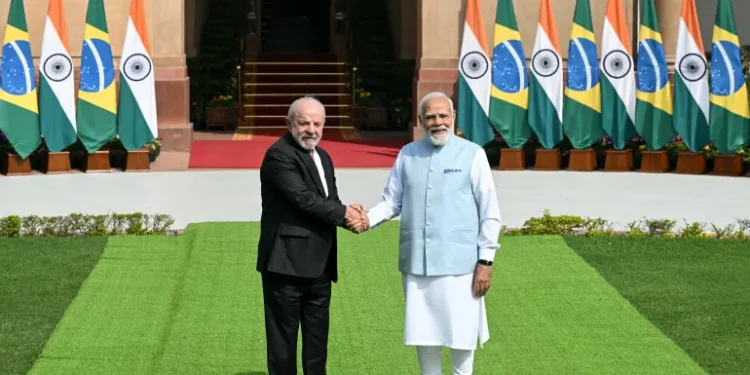
Brazil and India have signed a new agreement aimed at strengthening cooperation in critical minerals and rare earths, marking a significant step in New Delhi’s effort to diversify supply chains and reduce its dependence on China.
The deal was reached during Brazilian President Luiz Inacio Lula da Silva’s visit to New Delhi, where he met Indian Prime Minister Narendra Modi today to discuss expanding trade and investment opportunities between the two countries.
The agreement comes at a time when global competition for access to critical minerals is intensifying. China currently dominates the mining and processing of the world’s rare earth elements and other critical minerals that are essential to modern technologies. In recent months, Beijing has tightened its grip on exports of these materials, as the United States and other countries attempt to reduce their reliance on Chinese supply chains and build alternative sources.
India, one of the world’s fastest-growing major economies, has been seeking new partners to secure stable access to the materials needed for its expanding industrial base.
Rare earths and other critical minerals play a central role in the production of electric vehicles, renewable energy systems, telecommunications equipment, and advanced defense technologies. As India accelerates infrastructure development and manufacturing growth, the demand for these materials is rising sharply
Brazil, which follows China as the world’s second-largest holder of critical minerals, is seen as a strategic partner in this effort. The country’s vast mineral resources are used across a wide range of industries, from electric vehicles and solar panels to smartphones, jet engines, and guided missiles.
By strengthening cooperation with Brazil, India aims to build more resilient supply chains that can withstand geopolitical disruptions and market volatility.
While few details have emerged about the mineral deal so far, demand for iron ore, a material for which Brazil is the second-largest producer and exporter after Australia, in India has grown amid rapid infrastructure expansion and industrial growth.
While specific details of the mineral agreement have not yet been made public, both leaders underscored its strategic importance. In a statement, Modi described the pact as a “major step towards building resilient supply chains,” signaling India’s commitment to reducing vulnerabilities in sectors vital to economic growth and national security.
For India, securing reliable supplies of critical minerals is closely linked to its ambitions in clean energy and advanced manufacturing. The country has set ambitious targets for renewable energy capacity and electric vehicle adoption. These goals require steady access to minerals.
Lula echoed that emphasis on sustainability and long-term partnership. “Increasing investments and cooperation in matters of renewable energies and critical minerals is at the core of the pioneering agreement that we have signed today,” he said in a statement.
His remarks highlighted not only the mineral component of the deal but also the broader ambition to deepen collaboration in renewable energy and sustainable development.
India’s Foreign Ministry spokesperson announced that, along with the critical minerals and rare earths deal, nine other agreements were signed, including a memorandum of understanding that ranged from digital cooperation to health.
India’s Foreign Minister, Subrahmanyam Jaishankar also said that he was confident that Lula’s talks with Modi “will impart a new momentum to our ties.”
Moreover, Modi called Brazil India’s “largest trading partner in Latin America.” “We are committed to taking our bilateral trade beyond $20bn in the coming five years,” he said.
“Our trade is not just a figure, but a reflection of trust. When India and Brazil work together, the voice of [the] Global South becomes stronger and more confident.”
The meeting in New Delhi underscored the growing alignment between Brazil and India on issues of economic development, energy transition, and industrial resilience. As emerging economies with significant global influence, both countries are seeking to shape supply chains in ways that reflect their development priorities.
For now, the agreement signals a clear intention: to reduce overreliance on any single supplier and to strengthen partnerships among major developing nations. With demand for critical minerals set to increase as the world transitions toward cleaner energy and advanced technologies, the Brazil-India pact could become an important element in the evolving global resource landscape.