Ghana has reached a historic economic milestone, with the size of its economy crossing the 100 billion dollar mark for the first time.
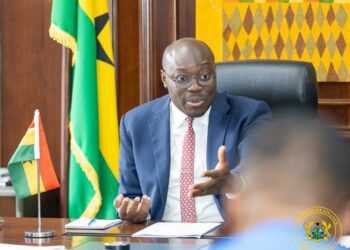
The announcement was made by Finance Minister Dr. Cassiel Ato Forson during the Presidential Dialogue with the Private Sector at the Kempinski Hotel, where he presented what he described as a broad based and comprehensive macroeconomic turnaround.
According to the Minister, Ghana’s economy, which was valued at less than 80 billion dollars when the current administration assumed office, is now projected to reach 114 billion dollars by the end of 2025. This remarkable expansion positions Ghana as the seventh largest economy in Africa in 2025 and signals renewed confidence in the country’s economic direction.
Fiscal Discipline Anchors the Recovery
Dr. Forson attributed the economic rebound to strict fiscal discipline and prudent financial management. He explained that government maintained tight expenditure controls, cut waste, rationalised spending and strengthened audit systems. At the same time, efforts were made to mobilise domestic revenue while protecting priority social investments such as education and health.
The results have been significant. The 2025 primary balance on a commitment basis was originally set at 1.5 percent of GDP. However, the actual outturn reached 2.6 percent, exceeding the target. The overall fiscal deficit on a commitment basis improved from a projected 2.8 percent to 1 percent. On a cash basis, the deficit narrowed from the projected 3.8 percent to 3.1 percent.
Total expenditure was also reduced by 11 percent compared to initial targets, reflecting deliberate spending restraint. Primary expenditure came in 10 percent lower than programmed. These measures created fiscal space while safeguarding social spending.

Public Debt Sees Dramatic Reduction
One of the most striking achievements highlighted during the dialogue was the sharp reduction in public debt. Ghana’s debt to GDP ratio fell from 61.8 percent in December 2024 to 45.3 percent in December 2025. In nominal terms, public debt declined by over 82 billion Ghana cedis within a year.
For the first time in Ghana’s history, the country recorded a negative debt accumulation rate of 11.9 percent. The Finance Minister described this as a turning point, noting that Ghana’s debt is now considered sustainable. For businesses and investors, this signals improved macroeconomic stability and reduced fiscal risk.
Cedi Emerges Strongest Currency in Africa
Exchange rate stability has also played a crucial role in the economic turnaround. The Ghana cedi recorded an impressive appreciation in 2025. By the end of the year, it had strengthened by 40.7 percent against the US dollar, 30.9 percent against the British pound and 24 percent against the euro.
This performance, according to International Monetary Fund data cited by the Minister, made the cedi the best performing currency in Africa in 2025. The turnaround is particularly notable considering that in 2024 the currency had depreciated sharply against major trading currencies.
The stronger currency has helped ease inflationary pressures, reduce import costs and restore confidence among businesses.
Inflation and Interest Rates Fall Sharply
Ghana’s inflation story has been equally encouraging. Inflation declined for 13 consecutive months, dropping from 23.8 percent at the end of 2024 to 3.8 percent by January 2026. This sharp disinflation has provided relief to households and businesses alike.
Interest rates have followed the same downward trend. The 91 day treasury bill rate fell dramatically from 27.7 percent at the end of 2024 to 6.4 percent in February 2026. The average commercial bank lending rate also dropped from 30.25 percent in 2024 to 20.45 percent in 2025.
The Finance Minister shared an anecdote of a business owner who was able to secure a bank loan at 13 percent, describing it as a clear sign that borrowing conditions are improving. Credit to the private sector expanded by 17.1 billion Ghana cedis in 2025 alone, with further growth expected in 2026.

Strong External Buffers and Trade Surplus
Ghana’s external sector has strengthened considerably. The trade account recorded a surplus of 13.7 billion cedis, supported largely by strong gold export earnings. Export receipts reached 31.7 billion US dollars compared to imports of 17.5 billion US dollars.
The current account surplus rose sharply from 1.5 billion dollars in 2024 to 9.1 billion dollars in December 2025. Gross International Reserves climbed to 13.8 billion dollars, enough to cover 5.7 months of imports, up from four months of cover the previous year.
These buffers provide additional stability against external shocks and enhance investor confidence.

Outlook for 2026 and Beyond
In the intervening time, the government has set ambitious but achievable targets for 2026. Overall GDP growth is projected at 4.8 percent, with non oil GDP expected to grow at 5 percent. Inflation is targeted at 8 percent plus or minus 2 percent, while the primary balance on a commitment basis is set at 1.5 percent of GDP.
The Finance Minister stressed that the objective is not only to maintain stability but to translate growth into tangible improvements in living standards. With the economy now above the 100 billion dollar threshold, the private sector is expected to play a central role in driving investment, job creation and economic transformation.
For many observers at the Presidential Dialogue. Ghana’s macroeconomic recovery is no longer theoretical. It is reflected in stronger growth, lower inflation, reduced debt and a more resilient currency. The challenge now is to sustain the gains and ensure that the benefits are widely shared across the country.
READ ALSO: President Mahama Pledges Productivity Revolution and Cocoa Value Reset