
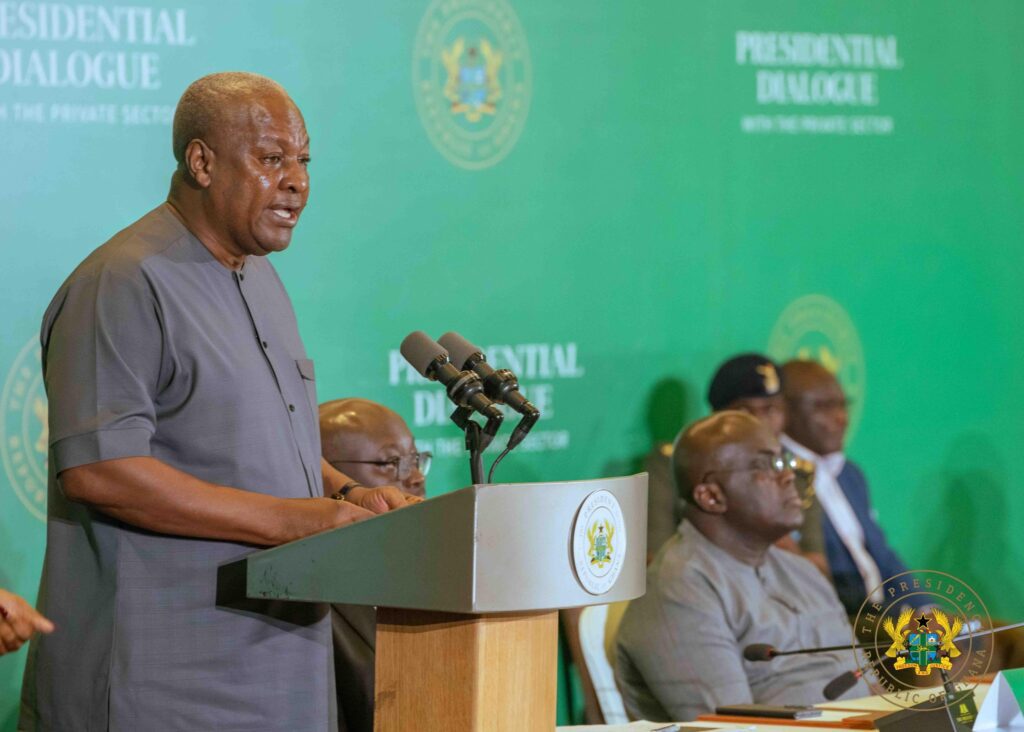
In a historic address at the Presidential Dialogue with the Private Sector, President John Dramani Mahama signaled the end of Ghana’s reliance on raw commodity exports by declaring a “productivity revolution.”
The President detailed a structural overhaul of the nation’s economic engine, anchored by the newly enacted 24-Hour Economy Authority Act and a radical reset of the cocoa and extractive sectors.
“The Cabinet will soon approve the National Agribusiness Policy to anchor our aim of value addition. We must work to make Ghana West Africa’s production hub”
President John Dramani Mahama
The President’s mandate was clear: Ghana must move from being a source of raw materials to becoming West Africa’s primary industrial production hub within five years. Central to this transformation is the 24-Hour Economy Authority, which the President recently assented into law.
The Authority is tasked with coordinating a nationwide transition to a multi-shift system, providing the legal and regulatory backbone for businesses to operate around the clock. For manufacturers, the incentives are tangible, including off-peak electricity tariffs, tax exemptions on equipment for expansion, and enhanced nighttime security.
By shifting from a single-shift to a three-shift model, the President argued that factories could maximize capital and labor productivity without the massive overhead of new physical infrastructure.
Cocoa Value Chain
The dialogue took place against the backdrop of significant turbulence in the global cocoa market. Addressing the recent fluctuations that necessitated a “painful” downward review of domestic producer prices to GHS 41,392 per tonne, the President announced a fundamental shift in how the sector is managed.
“The current crisis in the cocoa sector compels us to urgently introduce reforms in the entire cocoa value chain – emergency steps to cushion our cocoa industry and protect our farmers. We must move Ghana from a raw commodity exporter to a value-added producer”
President John Dramani Mahama
To insulate farmers and the national economy from future shocks, the government is introducing an automatic price mechanism that guarantees farmers 70% of the gross international FOB price at prevailing exchange rates.
Furthermore, the administration is moving to decouple the cocoa sector from foreign debt by introducing domestic funding for cocoa purchases. This shift effectively ends the 32-year reliance on foreign syndicated loans.
The plan also includes a mandatory drive for local value addition, with a target to process at least 50% of Ghana’s cocoa beans locally starting from the 2026/2027 season.
Extractive Industry Deadline
The “Value-Added Sovereignty” agenda extends deep into the extractive sector. In a bold declaration that sent ripples through the mining industry, President Mahama set a five-year time frame to achieve 100% local processing of all mineral ores.

This move is designed to ensure that the nation’s mineral wealth – including bauxite, manganese, and lithium – powers domestic industrial clusters rather than merely padding export statistics.
The President noted that this strategy is inextricably linked to Ghana’s participation in the African Continental Free Trade Area (AfCFTA). He redefined energy, finance, and enforcement reforms not just as domestic policies, but as “AfCFTA strategies,” essential for maintaining competitiveness in the world’s largest integrated market.
“Energy reform is an African Continental Free Trade Area strategy. Financing reform is an African Continental Free Trade Area strategy. Enforcement reform is an African Continental Free Trade Area strategy”
President John Dramani Mahama
Revolution in Action
Furthermore, the President emphasized that the 24-hour economy is not mere reform but a total “productivity revolution.”
By incentivizing manufacturers to utilize the “dead hours,” of the night, the government expects to see a surge in output that could finally push manufacturing’s contribution to GDP toward the 15% target set for 2030.
“Factories operating one shift produce one shift output. Factories operating three shifts maximize capital, infrastructure and labor productivity. This is not mere reform”
President John Dramani Mahama
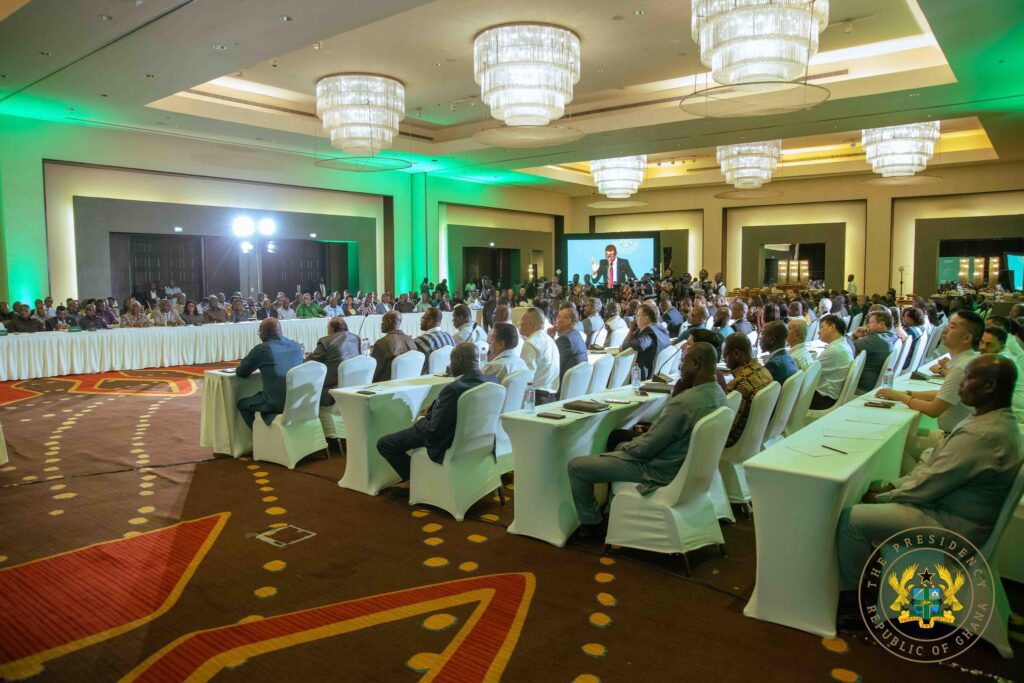
As the 24-Hour Economy Authority begins its nationwide rollout, the private sector is expected to play the leading role, supported by a government that has committed seed capital and a robust legal framework to ensure implementation success.
READ ALSO: Minerals Commission Advances Mining Industry as CEO Participates in PDAC