
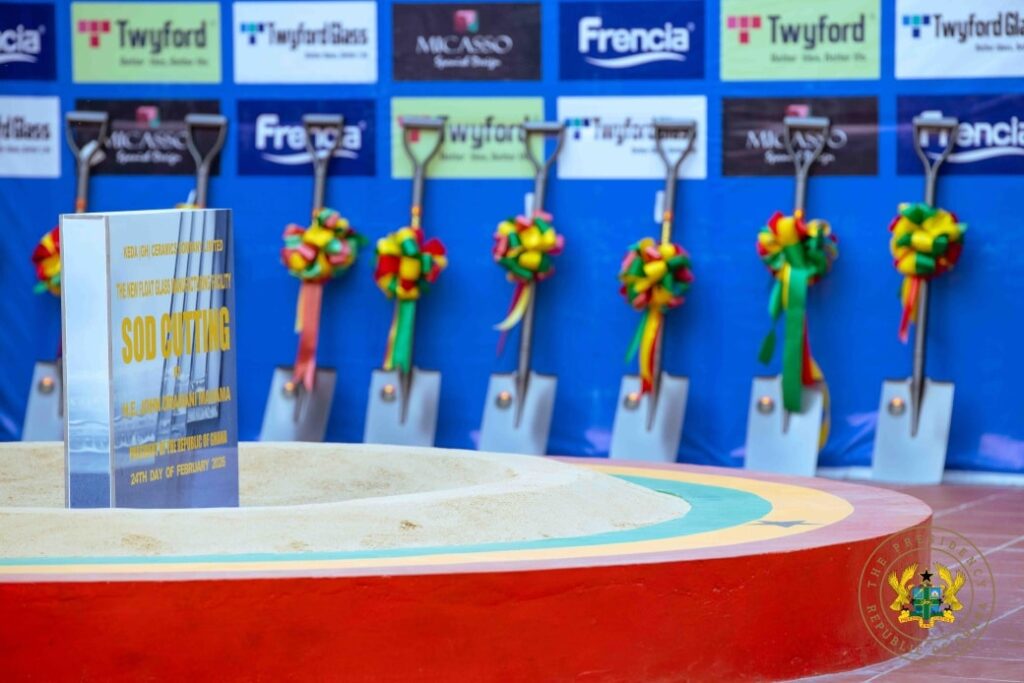
In a significant expansion of Ghana’s heavy industrial base, President John Dramani Mahama has cut the sod for the construction of the New Float Glass Manufacturing Company in Shama, Western Region.
The ceremony, organized by KEDA (Ghana) Ceramics Company Limited, represented a pivotal moment in the nation’s “Economic Reset,” moving Ghana closer to self-sufficiency in construction materials.
Alongside the new glass plant, the President inaugurated the fifth phase of KEDA’s Tile Production Line and commissioned a state-of-the-art sanitary wares factory, creating a consolidated industrial hub in the Western enclave.
The centerpiece of this development, the float glass facility, is designed to be a continental giant. Once fully operational, the plant will produce an estimated 1,400 tons of glass daily, positioning it as one of the largest manufacturing sites of its kind in Africa.
This move is strategically timed to capitalize on the growing demand for high-quality glass in the regional real estate and infrastructure sectors.

The President noted that the economic implications of the Shama project are profound. Beyond meeting domestic demand, the facility is expected to generate approximately $100 million in annual exports, providing a critical boost to Ghana’s foreign exchange reserves.
By substituting expensive imports with locally manufactured glass and sanitary ware, the government aims to stabilize the cedi, create sustainable employment opportunities, and strengthen local supply chains.
President Mahama emphasized that the success of such massive capital investments relies on a “triple partnership,” between the state, the investor, and the host community. He reaffirmed that his administration’s role is to provide the fiscal stability and infrastructure necessary for capital to thrive, while expecting investors to prioritize local skill development and quality standards.
Driving A Global Brand
The commissioning of the sanitary wares factory and the expansion of the tile production line further cement KEDA Ceramics’ role as a cornerstone of Ghana’s industrial transformation.

The President noted that the ability to produce tiles, toilets, and glass in a single localized hub reduces logistics costs and makes “Made-in-Ghana,” products more competitive on the international market, particularly under the African Continental Free Trade Area (AfCFTA) framework.
President Mahama reaffirmed that Made-in-Ghana products can compete globally when driven by skill, innovation, and uncompromising quality. By focusing on “uncompromising quality,” the administration is signaling to the private sector that local manufacturing is no longer about mere substitution, but about global excellence.
The President urged the management and staff of the new facilities to take a sense of ownership, noting that the sustainability of these jobs depends on the efficiency and dedication of the workforce.
The Shama industrial expansion serves as a physical manifestation of the government’s broader industrialization agenda. As the Trade Ministry prepares to finalize the National Agribusiness Policy, the heavy industry sector – led by projects like the KEDA glass plant – is providing the structural backbone needed for a diversified economy.
The ceremony concluded with President Mahama reminding all that Ghana is no longer content with being a spectator in the global manufacturing race.
With a production capacity of 1,400 tons of glass per day and a growing sanitary ware export base, the Western Region is being transformed into the industrial engine of the sub-region.
READ ALSO: Trump Touts Economy In State Of The Union Address