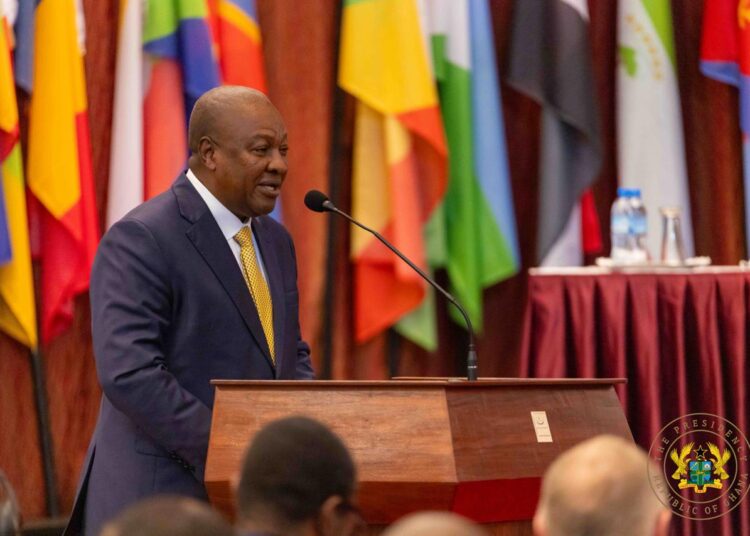
Ghana’s President HE John Dramani Mahama has declared that Africa’s most valuable inheritance is not its vast natural resources but its people and cultural heritage, urging leaders to place human dignity, freedom, and creativity at the centre of governance.
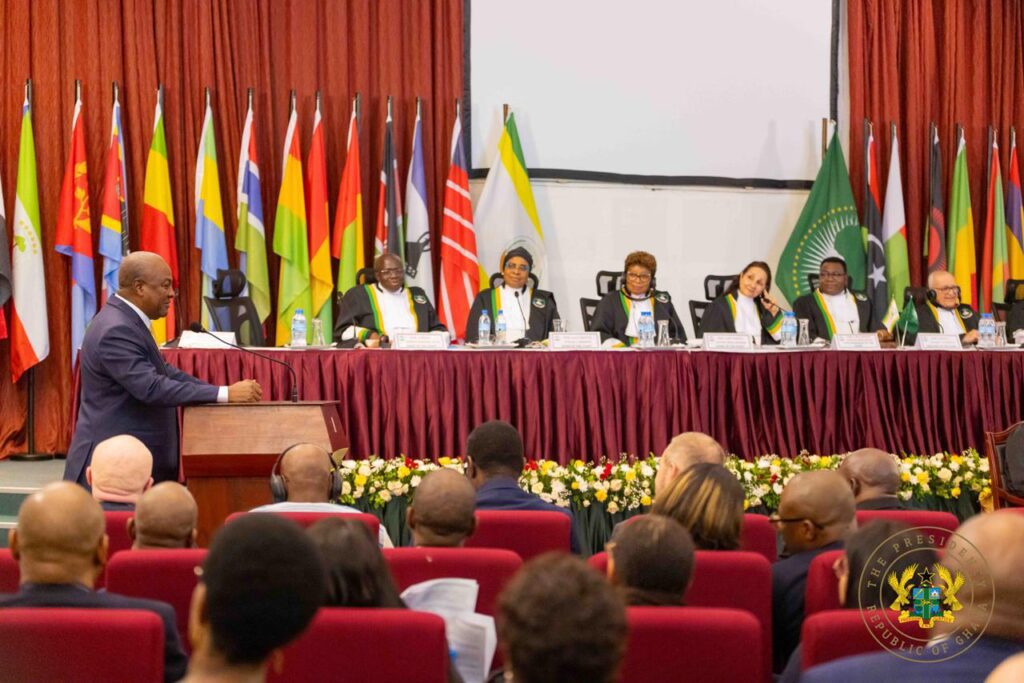
He made the remarks while delivering the inaugural address at the opening of the 2026 Judicial Year of the African Court on Human and Peoples’ Rights in Arusha, Tanzania, an occasion that also marked the court’s twentieth anniversary.
Addressing judges, diplomats, and legal practitioners from across the continent, President Mahama said Africa’s wealth has long been measured by gold, diamonds, oil, and other minerals, often at the expense of recognising the true engine of development.
According to him, history shows that those who exploited Africa understood the power of its people, which explains why visionary leaders and cultural symbols were silenced, imprisoned, or exiled.
Remembering Africa’s Silenced Voices
President Mahama recalled how figures such as Patrice Lumumba, Eduardo Mondlane, Thomas Sankara, and Amilcar Cabral were assassinated because of the threat their ideas posed to systems of exploitation.
He also cited the banishment of Nana Prempeh I and Yaa Asantewaa from the Gold Coast to the Seychelles, as well as the exile of Omukama Kabalega of Uganda.
“This is why Sam Nwiyoma was forced into exile from Namibia, and Nelson Mandela was imprisoned on Robben Island, which was a former leper colony off the coast of Cape Town in South Africa.
“And this is why Steve Biko was murdered in prison. We felt the absence of these individuals and recognised the potential that we lost as a result.”
President of Ghana HE John Dramani Mahama
He described the period from the mid nineteen seventies to the early nineteen nineties as Africa’s lost decades, marked by brain drain and stagnation, when per capita growth across many developing African countries hovered around zero.
President Mahama challenged African leaders to imagine a continent that measures wealth by the freedom, dignity, and potential of its citizens rather than by extractive output.
He asked what Africa might look like if individuals were assured liberty, self-determination, and protection from oppression, conflict, and persecution. These, he said, were not abstract questions but practical considerations that should guide policymaking in the decades ahead.
He pointed to demographic trends showing that by 2050 Africa’s population will reach about 2.5 billion, accounting for more than a quarter of the global population. By the end of the century, nearly forty percent of the world’s people will be African.
With a median age of just nineteen, compared to far older populations in Europe and North America, President Mahama said the continent holds extraordinary power if it invests wisely in its youth.
A Changing Global Context
The Ghanaian President warned that Africa must rethink how it relates to the rest of the world, especially as the image of the so-called Global North continues to erode.
He argued that countries long seen as models of democracy and human rights are themselves grappling with weakened judicial independence, executive overreach, restrictions on civil liberties, and declining public trust.
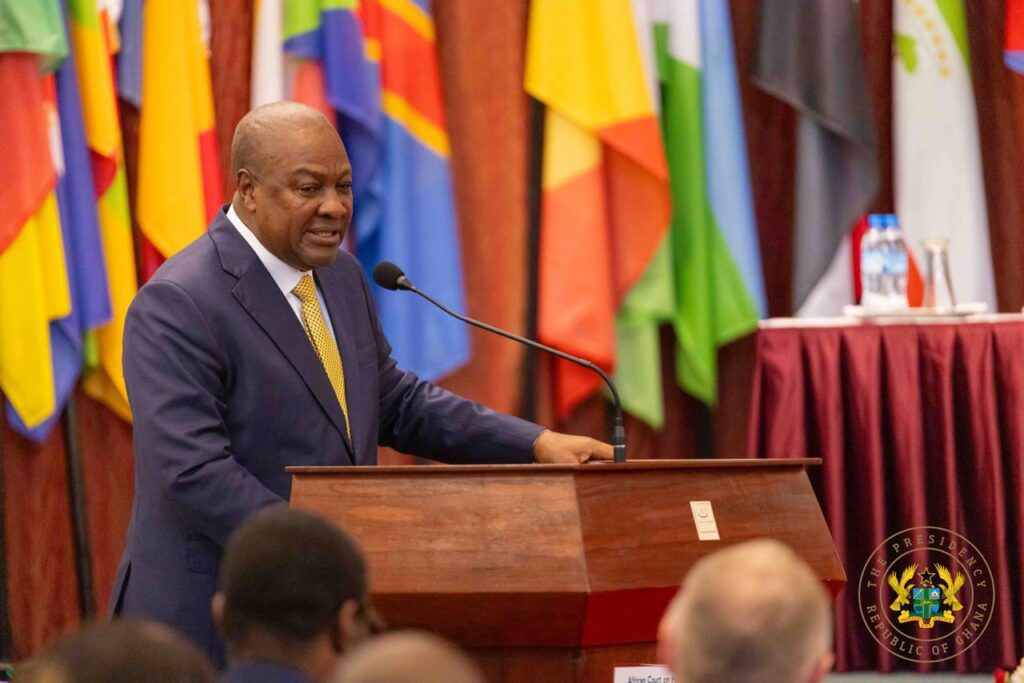
Quoting Julius Nyerere, President Mahama reminded the audience that one does not judge one’s health by comparing oneself to someone who is ill. He said Africa must stop uncritically adopting external benchmarks and instead define its own standards rooted in its history, values, and cultural identity.
President Mahama told the court that speaking before judges was a daunting experience shaped by memories from his youth. He recalled recurring nightmares of his father standing before judges after being detained during periods of military rule in Ghana.
His father, a former minister in the government of Kwame Nkrumah, was detained for more than a year following the 1966 coup that overthrew Ghana’s first republic.
Even after leaving public office and becoming a private farmer, his father was detained again after writing a letter to military ruler Ignatius Kutu Acheampong, offering unsolicited advice to leave power at the height of public approval.
Though later released, those experiences, President Mahama said, taught him how dangerous unchecked authority could be and deepened his respect for human rights and due process.
The Role of the African Court
Against this backdrop, President Mahama described the African Court on Human and Peoples’ Rights as an institution that serves all but is beholden to none.
He said the court’s work over the past two decades has helped recalibrate Africa’s moral compass and provided oversight to ensure respect for the rights enshrined in the Banjul Charter.
He stressed the need to empower the court through wider ratification of its protocol and faithful implementation of its judgments. According to him, no African leader should fear a strong court, as justice systems ultimately protect societies from cycles of abuse and instability.
President Mahama expressed pride in Ghana’s contribution to the court, citing the service of Sophia Akuffo, a former president of the court and later Chief Justice of Ghana, and Dennis Adjei, who currently serves as a judge.

He called on African Union member states that have not ratified the court’s protocol to do so without delay and urged governments to allow individuals and civil society organisations direct access to the court. Such steps, he said, would strengthen public trust and protect Africa’s greatest asset, its people.
Concluding his address in Arusha, President Mahama said Africa is at a defining moment. With stronger justice systems and a continental court in place, he believes the fears that haunted earlier generations can finally be laid to rest.
President Mahama urged leaders and citizens alike to honour the dreams of Africa’s ancestors by building societies grounded in dignity, liberty, and cultural pride.
As the court marks its twentieth anniversary, President Mahama said the task ahead is to ensure that in another twenty years it stands as a leading global judicial institution. He declared that the time for Africa is now and that the continent must step confidently into its greatness.
READ ALSO: Fuel Prices Increase as GOIL, Star Oil Adjust Pump Rates