Fuel prices increase at the pumps as two of Ghana’s major Oil Marketing Companies (OMCs) begin adjustments for the first pricing window of March.
The move follows earlier industry projections that petroleum product prices could rise between 1 percent and 3 percent per litre, driven largely by developments on the international oil market.
Checks by Vaultz News on March 2, 2026, confirm that GOIL has revised its petrol price upward, while diesel remains unchanged.
GOIL Adjusts Petrol, Holds Diesel Steady
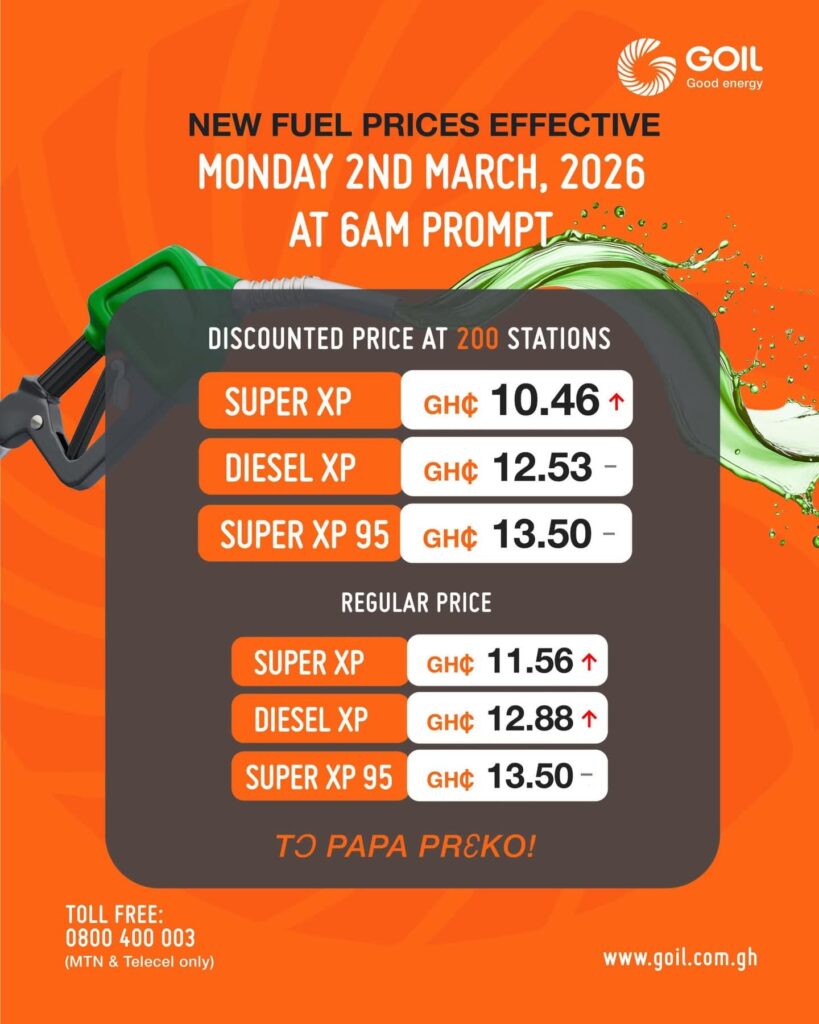
GOIL is now selling petrol at GH¢10.46 per litre, up from GH¢10.24 in the previous pricing window. Diesel, however, has been maintained at GH¢12.53 per litre.
In a statement, the company assured customers that it remains focused on affordability despite shifting market conditions. “Even as market conditions shift, GOIL remains committed to putting customers first,” the company stated.
“At 200 selected stations nationwide, we continue to sell Petrol at the NPA-approved price floor, ensuring more Ghanaians enjoy real savings without sacrificing the quality and performance they trust.”
GOIL
The latest development shows that GOIL has complied with the price floor announced by the National Petroleum Authority (NPA) for petrol. However, diesel is being sold above the regulatory floor of GH¢11.42.
Star Oil Follows with Similar Adjustments
Market leader Star Oil has also increased petroleum product prices at its service stations nationwide, effective 8:00 am on March 1, 2026.
Petrol at Star Oil has risen from GH¢10.24 per litre to GH¢10.46, aligning with GOIL’s revised rate. Diesel has also been adjusted upward to GH¢11.97 per litre, compared to the previous GH¢11.42.
A closer analysis indicates that while Star Oil adhered to the petrol price floor set by the NPA, its diesel pricing moved significantly above the mandated minimum threshold.
Other major OMCs have noted they are likely to adjust their prices either later today or in the coming days. Some operators say they are closely monitoring competitor pricing strategies before making final decisions.
With strict compliance expected regarding the NPA’s price floor, operators are not permitted to sell petrol below GH¢10.42 per litre or diesel below GH¢11.42 per litre.
International Market Pressures Drive Increase
Industry analysts attribute the latest upward adjustments to rising crude oil and finished petroleum product prices on the international market over the past two weeks.
Brent crude climbed to US$78 per barrel on March 2, 2026, amid ongoing tensions in the Middle East. The price rally reflects growing uncertainty around global supply routes and geopolitical instability.
Some analysts warn that crude prices could escalate further to US$90 per barrel if tensions persist. Such a development would likely intensify upward pressure on local pump prices in subsequent pricing windows.
Despite the increases, industry observers note that the adjustment could have been steeper if not for the cedi’s marginal appreciation against major trading currencies in recent weeks. The stronger local currency has somewhat offset the full impact of global price hikes on import costs.
COMAC Projections Signal Further Increases

Data from the Chamber of Oil Marketing Companies (COMAC) suggest that additional price adjustments may be on the horizon.
According to COMAC projections, petrol prices could rise by as much as 2.89 percent, potentially reaching GH¢12.04 per litre in coming windows. Diesel may increase by 0.86 percent to around GH¢13.22 per litre if current trends persist.
Interestingly, liquefied petroleum gas (LPG) may offer some relief to consumers. LPG is expected to decline slightly to GH¢13.87 per kilogramme, marking its first reduction this year.
For consumers, transport operators and businesses, the March pricing window signals the beginning of what could be a volatile period if global crude prices continue to climb.
While OMCs remain bound by regulatory floors, competitive pricing strategies and currency movements will shape how aggressively companies adjust their rates in the coming weeks.
For now, fuel prices increase modestly at the start of March, but the trajectory for the rest of the month will depend largely on international crude oil trends and exchange rate stability.
READ ALSO: From Accra To Titao: Policy And Security Failures In Protecting Ghanaian Cross Border Traders