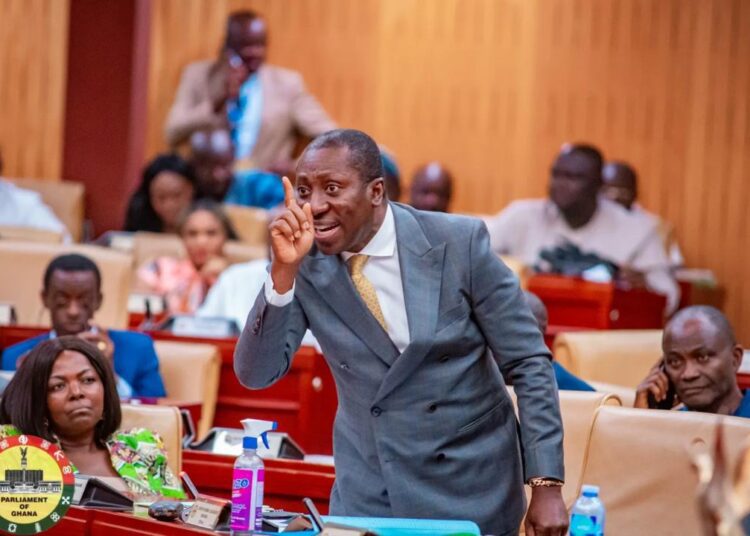
Hon. Alexander Afenyo-Markin, the Minority Leader in Parliament and Member of Parliament for Effutu, has issued a stern warning regarding the operations of the Ghana Gold Board (GoldBod), describing it as a massive scandal waiting to unfold.
He urged the leadership and management of the regulatory entity to proceed with extreme caution in executing their mandate, highlighting that significant institutional vulnerabilities remain undisclosed to the public eye.
“GoldBod is a very big scandal awaiting us. There are things we know that they don’t know. They should be careful. If you sell gold and make a loss, then you are not a good trader.”
Alexander Afenyo-Markin,
The Effutu lawmaker indicated that the Parliamentary Minority possesses sensitive operational intelligence regarding GoldBod that the institution’s leadership has failed to grasp.

Hon. Afenyo-Markin stressed that the management should not take its current privileged position for granted, as mounting scrutiny exposes severe vulnerabilities within state-backed gold purchasing structures.
His comments follow stark disclosures in International Monetary Fund (IMF) Country Report No. 26/213, which revealed that losses under the Bank of Ghana’s Domestic Gold Purchase Programme executed via GoldBod surpassed $1.7 billion in 2025 (representing roughly 1.5% of GDP), far exceeding earlier estimates of $214 million.
Vulnerabilities and Operational Fallouts
The severe loss disclosures contained within the IMF report raise systemic concerns about how GoldBod structures its pricing mechanisms, counterparty risks, and regulatory oversight over domestic bullion.

As Ghana scales up its domestic purchasing frameworks to stabilize foreign exchange reserves, unmitigated administrative lapses and mispriced guarantees could trigger staggering fiscal slippages.
If left uncorrected, these hidden institutional deficits risk eroding international donor trust, destabilizing sovereign debt sustainability efforts, and invalidating key performance benchmarks set under IMF economic support frameworks.
Furthermore, internal institutional vulnerabilities pose immediate operational risks to GoldBod’s supply chain execution and aggregator frameworks.
Recent multi-million-cedi fraud investigations and missing gold advances highlight systemic gaps in Tier-2 dealer verification and cash-for-gold collateralization protocols.

As public pressure intensifies for independent bipartisan audits into GoldBod’s financial footprint, the institution faces acute operational disruption, increased compliance burdens, and potential executive realignments aimed at tightening regulatory enforcement over state-funded gold acquisitions.
Macroeconomic Stress and Market Credibility
On a broader industry level, the looming scandal threatens to disrupt Ghana’s Extractive Sector Credibility and destabilize private sector participation within the formal mining ecosystem.
GoldBod was envisioned as a primary engine for tracking small-scale mining output, curtailing illicit gold flight, and building strategic national reserves.
However, large-scale financial leakages and opaque counterparty transactions risk disincentivizing legitimate mining aggregators and international off-takers who rely on transparent, market-aligned spot prices.

Ultimately, persistent governance failures within GoldBod could paralyze national gold-backed reserve initiatives and diminish foreign direct investment across Ghana’s mining sector.
If internal controls are not immediately revamped to address the multi-billion cedi systemic gaps, the institution risks transitioning from an economic stabilization tool into a fiscal liability.
Legislative oversight committees are now positioned to enforce stringent accountability frameworks, compelling GoldBod to undergo thorough structural reforms to secure public assets and retain international market confidence.
READ ALSO: Ghana International Horticulture Expo 2026 Set to Boost Agricultural Self-Reliance