
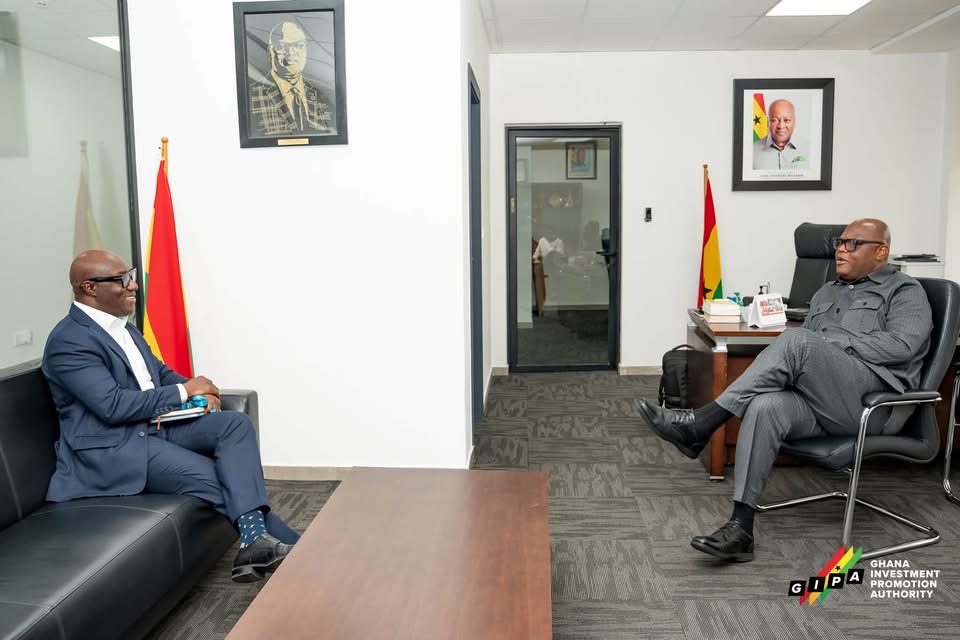
The Chief Executive Officer of the Ghana Investment Promotion Authority (GIPA), Mr. Simon Madjie, has held discussions with Deloitte Africa Senior Partner, Mr. Joe Eshun, on opportunities to strengthen investment facilitation, technology transfer and industrial development.
The discussion followed Mr. Eshun’s return to Ghana after more than three decades of professional experience across Europe and Africa.
The courtesy call provided a platform for the two institutions to examine potential areas of collaboration aimed at attracting investment into priority sectors of Ghana’s economy, strengthening domestic industries and expanding opportunities for Ghanaian businesses.
The engagement also underscored the importance of connecting international professional expertise with local investment priorities to support sustainable economic growth.
The discussions come as Ghana continues to position private sector investment as a driver of industrial expansion, employment creation and economic transformation.
According to the Ghana Investment Promotion Centre’s 2024 fourth-quarter investment report, the Centre registered 140 projects during the year, representing an 11.48 per cent increase over 2023, although the reported foreign direct investment value declined by five per cent to US$617.61 million.
“The courtesy call provided an opportunity to discuss GIPA’s mandate and explore areas of collaboration between the two institutions.”
CEO of GIPA, Mr. Simon Madjie
Investment Facilitation and Strategic Partnerships
Investment facilitation featured prominently in the discussions, reflecting the need to create an environment in which domestic and international investors can identify opportunities, navigate regulatory requirements and establish commercially viable operations.
GIPA’s mandate places investment attraction and facilitation at the centre of efforts to mobilise capital for Ghana’s development. Effective facilitation requires coordination among investors, government institutions, financial organisations and private-sector partners to address administrative challenges and improve the conditions for investment.
For professional services firms such as Deloitte, potential areas of engagement include business advisory support, investment analysis, financial and risk management services, regulatory guidance and assistance with evaluating commercial opportunities.
These capabilities can help businesses assess market conditions, structure investments and make informed decisions about expansion.
However, the value of any partnership would ultimately depend on the development of practical initiatives that respond to investor needs and Ghana’s economic priorities.
“Discussions touched on investment facilitation, technology transfer agreements, strengthening local industries and opportunities to attract investment into priority sectors of Ghana’s economy.”
Deloitte Africa Senior Partner, Mr Joe Eshun
These figures highlight the importance of sustaining investor confidence while ensuring that capital inflows contribute to productive economic activity.
The collaboration between investment promotion institutions and professional services organisations could support this objective by improving access to technical advice, strengthening business planning and helping investors understand the commercial and regulatory environment.
Technology Transfer and Industrial Development
Technology transfer emerged as another important area of discussion, particularly in relation to strengthening local industries and improving the capacity of Ghanaian businesses to compete in domestic and international markets.
Ghana has an established legal framework governing technology transfer agreements. Under the former Ghana Investment Promotion Centre Act, 2013 (Act 865), such agreements were subject to registration and review, with provisions for monitoring compliance.
The framework also covered technical assistance, industrial property rights, technical know-how and management services.
Ghana subsequently enacted the Ghana Investment Promotion Authority Act, 2026 (Act 1173), establishing the Authority to promote, facilitate and regulate investments into and within the country. The legislation was gazetted on July 15, 2026.
“The discussions highlighted the importance of partnerships in supporting industrial development and creating opportunities for Ghanaian businesses.”
CEO of GIPA, Mr. Simon Madjie
For local industries, the central consideration is ensuring that technology transfer produces measurable benefits beyond the initial investment. These may include workforce training, improved production standards, stronger technical capabilities, increased local participation in supply chains and the development of products that meet international market requirements.
Partnerships involving investment institutions and professional advisers could help businesses identify suitable technology providers, evaluate transfer arrangements and assess the long-term commercial implications of adopting new production systems.
Mobilising Expertise for Ghanaian Businesses
Mr Eshun’s return to Ghana after more than three decades of professional experience across Europe and Africa provides a further dimension to the engagement, particularly regarding the potential contribution of international experience to Ghana’s business environment.
Also professionals with extensive cross-border experience can bring knowledge of different markets, corporate practices, investment structures and approaches to managing complex business operations.

When connected to local institutions and enterprises, this expertise can support knowledge exchange and improve the capacity of businesses to respond to changing market conditions.
For Ghanaian companies seeking to expand, access to professional advice can be important in areas such as financial management, corporate governance, risk assessment, investment readiness and international market entry.
These capabilities are particularly relevant for businesses preparing to attract external capital, establish strategic partnerships or enter regional and global value chains.
The engagement also creates an opportunity to explore how investment promotion can be linked more closely with the practical needs of businesses. Rather than focusing solely on attracting investors, coordinated initiatives could help local enterprises strengthen their operations and prepare to participate in investment-led industrial development.
Mr Madjie welcomed Mr Eshun’s return to Ghana and reaffirmed GIPA’s openness to working with Deloitte to advance shared investment and development priorities.
‘’GIPA’s openness to working with Deloitte to advance shared investment and development priorities.”
Deloitte Africa Senior Partner, Mr Joe Eshun
The courtesy call establishes a basis for further engagement between the two institutions, although no specific partnership agreement, investment commitment or implementation timeline was announced in the information provided.
The next step will be translating the areas discussed into clearly defined initiatives that support investors, strengthen domestic enterprises and improve the transfer of knowledge and technology.