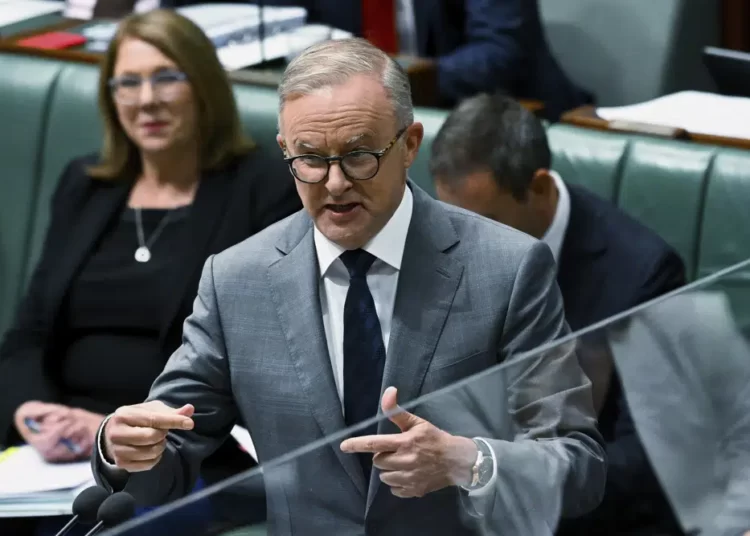
Australian Prime Minister, Anthony Albanese has vowed to protect citizens as tensions continue to escalate across the Middle East.
Albanese disclosed that the Australian government is intensifying efforts to safeguard citizens living or travelling in the Middle East amid the instability that is disrupting movement across the region, while remaining cautious and defensive in the face of the unfolding conflict.
“The first priority of my government is and always will be to keep Australians safe. There are around 115,000 Australians in the Middle East, with 24,000 in the UAE. Helping Australians also means helping the UAE and other Gulf nations defend themselves against unprovoked attacks.
“My government has been clear that we’re not taking offensive action against Iran. And we’ve been clear that we are not deploying Australian troops on the ground in Iran. We continue to work on contingencies to keep Australians safe and to help travellers leave the Middle East.”
Anthony Albanese
The Prime Minister reiterated that Australia’s involvement in the region is strictly defensive, assisting Gulf partners such as the UAE while ensuring Australian troops are not deployed on Iranian soil or engaged in offensive operations.
He added that the government will continue working on plans to keep Australians safe and help travelers leave the Middle East and highlighted that the Department Foreign Affairs and Trade (DFAT) personnel are already deployed to provide crisis and consular support.
Most importantly, Albanese confirmed that more than 2,600 Australians have now returned home. However, he noted that “significant challenges remain and further work is underway to support those still seeking to leave.”
Australia’s Defensive Measures and Support to Gulf Partners
As Middle East tensions escalate, the Australian government emphasizes a strictly defensive role, supporting Gulf allies like the UAE without direct involvement in combat operations against Iran.
The Prime Minister announced plans to deploy a long-range reconnaissance aircraft and air-to-air missiles to help Gulf nations defend against Iranian attacks while focusing on protecting Australian nationals.
“The Iranian conflict in the Middle East began just over a week ago, and Iran’s reprisal attacks continue to escalate already at a scale and depth we haven’t seen before. Twelve countries across the region, from Cyprus through to the Gulf, are continuing to be targeted.”
Anthony Albanese
He said that Australia “will deploy an E-7A Wedgetail to the Gulf to help protect and defend Australians and other civilians,” adding that the Wedgetail and supporting Australian Defence Force will “protect and secure airspace above the Gulf” for the next four weeks, and help the region with its “collective self-defence.”
This aircraft deployment follows a conversation between the Prime Minister and President Mohammed bin Zayed, further supporting regional security and civilian protection.
These defensive assets will support allied forces under the principle of collective defence and strengthen regional security in response to unprovoked attacks.
The Prime Minister further indicated that Australia has supported action aimed at preventing Iran from getting a nuclear weapon and preventing Iran from continuing to threaten international peace and security.
He reaffirmed that the governments position remains it does not want to see the conflict escalate and called all parties to uphold international humanitarian law and to protect civilian life.
“We’re taking defensive action to support our partners’ efforts to keep Australians safe. Deployed ADF assets will operate according to the right of collective self defence.”
Anthony Albanese
Richard Marles, Deputy Prime Minister of the Australian government, confirmed that at the request of the United Arab Emirates, Australia will be deploying an E-7 Wedgetail aircraft to the Gulf, along with approximately 85 personnel to operate the air frame.
Marles described the E-7 as one of the world’s leading platforms for long-range airborne reconnaissance and command, noting its recent use in the defence of Ukraine from Poland.
In addition, Australia will supply the UAE with advanced medium-range air-to-air missiles, which Marles emphasized are strictly defensive. “All of this is in the defence of the Gulf countries,” he said, highlighting that the deployment and equipment support are intended to protect regional allies, particularly in areas with significant Australian populations.
He mentioned that the UAE government expressed gratitude for Canberra’s contribution, calling attention to the importance of Australia’s role in supporting the security of its partners in the Gulf.
This gesture reflects the deep-rooted diplomatic bond between the two nations and emphasizes the value of Australia’s ongoing partnership in regional security efforts.
READ ALSO: Gender Minister Leads Ghana @70th UN Commission on Status of Women