Minority in Parliament has challenged the ownership of the “Gold for Oil” reserve programme, asserting that the initiative was conceptualized and launched by the previous New Patriotic Party (NPP) administration under the leadership of former Vice President Dr. Mahamudu Bawumia.
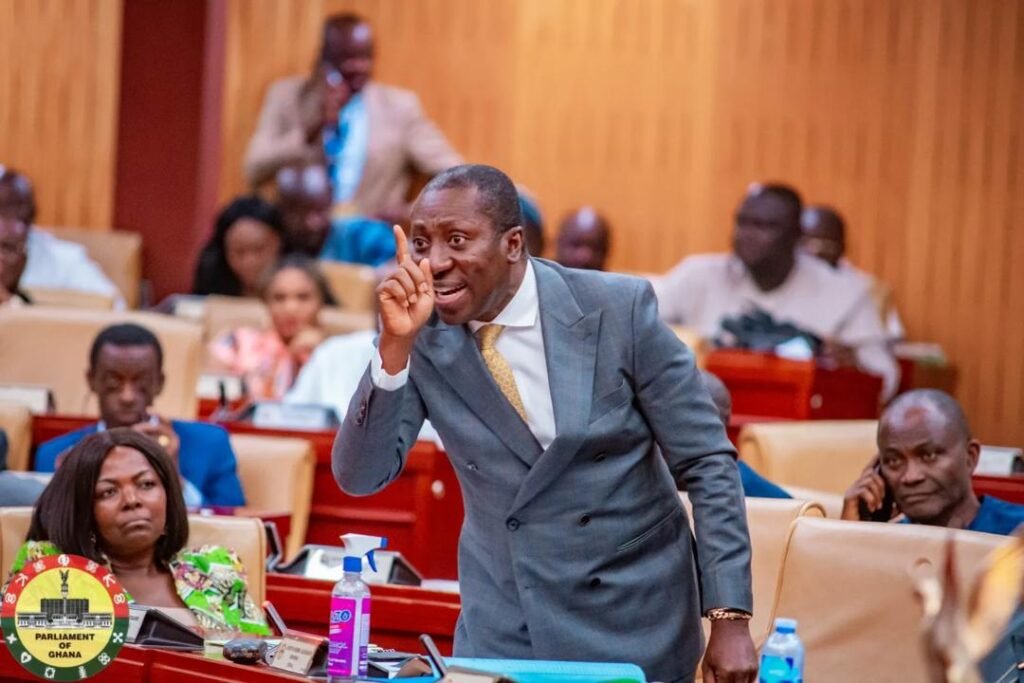
During a heated parliamentary debate, the Minority Leader, Hon. Alexander Afenyo-Markin, argued that the current government is merely marketing a “signature innovation” that it did not invent, but rather inherited from its predecessors.
Dwelling on this claim, the Minority emphasized that the policy framework and design were the intellectual products of Dr. Bawumia’s economic team, intended to leverage Ghana’s mineral wealth to stabilize the currency and ensure energy security.
They contend that the current administration has engaged in a strategic rebranding of the programme, effectively “putting their name on the door” while presenting it to the international community as an original idea.
This dispute over policy lineage comes at a time when the Gold for Oil initiative is being touted as a key driver behind the cedi’s recent appreciation and the significant reduction in national inflation.
“The gold for oil reserve programme that this administration is marketing to Ghanaians as a signature innovation was never invented by this government. It was conceived, designed, and launched by the NPP administration, spearheaded by the former Vice President, Dr. Mammoud Bawumia . Mr. Speaker, it was our policy, our framework, our initiative.”
Hon. Alexander Afenyo-Markin
The Economic Significance of Gold-Backed Initiatives
The fierce battle over the “intellectual and policy credit” for the Gold for Oil programme stems from its transformative impact on Ghana’s macroeconomic landscape.
By mid-2025, the policy had contributed to a dramatic shift in the nation’s trade balance, helping the cedi achieve a 40.7% appreciation against the US dollar.
For the extractive sector, this initiative represents a pivot from traditional gold exports to a “commodity-based reserve strategy” that treats gold as a strategic national asset rather than a mere export product.
Industry analysts suggest that the programme’s success in formalizing artisanal and small-scale mining (ASM) has been a “game-changer for the formal economy.”
By purchasing gold locally to fund fuel imports, the state has effectively bypassed the need for scarce foreign exchange, reducing the pressure on the Bank of Ghana’s reserves.
This “homegrown solution” has not only stabilized pump prices but also provided a “buffer against global market volatility,” making it a trophy that any administration would be eager to claim as its own legacy.
Political Tug-of-War Over Policy Legacy

The struggle for ownership is deeply rooted in the political narrative of “economic competence” that dominates Ghanaian elections.
The Minority insists that “Ghana cannot learn right lessons from its recent economic history” if the origins of successful policies are permitted to be rewritten by those currently in power.
They point to the irony of the current administration now championing a framework that they “spent years opposing” while in opposition.
From the government’s perspective, the successful execution and “re-branding” of the programme are viewed as evidence of superior implementation capacity.
However, the Minority maintains that the NPP “pulled the programme from the ground up,” and failing to acknowledge this historical fact is a “dishonest” attempt to monopolize political gains.
As the 2026 political cycle intensifies, the “Gold for Oil” debate has become a microcosm of the larger battle over who truly holds the blueprint for Ghana’s economic recovery.
Transparency and Future of the Extractive Sector

Beyond the political optics, the dispute highlights the need for institutionalized transparency in how mineral-backed policies are managed across transitions of power.
The Minority Leader warned that his side of the house “will not allow that rewriting to stand,” signaling a push for more rigorous documentation of policy origins in parliamentary records.
For stakeholders in the mining and extractive industry, the continuity of the programme is more critical than its name, yet the “lack of transparency” in its initial rollout remains a point of contention for both sides.
As Ghana moves toward a more “progressive gold royalty system,” the debate over who pioneered the gold-for-oil framework will likely influence future legislation regarding mineral income.
Whether the credit ultimately rests with the “brainchild” of Dr. Bawumia or the current implementers, the policy has undeniably shifted how Ghana utilizes its extractive wealth.
For now, the Minority remains steadfast in its demand for historical accuracy, insisting that the government must recognize the “policy and framework” it inherited.
READ ALSO: GIPC Seeks Asantehene’s Blessing for Ashanti Investment Forum