
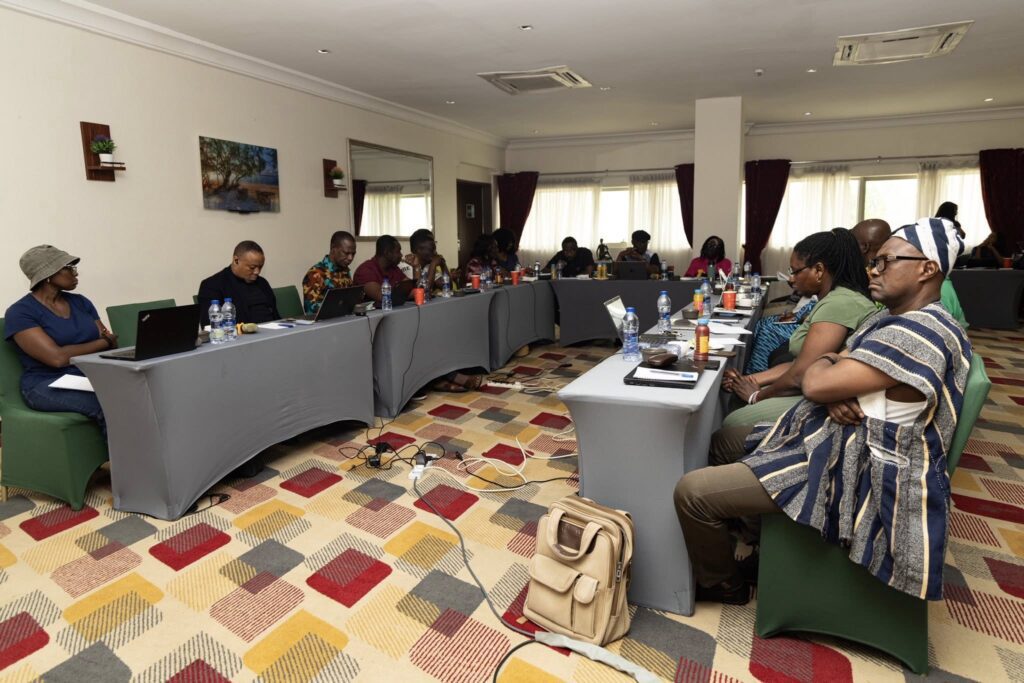
The Ghana Export Promotion Authority (GEPA) has concluded a high-intensity, four-day strategic retreat this week, marking a decisive internal pivot toward the “execution-heavy” phase of the National Export Development Strategy (NEDS).
Held in Accra, the retreat brought together the Authority’s full management spectrum to conduct a ruthless performance audit of current systems and calibrate the machinery of state to meet the aggressive Non-Traditional Export (NTE) targets set for the 2026 fiscal year.
This internal session dismantled departmental silos and ensured that every unit within GEPA is operationally synchronized with the government’s overarching Accelerated Export Development and Industrialization mandates.
“The Management Team of the Ghana Export Promotion Authority held a four-day retreat to review performance, assess ongoing initiatives, and align strategic priorities toward accelerating the growth of Ghana’s Non-Traditional Exports.
“Discussions focused on strengthening internal systems, improving coordination across departments, and identifying practical steps to enhance the Authority’s overall impact”
Ghana Export Promotion Authority
GEPA noted that it is strengthening internal systems and improving coordination, in order to support a new wave of Ghanaian exporters who operate across multiple time zones and require real-time administrative support. The four-day retreat was a recalibration aimed at delivering immediate, tangible value to the Ghanaian exporter.

The core of the 2026 mandate is the rapid acceleration of Non-Traditional Exports. While gold and cocoa remain traditional anchors, the Ministry of Trade, Agribusiness and Industry (MoTAI) has tasked GEPA with expanding the footprint of processed agribusiness products, industrial components, and artisanal goods.
The retreat focused on identifying the specific “practical steps” required to move these goods through the AfCFTA digital trade corridors with zero friction.
Management identified that the “next phase of implementation” requires a shift from general promotion to targeted, data-driven market entry. This includes leveraging the AfCFTA Digital Trade Protocol to provide Ghanaian MSMEs with real-time market intelligence and direct links to continental buyers.
For GEPA, prioritizing high-growth sectors – such as processed shea, industrial salt, and apparel – means the nation’s foreign exchange earnings will no longer be vulnerable to the volatility of a few primary commodities.
Internal System Strengthening
A significant portion of the four-day session was dedicated to a “departmental audit,” where the leadership acknowledged that to deliver a 24-Hour Economy, the state’s trade facilitators must first eliminate the internal bureaucratic friction that delays export documentation and certification.
Discussions focused on digitizing the entire export path from initial registration to final shipment tracking, ensuring that GEPA remains the most efficient trade agency in the sub-region. The retreat’s outcome includes a new Inter-Departmental Coordination Framework, which mandates daily synchronization between the Research, Finance, and Marketing departments.
This guarantees that when a Ghanaian exporter identifies a market opportunity in Kenya or the EU, GEPA’s internal machinery can move at the “speed of business.” This internal efficiency provides local manufacturers with the certainty that their products will not sit in warehouses due to administrative delays.
The government has redefined GEPA’s success not by the number of workshops held, but by the value delivered to the individual exporter. The retreat identified that “value” in 2026 means lower transaction costs, faster access to international trade fairs, and robust representation in global supply chain negotiations.
This is particularly critical for the agribusiness sector. As the Feed Ghana Programme generates a surplus of raw produce, GEPA’s role is to ensure that this surplus is processed and exported as finished goods.
During the retreat, management reviewed the progress of the Regional Export Hubs, which serve as the frontline for MSME onboarding. It was noted that these hubs are being equipped with digital tools to provide rural processors with the same level of global visibility as large-scale industrial firms in Tema or Kumasi.
“Outcomes from the sessions are expected to guide the Authority’s next phase of implementation in delivering value to exporters and contributing to national economic growth”
Ghana Export Promotion Authority
As GEPA’s management emerged from the four-day retreat, the strategic priorities for the remainder of the year were clearly mapped out. The Authority is now operating under a results-oriented framework, with the 2026 economic recovery built on the strength of Ghana’s exports.

The retreat’s focus on practical steps means that exporters can expect a surge in specialized training, enhanced digital platforms, and more aggressive representation in the AfCFTA marketplace.