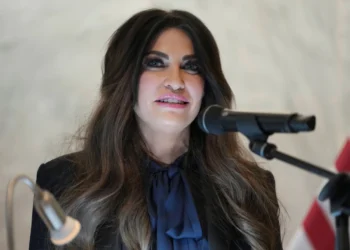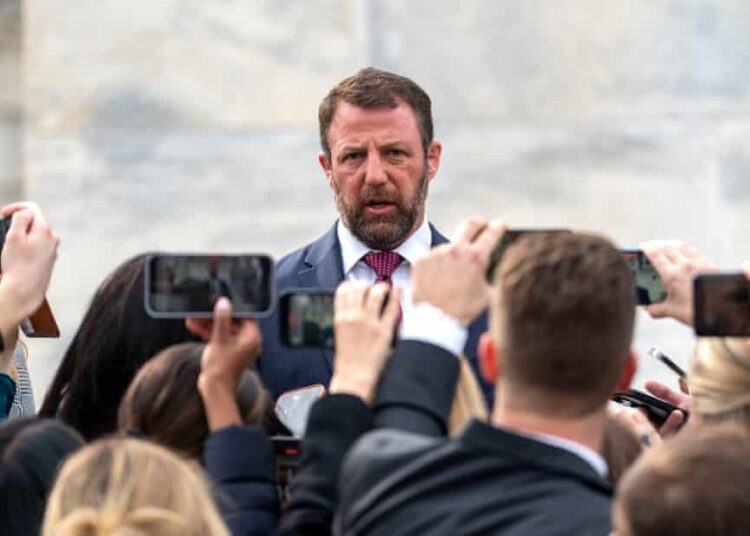
A key Senate committee has approved Markwayne Mullin’s nomination to lead the Department of Homeland Security (DHS) on a near party line vote.
The 8-7 vote came a day after the Mullin, a Republican Senator, faced questions at his confirmation hearing about his approach to Donald Trump’s immigration enforcement agenda and accusations of encouraging violence.
Nearly all eight Republicans on the Senate committee on homeland security and governmental affairs voted to advance Mullin’s nomination, with the sole exception of the panel’s Chair, Rand Paul of Kentucky.
John Fetterman of Pennsylvania was the sole Democrat to support Mullin’s nomination, with his other six colleagues opposing him.
Fetterman, who has frequently challenged his own party, said that his vote was “rooted in a strong committed, constructive working relationship with Senator Mullin for our nation’s security.”
In brief comments before the vote, the committee’s top Democrat, Gary Peters, said, “The Department of Homeland Security needs a leader who can restore the trust DHS has broken with the American people, and with this committee.” He added, “At his confirmation hearing yesterday, we saw that, unfortunately, Senator Mullin is not up to that challenge.”
He accused Mullin of failing to be “forthright and transparent” during the confirmation process, and added that he was “very troubled by Senator Mullin’s willingness to condone political violence, and the message that that sends across DHS.”
The Michigan Senator noted that beyond Mullin’s 2023 confrontation with Teamsters President Sean O’Brien during a committee hearing in which he appeared to be ready to brawl with the witness, a Senate ethics committee report had found that he “advocated physical violence as a means to resolve political disagreement.”
Democrats bombarded Mullin, a first-term Senator from Oklahoma who has publicly backed Trump’s hardline approach to immigration enforcement, with questions at his Wednesday confirmation hearing about how far he would go in supporting the administration’s policies.
During his testimony before the Senate Homeland Security and Government Affairs Committee, Mullin tried to make the case that he would be a steady hand after the tumultuous tenure of Kristi Noem, Trump’s first DHS Secretary.
Mullin also signaled support for Trump’s immigration priorities, which are central to the funding standoff after the death of at least three American citizens at the hands of federal agents.
Adopting a more diplomatic tone than he has taken in the past, he expressed regret for critical comments he had made about Alex Pretti, one of two US citizens killed by immigration agents in Minneapolis during the tumultuous surge into the city earlier this year, and also signaled he would like DHS’s operations to have a lower public profile than under outgoing secretary Kristi Noem.
However, Mullin otherwise showed few breaks with the president, refusing to commit to not having immigration agents positioned near polling stations during upcoming elections, and dodging questions about specific immigration arrests by saying he was not familiar with those cases.
Mullin did say that he would ensure immigration agents obtain judicial warrants before entering homes or businesses, amid reports that officers from Immigration and Customs Enforcement, which DHS oversees, have been told they could conduct searches with only an administrative warrant, which is signed by a supervisor at the agency, rather than a judge.
Mullin’s hearing was unusually combative and came close to going off the rails as he engaged in heated exchanges with some Democrats as well as Paul.
In addition to a lengthy exchange over Mullin’s failure to disclose what he characterized as a “classified” congressional trip while a House member, Paul opened the hearing with a fiery statement challenging Mullin’s fitness to lead DHS.
Paul pointed to comments Mullin made after a funding fight, when he called Paul a “freaking snake” and said he understood why a neighbor had tackled Paul in a lawn care dispute.
That incident happened several years ago, and Paul suffered multiple broken ribs and later had surgeries he linked to the attack. “I just wonder if someone who applauds violence against their political opponents is the right person to lead an agency that has struggled to accept limits to the proper use of force?” Paul said.
Mullin refused to back down. “For you to say I’m a liar, sir, that’s not accurate,” Mullin said. Paul later said that he would not vote for Mullin’s confirmation.
Mullin’s Nomination To Be Considered By Full Senate

Mullin’s nomination will now be considered by the full Senate, where Republicans appear to have the numbers to confirm him.
A vote on his confirmation is expected in the coming days.
Mullin’s nomination collides with a standoff in Congress over funding for the department, which Democrats have refused to vote for unless the Trump administration and their Republican allies agree to a host of new guidelines on officers from agencies like Immigration and Customs Enforcement (ICE) and the border patrol, both of which are overseen by DHS.
READ ALSO: NRGI Proposes Licensing Reforms to Avoid Mining Corruption in Lithium Sector