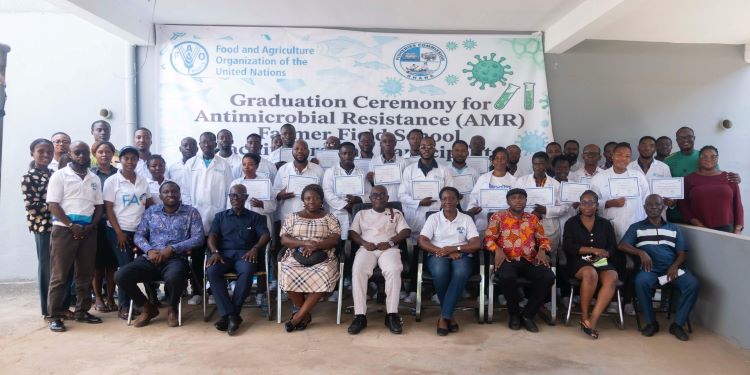
The Eastern Regional Office of the Fisheries Commission in Koforidua, in collaboration with the Food and Agriculture Organization (FAO), has signaled a seismic shift in the nation’s aquaculture strategy at a recent graduation and certificate award ceremony for the Antimicrobial Resistance (AMR) Aquaculture Farmer Field School.
According to the Commission, the new generation of fish farmers have been officially commissioned to lead a “science-based revolution.” This pioneering initiative is the first of its kind in the aquaculture sector, specifically designed to decouple tilapia and catfish production from a dangerous reliance on antimicrobials.
“Spearheaded by the Food and Agriculture Organization and the Fisheries Commission’s Fish Health Unit, the programme reinforces a powerful message that aquaculture can thrive without reliance on antimicrobials when guided by strong biosecurity measures and best management practices”
Fisheries Commission, Eastern Regional Office
The Commission noted that the program is focused on proving that high productivity and public health safety are not mutually exclusive – they are, in fact, deeply interdependent. The emergence of this Farmer Field School (FFS) model comes at a critical time for Ghana’s Blue Economy.
For years, small-scale and commercial fish farmers have often relied on the “prophylactic use of antimicrobials to combat high mortality rates,” in overcrowded or poorly managed ponds. However, the Fisheries Commission’s Fish Health Unit is now championing a different narrative: that aquaculture can thrive without these chemicals if the underlying “environmental stressors,” are addressed.

Building on the successful 2019 intervention in the poultry sector, this 2024 expansion into aquaculture represents a national effort to build a safer and more sustainable food system.
At the heart of this six-month intensive program was a participatory, hands-on learning model that moved away from the classroom and into the water. The core of the curriculum was a practical comparative study involving two distinct environments: an experimental tank and a control tank.
This learning by doing approach allowed the 22 graduating fish farmers to witness, in real-time, the impact of professionalized management versus conventional methods. The experiment focused on the two most commercially viable species in Ghana – African Catfish (Clarias gariepinus) and Tilapia (Oreochromis niloticus).
The experimental tank was managed under strict biosecurity protocols with a relentless focus on water management. Parameters such as aeration, consistent water changes, and oxygen stability were monitored with scientific precision, and no antimicrobials were introduced.
Conversely, the control tank reflected “farmers’ usual practices,” characterized by less structured water changes and inconsistent aeration. According to the Commission, the results were undeniable: the experimental tank showed significantly lower mortality and higher yields.
“This trial effectively demystified the need for drugs, proving that healthy fish are a product of a healthy environment, not a chemical cocktail,” the Commission added.
National Impact and Regional Leadership
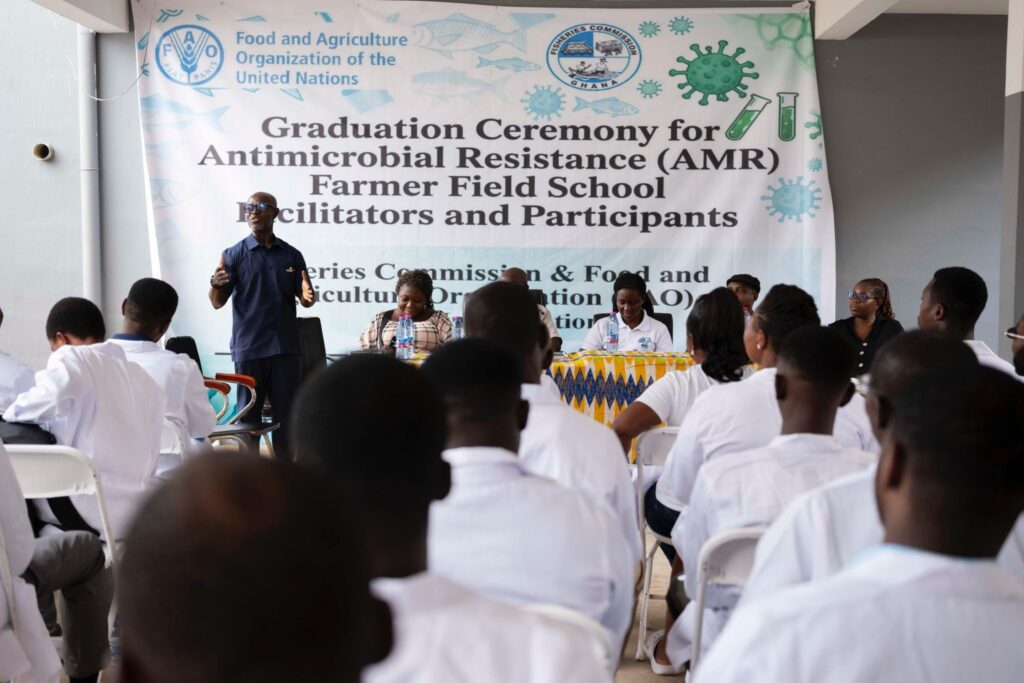
The Eastern Regional Director, Mr. Richard Yeboah, described the graduation as more than just a ceremony, dubbing it as a reflection of “commitment, discipline, and transformation.”
The success of this Koforidua cohort contributes to a growing national movement that has already empowered over 360 farmers across 16 different Farmer Field Schools spanning the poultry, pig, and aquaculture sectors. This scaling effect is essential for Ghana’s goal of meeting domestic fish demand while protecting the public health interests of the consumer.
The AMR Project Coordinator, Dr. Kofi Afakye, emphasized that the skills acquired by the graduates have direct implications for environmental protection. When antimicrobials are used excessively in open-water or pond systems, the runoff can lead to resistant bacteria in the wider ecosystem.
Equipping farmers with the tools to reduce this chemical footprint effectively safeguards the environment for future generations of fishers, especially as the program encourages a “data-driven approach,” where farmers are expected to keep meticulous records and seek professional guidance rather than resorting to over-the-counter antimicrobial solutions.
The keynote messages delivered during the ceremony framed aquaculture as a national security priority. Beyond the economics of fish farming, the graduates were reminded that their work is about “feeding a nation,” and protecting the integrity of its food chain.
The Head of the Aquaculture Division, Mr. Gideon Boakye, urged the graduates to act as community champions, spreading these science-based practices to neighboring farms that may still be stuck in the cycle of antimicrobial dependency – a leadership role is particularly important given the evolving needs of the sector.
He noted that while the program started with a focus on tilapia, it was “dynamically expanded to include catfish farming due to the high demand for expertise in that sub-sector.”

This responsive innovation ensures that the Fisheries Commission remains aligned with the actual market activities of Ghanaian farmers, as success, in this new era, is measured not just by the weight of the harvest, but by the responsibility of the practice.
As the 26 graduates (including community and government facilitators) prepare to return to their respective fields, the Head of Fish Health, Mad. Mary Nkansah, issued a stern but necessary call to action.
She urged the farmers to maintain a formal, ongoing relationship with the Fisheries Commission and its strategic priorities for 2026, which involve sustaining and scaling these biosecurity gains through constant communication between the Fish Health Unit and the operators on the ground.
The ceremony concluded with the official award of certificates, marking the end of a transformation journey. For the Eastern Region, these farmers now represent the frontline in the fight against antimicrobial resistance.
READ ALSO: Trump Issues Another Threat To Iran Over Strait of Hormuz Closure