Ghana is seeking to attract South African investment into cocoa processing, pharmaceutical manufacturing, cosmetics and confectionery production as the Ghana Cocoa Board (COCOBOD) explores partnerships to rehabilitate unproductive cocoa farms and strengthen the industry’s financial sustainability.
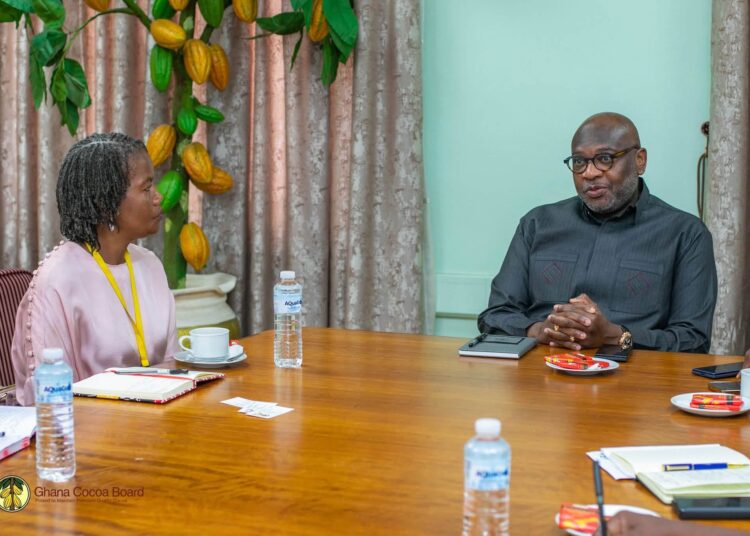
The initiative emerged during a meeting between COCOBOD Chief Executive Officer Dr. Ransford Anertey Abbey and a South African delegation led by High Commissioner Designate Linda Shongwe, which discussed opportunities for cocoa value addition, plantation rejuvenation and stronger economic cooperation between the two countries.
Dr. Abbey invited South African pharmaceutical, cosmetics and confectionery companies to explore commercial opportunities in Ghana’s cocoa industry, positioning the sector as a potential source of industrial investment, employment creation and increased domestic processing.
The engagement comes as Ghana implements reforms intended to improve cocoa farmers’ earnings, restructure the financing of the industry and retain more economic value from cocoa production within the country.
‘’Our Focus is to implement reforms to support our cocoa farmers to record growth within the cocoa industry’’
CEO of Cocoa Board, Dr. Ransford Abbey
According to COCOBOD, Ms Shongwe expressed strong interest in understanding Ghana’s policy framework for supporting cocoa farmers and protecting their livelihoods. She also indicated the importance of further engagement between institutions in both countries to strengthen bilateral economic relations.
The meeting also addressed recent immigration related tensions and their implications for relations between the two African countries.
Dr. Abbey recalled Ghana and South Africa’s historical connections through their respective struggles for liberation and the wider pursuit of African unity, urging both sides to pursue reconciliation and renewed cooperation.
Cocoa Legislation Offers New Investment Framework
A central issue during the discussions was the Ghana Cocoa Board Act, 2026 (Act 1182), which introduces reforms to cocoa-sector governance, farmer compensation and financing.

The legislation guarantees cocoa farmers a minimum of 70 per cent of the realised gross free-on-board (FOB) price of cocoa. The FOB value represents the price of cocoa for export at the point of shipment, before international freight, insurance and delivery costs.
The law is intended to provide a clearer relationship between international cocoa market conditions and the prices received by Ghanaian farmers, while establishing a more predictable framework for managing the industry.
For the 2026/27 cocoa season, Ghana set the producer price at GH¢42,400 per tonne, equivalent to GH¢2,650 for a 64-kilogramme bag. COCOBOD announced that the price represented 71.18 per cent of the realised gross FOB value.
The new price took effect on September 25, 2026, following consultations involving the government and cocoa-sector stakeholders.
The legislation also introduces safeguards against the destruction of cocoa farms, strengthens the protection of cocoa trees and restricts COCOBOD from undertaking quasi-fiscal activities outside its core responsibilities.
These measures are particularly significant as Ghana confronts challenges associated with ageing plantations, cocoa diseases, weather variability and illegal mining activities affecting agricultural land.
For potential South African investors, the reforms provide a framework within which opportunities in processing, manufacturing and agricultural financing could be explored.
Domestic Financing to Reduce Exposure
Dr. Abbey also outlined the shift from Ghana’s longstanding reliance on offshore syndicated loans towards a domestic, cedi-denominated financing system.
For more than three decades, Ghana has relied heavily on syndicated loans backed by forward cocoa sales to finance annual cocoa purchases. Although the arrangement provided liquidity, it also tied substantial portions of the crop to offshore financiers.
”The new funding model will come with a new pricing mechanism which will involve periodic reviews, maybe quarterly and will be used for the entire crop.”
CEO of Cocoa Board, Dr. Ranford Abbey
The proposed financing approach seeks to mobilise funds from domestic financial institutions and investors through instruments such as commercial paper and commercial notes.
The strategy is expected to expand local participation in cocoa financing, improve the availability of capital for domestic processors and reduce the sector’s dependence on external borrowing arrangements.
The reforms are particularly relevant amid recent financial pressures on the cocoa industry, including delayed payments to farmers and liquidity constraints affecting cocoa purchases.
On October 8, 2026, Reuters reported that COCOBOD had raised GH¢3.39 billion, equivalent to approximately US$288 million, through a short-term domestic debt issuance intended to support cocoa purchases from farmers.
The transaction highlights the importance of developing reliable domestic financing channels to sustain operations and maintain payments across the cocoa supply chain.
South African Bank Considered for Farm Rehabilitation
Beyond processing and manufacturing, the discussions explored a potential funding partnership with the Development Bank of Southern Africa (DBSA) to rehabilitate unproductive cocoa plantations.

Under the proposal outlined by Dr Abbey, financing would support the restoration of moribund farms, with cocoa harvested from the rehabilitated plantations eventually contributing directly to loan repayments.
COCOBOD indicated that the proposed arrangement would ring-fence the rehabilitated farms’ output for repayment, beginning in the third year of production.
The model would link financing to agricultural production rather than depending entirely on conventional repayment arrangements, potentially creating a structure through which investment in neglected farms could generate returns over time.
However, the proposal remains an investment opportunity under discussion, and the available announcement does not establish that a funding agreement has been concluded with the DBSA.
Farm rehabilitation is an important consideration for Ghana’s cocoa industry, which continues to contend with declining productivity in some growing areas.
The Ghana News Agency reported in September 2026 that the Cocoa Rehabilitation Programme, launched in 2020, was designed to replace ageing, diseased and unproductive trees with improved cocoa varieties capable of producing higher yields and bearing fruit earlier.
Such interventions are intended to restore farm productivity, strengthen farmer livelihoods and sustain the supply of cocoa beans for domestic processing and export.
For a prospective financing partner, the proposed arrangement would require careful assessment of rehabilitation costs, production timelines, farm yields, disease risks and the prices obtainable for cocoa.
Value Addition Remains a Priority
The proposed engagement with South African businesses also aligns with Ghana’s wider ambition to expand domestic cocoa processing and increase the economic benefits derived from the crop.
Investment in cocoa-derived products could create opportunities across several industries, including food manufacturing, cosmetics and pharmaceutical research. Such ventures could support local employment, stimulate demand for processed cocoa and strengthen commercial links between Ghanaian producers and South African manufacturers.
The commercial potential, however, will depend on investment commitments, processing capacity, access to finance, market demand and the ability of businesses to compete in domestic and international markets.
READ ALSO:Closer EU Ties More Plausible Than UK Rejoining — Analyst