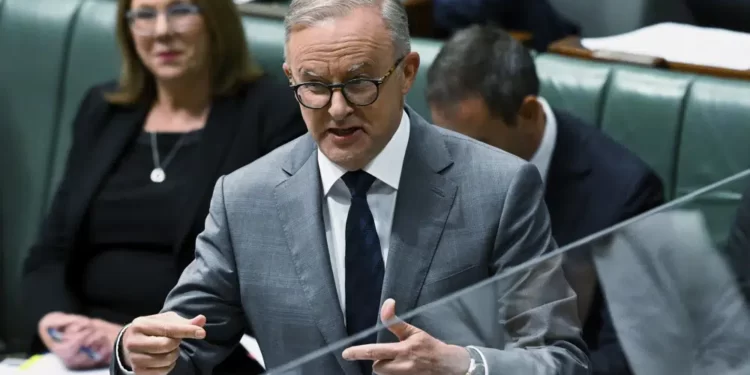
Australia’s Prime Minister, Anthony Albanese has warned of more potential economic pain in the coming months due to the impact of the war.
Albanese said in a rare address to the nation that the months ahead will be difficult.
“The months ahead may not be easy. I want to be upfront about that. No government can promise to eliminate the pressures that this war is causing.”
Anthony Albanese
Facing huge increases in petrol prices, Albanese urged Australians to switch to using public transport, preserving fuel for rural communities and essential services.
“Australia is not an active participant in this war. But all Australians are paying higher prices because of it. Farmers and truckies, small businesses and families are doing it tough. And the reality is, the economic shocks caused by this war will be with us for months.”
Anthony Albanese
Albanese has previously sought to reassure motorists that shipments of fuel continue to arrive in Australia, and petrol shortages in rural towns stem from panic buying and distribution bottlenecks.
“If you’re hitting the road, don’t take more fuel than you need – just fill up like you normally would. Think of others in your community, in the bush and in critical industries.”
Anthony Albanese
Australians can help the situation by switching to taking the train, bus or tram to work, he said.This will preserve fuel for nurses, shift workers, trades people and miners who rely on driving.
“That builds our reserves, and it saves fuel for people who have no choice but to drive. Farmers and miners and tradies who need diesel, every single day. And all those shift workers and nurses, who do so much for our country.”
Anthony Albanese
Australia this week announced temporary tax relief for small businesses and halved a fuel tax to help motorists experiencing soaring petrol prices, but has resisted imposing fuel restrictions.
Geographically isolated and with only two working oil refineries, Australia is heavily exposed to disruptions in global fuel supply and imports most of its petrol.
Australia holds roughly 37 days’ worth of petrol in reserve, according to government figures, far below the 90-day minimum dictated by the International Energy Agency.
“No government can promise to eliminate the pressures that this war is causing. I can promise we will do everything we can to protect Australia from the worst of it.”
Anthony Albanese
The government maintains petrol rationing is still a long way off and could be avoided altogether if enough alternative supply is secured, should the Strait of Hormuz remain closed.
Albanese’s address was the first nationally televised address since March 2020, when Scott Morrison spoke to the nation about the then-developing COVID-19 pandemic. The only other such speech this century was in October 2008, when Kevin Rudd addressed the nation about the global financial crisis.
The Prime Minister’s tone was slightly less upbeat than two days ago after the national cabinet meeting, but the message about the need to keep the economy moving was the same.
Government To Invoke Emergency Powers
Earlier, Western Australia’s Energy Minister Amber-Jade Sanderson said the state government would invoke emergency powers to force fuel companies to provide information about their supply chains.
Sanderson said the emergency powers gave the government oversight about fuel volumes and distribution and allowed it to act quickly to allocate fuel to where it was needed the most and to avoid disruptions.
Meanwhile, Donald Trump, who will deliver his own national televised address later today said that the war would last another two to three weeks.
“Maybe two weeks, maybe a couple of days longer to do the job. It’s possible we’ll make a deal before then.”
Donald Trump
Trump said that he believed Iran’s military and nuclear capacity had been sufficiently degraded. “It will take 15 to 20 years for them to rebuild what we have done to them,” he said.
However, he is washing his hands of responsibility for reopening the Strait of Hormuz.
US Secretary of State Marco Rubio said on Tuesday that Washington could see “the finish line” in the Iran war, now in its fifth week. “We can see the finish line. It’s not today, it’s not tomorrow, but it is coming,” Rubio stated. He also said there was potential for a direct meeting with Iran at some point.
READ ALSO: Trump Issues Another Threat To Iran Over Strait of Hormuz Closure