
The Minority in Parliament has accused the government of introducing LGBTQ related content into Ghana’s education system, describing the move as a contradiction of earlier assurances to promote what it calls Ghanaian family values through the curriculum.
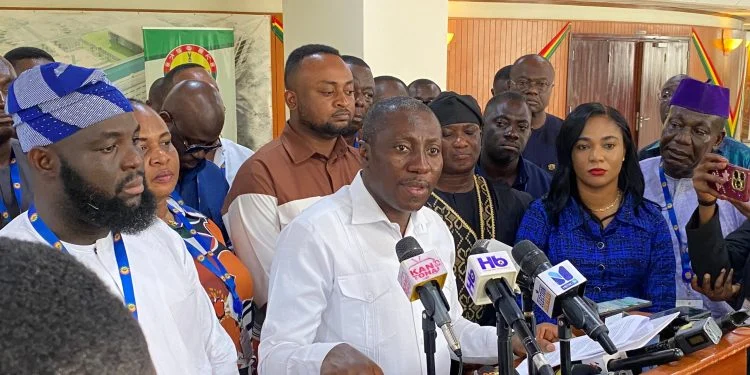
The allegations were made at a press conference at Parliament House by John Ntim Fordjour, Member of Parliament for Assin South, speaking on behalf of the caucus.
Addressing journalists, Rev. Fordjour described the development as deeply concerning, arguing that it represents a departure from commitments made by President John Dramani Mahama during engagements with religious leaders prior to and after assuming office.
According to the Minority, the issue stems from a proposal made by President Mahama in January 2025 during an engagement with the Catholic Bishops’ Conference.
At the time, the President suggested that embedding Ghanaian family values within the national curriculum could serve as an alternative to legislation on matters related to LGBTQ issues.

Rev. Fordjour recalled that the President emphasised the role of education in shaping societal values, stating that a well structured curriculum could eliminate the need for legal enforcement.
“More than even the family values bill, it is about agreeing on a curriculum that inculcates these values into our children as they are growing up so that we do not need to legislate it”.
MP for Assin South Hon. Rev. John Ntim Fordjour
He said this assurance was widely welcomed by stakeholders who believed it would strengthen cultural values through education. However, the Minority now argues that the government has taken a different path.
Claims of controversial content in teaching materials
The former Deputy Minister of Education, Rev. Fordjour alleged that instead of reinforcing traditional values, the government has introduced concepts related to gender identity into school materials.
He presented what he described as a teacher manual for physical education and health, which he claimed was developed under the supervision of the Ministry of Education and distributed through the Ghana Education Service and the National Council for Curriculum and Assessment.

He cited sections of the material that define gender identity as a person’s internal experience, which may not necessarily correspond with their assigned sex at birth. According to him, the content suggests that gender can include being male, female, or a combination of both.
“This is what has been presented to our students in the first week of the academic term,” he said, expressing concern about the implications of such content for young learners.
The Minority further alleged that teachers were trained through workshops to deliver these lessons, indicating what it described as a structured implementation process.
Government response and ongoing controversy
The issue has sparked debate following an earlier response from the National Council for Curriculum and Assessment, which initially denied the presence of such content in official materials.
However, Rev. Fordjour claimed that the council later acknowledged the inclusion of what it described as controversial definitions in a senior high school teacher’s manual.
According to the Minority, the government subsequently characterised the content as an anomaly. Rev. Fordjour, however, rejected this explanation, arguing that the materials were officially approved, printed, and distributed, suggesting a more deliberate process.

He also disputed claims that the materials had been withdrawn from schools, stating that they remain in circulation. “Go to the schools and ask the teachers. The books are still there,” he asserted.
Minority raises concerns over policy direction
Beyond the curriculum, the Minority also pointed to what it described as broader efforts to introduce similar concepts into national policy frameworks. Rev. Fordjour referenced sections of recommendations from the Constitutional Review Committee, suggesting that they could pave the way for changes in the legal framework if adopted.
He argued that these developments raise questions about the consistency of the government’s policy direction, particularly in light of earlier statements emphasising the protection of cultural and family values.
The caucus maintains that the introduction of such content into schools represents a significant shift from the government’s stated position and has called for greater transparency on curriculum development processes.
The controversy highlights ongoing national debates around education, culture, and policy priorities. While the Minority has framed the issue as a matter of protecting societal values, broader discussions continue about the role of education in addressing complex social topics.
Education experts and policymakers often emphasise the importance of curriculum development processes that involve consultation and alignment with national priorities. The current debate underscores the sensitivity of such processes and the need for clarity in communication.
For the Minority, however, the issue remains one of accountability. Rev. Fordjour insisted that the government must provide clear explanations regarding the content of teaching materials and the rationale behind their inclusion.
As the discussion unfolds, the matter is likely to remain a focal point of political and public discourse, reflecting deeper questions about governance, education, and the values that shape national development.
READ ALSO: Regulatory Fairness: GITA Applauds MoFAD Over License Reinstatement