Seven referees from across Africa have been selected to officiate at the upcoming FIFA World Cup 2026 to be hosted in the USA, Canada and Mexico, underlining the continent’s growing influence and credibility in global football officiating.
The Confederation of African Football (CAF) will be represented by match officials from Algeria, Egypt, Gabon, Morocco, Mauritania, South Africa, and Somalia.
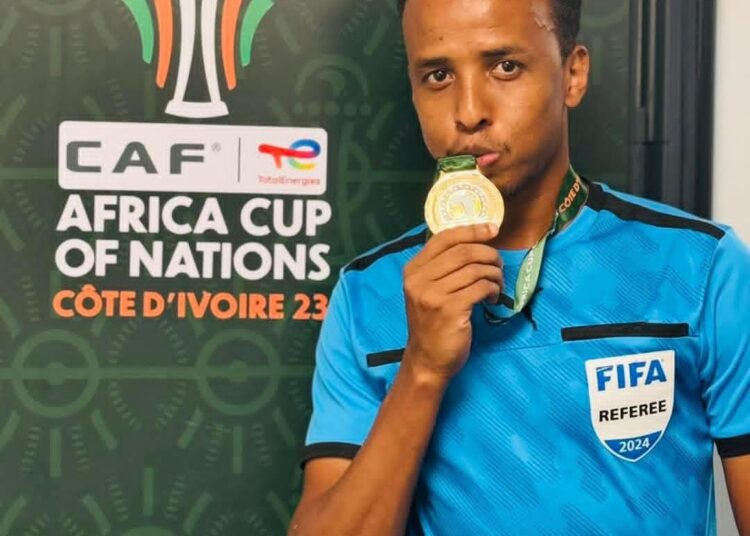
The selected referees include Mustapha Ghorbal (Algeria), Amin Mohamed (Egypt), Pierre Atcho (Gabon), Jalal Jayed (Morocco), Dahane Beida (Mauritania), Tom Abongile (South Africa), and Omar Artan (Somalia).

Their appointments reflect both individual excellence and CAF’s sustained efforts to elevate refereeing standards across Africa.
It is also a significant moment for several nations whose officials continue to gain recognition on the global stage.
Ghorbal Leads with Experience

Among the selected officials, Mustapha Ghorbal stands out as the most experienced. The Algerian referee has previously officiated at both the 2018 and 2022 editions of the World Cup, making him one of Africa’s most trusted figures in high-stakes international matches.
The Algerian was the center referee for two games at the 2022 FIFA World Cup in Qatar. He handled the group stage matches between The Netherlands and Ecuador and the Australia versus Denmark fixture as well as being appointed as the fourth referee in the games involving Croatia and Japan in the round of 16 and the quarter finals clash between Brazil and Croatia.
Ghorbal’s consistent performances in major tournaments, including the Africa Cup of Nations and intercontinental competitions, have earned him widespread respect. His inclusion comes as little surprise, given his calm authority, decision-making accuracy, and ability to manage high-pressure encounters.
His experience will likely position him for key fixtures during the tournament, where FIFA traditionally relies on seasoned referees to handle decisive matches.
Fresh Faces Step Onto the Global Stage

While Ghorbal brings experience, several of the other referees will be making their World Cup debuts, marking a new chapter in their careers. Somalia’s Omar Artan is among the standout debutants.
His selection is particularly significant, as it highlights progress in refereeing development in countries that have historically had limited representation at the highest level. Artan’s rise through the ranks has been steady, and his appointment signals confidence in his abilities to perform on football’s biggest stage.
Similarly, officials like Pierre Atcho, Jalal Jayed, Dahane Beida, Tom Abongile, and Amin Mohamed will be looking to make strong impressions in their first World Cup appearances.
Each has built a solid reputation within CAF competitions and has undergone rigorous FIFA training and assessment programs leading up to the tournament.
Their inclusion suggests a deliberate effort by FIFA to blend experience with emerging talent, ensuring both quality and continuity in officiating standards.
African Representation: Progress and Perspective
The appointment of seven referees for the 2026 tournament reflects both continuity and evolution in African representation at the World Cup. While the number is slightly lower than the eight referees selected for the FIFA World Cup 2022, it still signals strong and consistent trust in African officials at the highest level.
The 2022 edition in Qatar marked a milestone moment, not only because of the increased number of referees but also due to historic breakthroughs. Salima Mukansanga made history as the first African woman appointed as a center referee at a World Cup, setting a precedent for inclusivity and diversity in officiating.
That tournament also saw expanded roles for African officials, including Video Assistant Referee (VAR) assignments, highlighting FIFA’s confidence in their technical competence and decision-making capabilities.
The 2026 World Cup will feature an expanded format with 48 teams, up from 32 in previous editions. This structural change has created more opportunities not only for players and teams but also for match officials.
With more matches to oversee, FIFA has broadened its pool of referees, allowing for a wider representation of confederations. For CAF, this translates into sustained visibility and continued opportunities to prove its officiating quality on a global stage.
However, the slight drop from eight referees in 2022 to seven in 2026 raises questions about whether Africa is maximizing its potential pool of elite referees. While the numbers remain strong, maintaining and exceeding previous benchmarks will be key to ensuring long-term influence.
CAF’s Growing Influence

The consistent inclusion of African referees in World Cup tournaments is a testament to CAF’s increasing role in global football governance. Over the years, African referees have worked to overcome criticism regarding consistency and decision-making, investing heavily in training, technology adoption, and performance analysis.
CAF’s referee development programs, coupled with FIFA’s elite officiating initiatives, have helped produce a new generation of officials capable of meeting the demands of modern football.
The integration of VAR and stricter fitness and assessment standards has further improved performance levels.This latest recognition reinforces the idea that African referees are no longer peripheral figures but key contributors to the global game.
Officiating at the World Cup remains the pinnacle of a referee’s career. The pressure is immense, with every decision subject to global scrutiny.
For the seven CAF referees selected, the tournament represents both validation and a test of their readiness at the highest level. Strong performances could cement Africa’s reputation as a hub of elite refereeing talent, while inconsistencies could reopen old criticisms.
The margin for error is thus, minimal. Progress has been made, but the next step is dominance not just participation. The 2026 World Cup offers African referees the stage to prove they belong not just among the best, but at the very top.
READ ALSO: Leaders Call For Lebanon’s Inclusion In US-Iran Ceasefire