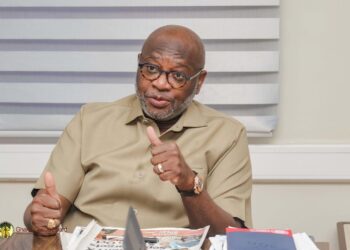
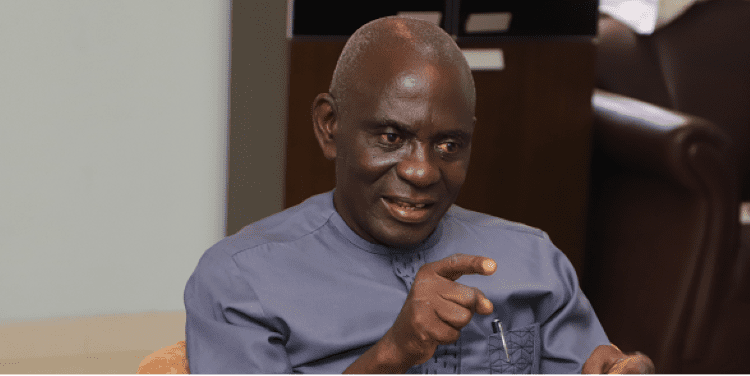
Former Deputy Minister for Local Government and Rural Development and renowned agricultural policy advisor, Hon. Abraham Dwuma Odoom, has declared that the Central Region possesses the untapped capacity to single-handedly achieve rice self-sufficiency for the entire nation.
Speaking of a bold policy challenge that has sent ripples through the national agribusiness sector, Hon. Odoom presented a visionary roadmap that positions the region as a strategic breadbasket, provided the government takes the aggressive step of reclaiming lands currently devastated by illegal mining, popularly known as “galamsey.”
“The Central Region alone has the capacity to produce rice to feed the whole of Ghana. From behind the prisons to the Sefwi area and Dunkwa, all have good lands to support rice cultivation. Why are we that lazy? Our over-reliance on food imports undermines our overall food security”
Hon. Abraham Dwuma Odoom, Former Deputy Minister and Agricultural Policy Advisor
Hon. Odoom, whose tenure as a policy advisor for the Competitive Africa Rice Initiative (CARI) in Nigeria saw that nation achieve historic production milestones, argued that Ghana’s reliance on food imports is a result of a lack of strategic will rather than a lack of resources – His intervention coming at a time when the national economy is seeking to insulate itself from global supply chain shocks.
The crux of Hon. Odoom’s argument lies in the unique topography of the Central Region. He noted that the region is endowed with vast, low-lying arable lands that are naturally ideal for large-scale rice cultivation.
Unlike other terrains that require expensive, artificial irrigation systems, these lowlands provide a natural habitat for rice varieties that could stabilize Ghana’s supply chain and drastically reduce the hundreds of millions of dollars annually spent on rice imports.

Hon. Odoom pointed to specific geographic corridors as prime zones for an agricultural revolution, arguing that leveraging these existing natural assets in the region can produce enough rice to feed the country’s citizens and even generate enough sugarcane to sustainably revive the Komenda Sugar Factory.
Clustering Farmers
For the former Deputy Minister, the path to self-sufficiency is built on a “cluster model,” that prioritizes processing and efficiency. He cited the existing rice mill at Assin Akropong as a blueprint for success.
Instead of farmers working in isolation, Hon. Odoom proposed a 24-hour supply chain where smallholders are organized around milling stations, ensuring that the mills operate at full capacity, producing a consistent supply of high-quality, bagged Ghanaian rice for the market. This industrial approach would transform farming from a subsistence activity into a high-yield business.
According to Hon. Odoom, the government can ensure that mills never run dry by calculating the specific tonnage capacity of each farmer in a cluster. He assured that this “24-hour format,” would not only make local rice more available but would also make it more competitive against imported brands that currently dominate urban supermarket shelves.
The most provocative part of Hon. Odoom’s roadmap was his demand for the immediate cessation and reclamation of galamsey-affected lands. He described the devastation of arable land by illegal miners as a national tragedy that must be corrected through agricultural conversion.
He issued a direct challenge to the government: hand over the degraded mining sites to agricultural experts for restoration and immediate planting of maize and rice.

Though the cost of reclaiming a single hectare of galamsey land is high, Hon. Odoom argued it is a necessary investment when compared to the long-term cost of food insecurity. For him, by turning “red zones,” into “green zones,” the government would be solving two crises at once: halting environmental degradation and securing the national food supply.
Expertise-Led Governance
Despite his clear blueprints for success, Hon. Odoom expressed a poignant frustration regarding the lack of high-level engagement with sector experts. Having helped Nigeria achieve its rice revolution, he found it lamentable that his “home-grown,” expertise is not being fully utilized by the authorities in Accra.
His addres served as a reminder that while the government has ambitious plans, the implementation requires the hands-on technical logistics that only seasoned experts can provide.
The Ministry for Food and Agriculture (MoFA) and the broader economic management team are now under pressure to respond to this regionalized roadmap. If the government accepts Hon. Odoom’s challenge to reclaim galamsey lands in the Central Region, the 2026 planting season could mark the beginning of a new era of Ghanaian economic independence.
“The ideas are there, but unfortunately, I am not being consulted enough to leverage my expertise for the government. With concerted effort and government backing, the nation could achieve rice self-sufficiency – and even produce its own tomatoes and onions to feed its people”
Hon. Abraham Dwuma Odoom, Former Deputy Minister and Agricultural Policy Advisor
In the high-stakes world of West African agribusiness, Hon. Dwuma Odoom’s proposal is a rare ready-to-go strategy that focuses on the Central Region’s lowlands, reclaiming mining sites, and clustering farmers around mills, to end Ghana’s reliance on foreign rice.
The only question that remains is whether the political will exists to turn the Agricultural Policy Advisor’s blue print into tangible outcomes.
READ ALSO: Ghana’s Financial Crime War Takes New Turn