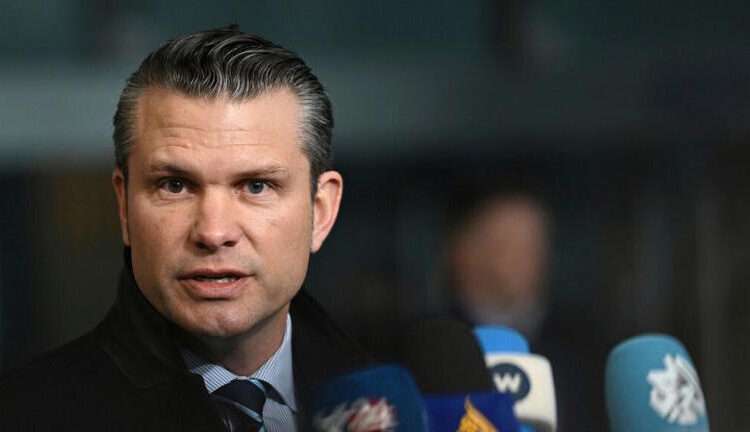
US Defence Secretary, Pete Hegseth has been questioned about the economic costs of the war against Iran.
This came as he faced questioning from lawmakers for the first time since the Trump administration launched the war against Iran, which Democrats have contested as a costly conflict of choice waged without congressional approval.
Until now, Hegseth has avoided public questioning from lawmakers about the war, although he and General Dan Caine, the Chairman of the Joint Chiefs of Staff, have held televised Pentagon briefings. Hegseth has mostly taken questions from conservative journalists, while citing Bible passages to castigate mainstream outlets.
Democrats quickly pivoted to the ballooning costs of the Iran war, the huge drawdown of critical US munitions and the bombing of an elementary school that killed children. Some lawmakers also questioned how prepared the military was to shoot down swarms of Iranian drones, some of which penetrated US defences and killed or injured American troops.
Appearing before a House Committee on Armed Services business meeting on the Department of Defense Fiscal Year 2027 on Capitol Hill, Hegseth faced intense questions from Rep. Ro Khanna, a California Democrat, about what American households would have to pay due to the economic repercussions of the war with Iran. “Do you know how much it will cost Americans in terms of their increased cost in gas and food over the next year because of the Iran war?” Khanna asked. Pete Hegseth retorted, “I would simply ask you what the cost is of an Iranian nuclear bomb.”
Khanna then accused Hegseth and the Trump administration of failing to live up to the president’s campaign promises of lowering the cost of living for Americans. He argued that Iran’s blockade of the Strait of Hormuz would cause American households to pay thousands more dollars for gas and food.
“I’m sad for all the people who voted for Trump. I’m sad for them because you betrayed them.”
Ro Khanna
Jules Hurst III, the Acting Undersecretary of war for finances, said most of the expense has been on munitions, but the military has also spent money on running the operations and equipment replacement. “We will formulate a supplemental through the White House that will come to Congress once we have a full assessment of the cost of the conflict,” Hurst added.
Democratic Representative Chrissy Houlahan asked Hegseth about how long the war is going to last.
“How many more months, just by order of magnitude, do you think that you’re going to need to be able to conclude operations successfully? And how many more billions of dollars do you think you’re going to ask this body for?”
Chrissy Houlahan
Hegseth refused to answer the question, saying that the US military would never tip its hand to an adversary about how long it would be committed to the mission.
Also, the Defence Secretary pushed back on Democratic criticisms that the Trump administration has led Americans into a “quagmire,” pointing out that the conflict is only two months old and asserting it has had great success against the Islamic Republic. He asserted that the US wars in Iraq and Afghanistan dragged on for years.
Trump said in early March that operations are likely to last four to five weeks but that he was prepared “to go far longer than that.” The US and Iran appear to be locked in a stalemate. Trump seems unlikely to accept Tehran’s latest offer to reopen the strait if the US ends the war, lifts its sea blockade and postpones nuclear talks. The Iranians seem unwilling to give up their nuclear ambitions before ending the conflict.
Deadly Iran School Strike Still Under Investigation
Additionally, Hegseth said that two months after a deadly strike on an Iranian elementary school killed more than 165 people, including many children, the incident remains under investigation.
He made the remarks after California Democrat Ro Khanna pressed the Defence Secretary on the costs associated with the strike. Hegseth replied that “that unfortunate situation remains under investigation” but that he “wouldn’t tie a cost to that.”
Hegseth told reporters last month that the military assigned a general from outside of US Central Command to investigate the strike. Still, he refused questions about what led to it while arguing that the US does not target civilians.
Those comments came just days after a news agency reported that there was growing evidence that pointed to US culpability for the Feb. 28 strike, which hit a school adjacent to a Revolutionary Guard base in Minab, Iran.
READ ALSO: Campion Rejects Ad Hoc Support For Fishing Communities at Global Congress