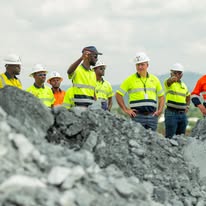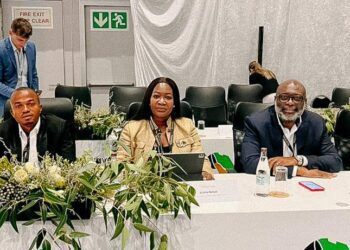

Nana Ampasi Bene-Mireku I, the Abakoma/Akyempimhene of the Damang-Wassa Division, has issued a clarion call for the institutionalization of radical inclusivity in the ongoing transition negotiations of the Abosso Goldfields Damang Mine.
The traditional leader emphasizes that the shift from active management by Gold Fields to a new operational phase must not relegate the local community to the status of “passive bystanders” or “pawns” in a corporate maneuver.
Instead, he advocates for a framework where traditional authorities, youth groups, and local professionals are integrated into the decision-making core to ensure that the post-mining economy is both resilient and representative of the people’s aspirations.
“The community must always be treated as enlightened stakeholders and not passive bystanders who get informed of decisions. Most of our local chiefs have inadequate capacity to navigate the complex issues in mine transitions, and traditional leadership often fails to draw on the expertise of their own sons and daughters. In the end, the community gets effectively excluded and treated as passive observers ready to be manipulated.”
Nana Ampasi Bene-Mireku I,

The Chief points out the historical tendency of corporate and state actors to engage in “box-ticking” exercises, where meeting with local chiefs is equated to genuine community consent.
Nana Ampasi Bene-Mireku I argues that this approach often exploits the technical capacity gaps within traditional leadership, effectively excluding the broader expertise of the community’s “sons and daughters” who possess the professional acumen to navigate complex transition protocols.
By fostering a multi-stakeholder negotiation environment, the transition can move beyond mere surface-level consultations toward a “Social Transition Protocol” that addresses legacy debts, spatial release agreements for community expansion, and the establishment of ring-fenced social endowments to fund long-term innovation.
Bridging the Capacity Gap through Collaborative Governance

A sustainable transition for the Damang mine depends heavily on the quality of engagement between the state, the new operator, and the host communities.
Thorough research into global mining best practices suggests that when host communities are treated as partners, the resulting “Social License to Operate” (SLO) significantly reduces operational risks and social friction.
In the context of Wassa Fiase, inclusive negotiations serve as a safeguard against the “unconscious exploitation” that occurs when technical decisions regarding land use and infrastructure are made in isolation.
By involving local professional engineers, environmentalists, and educators from the area the negotiation process gains a layer of local accountability that government-to-corporate dialogues often lack.
Furthermore, responsible mining entails a commitment to the “unborn future” of the region. Effective engagement ensures that the transition doesn’t merely result in “handing over a hole in the ground,” but rather a structured handover of viable assets.
Collaborative negotiations allow for the mapping of local needs against mine infrastructure, ensuring that water reservoirs and road networks remain functional for the populace. This proactive involvement creates a sense of ownership, which is the bedrock of social stability in extractive enclaves.
From Industrial Extraction to Agrarian Innovation

The transition offers a unique opportunity to pivot from a finite mineral economy to a “New Agricultural Frontier.”
Taking inspiration from the Latrobe Valley in Australia, the proposal for Damang involves repurposing industrial land into high-tech, climate-smart farming zones and intensive agricultural hubs.
The presence of massive multi-stream dams, such as the Nkrakra and Tamane, presents a strategic opening for commercial aquaculture.
If integrated into the transition plan through inclusive dialogue, these water bodies can provide sustainable employment and food security, while simultaneously preventing them from becoming stagnant breeding grounds for malaria-carrying mosquitoes.
Sustainable alternative employment is a primary concern for the youth of Damang, Huni-Valley, and Aboso.
The call for a “well-structured Cooperative mining system” utilizes abandoned mined-out pits as a means of providing organized, legal livelihoods for the youth.
This transition from large-scale industrial mining to community-led cooperatives, managed under a formal protocol, ensures that the economic pulse of the region continues to beat long after the primary ore bodies are exhausted.
Such initiatives require the state and the new operator to look “beyond the fence” to see the people as the most valuable resource.
Securing Legacies through the Social Transition Protocol

The proposal for a new national and global “Social Transition Protocol” is designed to codify the rights of host communities during the sunset stages of a mine’s life.
This protocol mandates Spatial Release Agreements, which are essential for allowing land-constrained communities the room to grow and diversify their economies.
Additionally, the settlement of “Legacy Debt” is highlighted as a non-negotiable requirement to resolve decades-old compensation claims that often linger as a source of local resentment.
By ring-fencing social endowments, the community secures a dedicated financial engine to power the shift from extraction to innovation, ensuring that healthcare and education amenities do not collapse once active mining ceases.
Ultimately, the transition of the Abosso Goldfields Damang mine should be viewed as a “birth” rather than an “ending.”
The success of this new chapter rests on the ability of the Government of Ghana and the new operators to recognize that the resilience of the Wassa Damang people is a greater asset than the gold remaining in the soil.
By adopting a transparent, inclusive, and professional negotiation framework, the industry can set a new standard for responsible mining that honors the past while aggressively securing a prosperous, post-extraction future for the next generation.
READ ALSO : European Commission Head Urges Intensified Efforts For Homegrown Renewable Energy