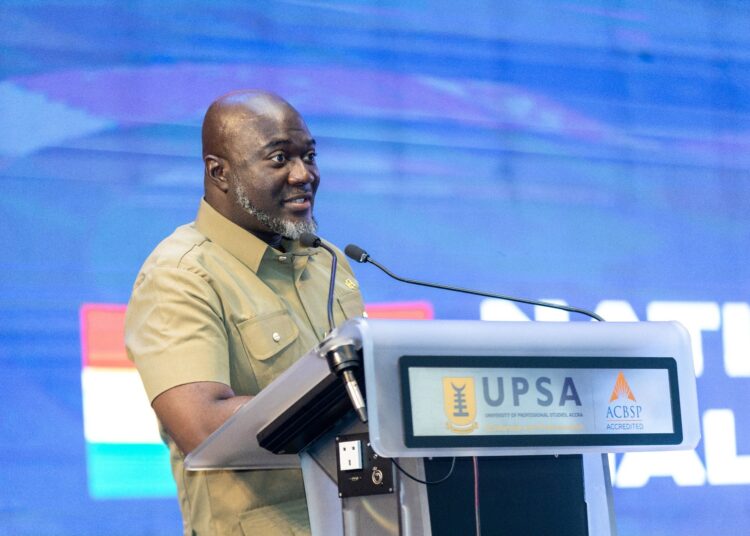
Duncan Amoah, the Executive Secretary of the Chamber of Petroleum Consumers (COPEC), has defended a strategic proposal to reduce fuel prices by GH¢1.65 per litre, arguing that a balanced reduction across multiple levies is essential to prevent the collapse of critical state infrastructure.
This recommendation, born out of a joint consultation between COPEC, IMANI Africa, and the Institute for Energy Security, suggests that rather than scrapping specific taxes entirely which could paralyze the road and power sectors the government should implement “half-cuts” across the board.
By spreading the relief across the Unified Petroleum Pricing Fund (UPPF), the BOST margin, and the Energy Sector Recovery Levy, the proposal seeks to provide immediate financial breathing room for consumers while ensuring the state retains the revenue necessary to manage the energy debt and maintain road networks.
“We said that, look, take out some minimum portions of it, of everything, so that cumulatively you can be able to give the consumer something. But the government of the day should also not suffer a collateral consequence because of the tensions in the Gulf. People can squeeze within the period, but still be able to at least execute whatever mandate that they need to.”
Duncan Amoah, the Executive Secretary of the Chamber of Petroleum Consumers (COPEC)

Duncan Amoah noted that an indiscriminate removal of taxes would likely lead to a “collateral consequence” where essential services suffer a total shutdown within a matter of weeks.
The current global tensions in the Gulf have placed immense pressure on local pump prices, prompting the coalition of think tanks to advocate for a two-month relief period rather than the four-week window initially considered by the government.
By reducing the 12-pesewa BOST margin to 6 pesewas and slashing the 90-pesewa UPPF by half, the plan ensures that transporters can still afford to distribute fuel across the country while primary infrastructure funds remain solvent.
Amoah emphasized that this middle-ground approach allows the government to procure light crude oil for power plants and continue fixing road infrastructure via the Road Fund, even as it grants the public a cumulative reprieve.
The Risk of Indiscriminate Tax Scrapping

The primary danger of completely eliminating specific petroleum taxes lies in the immediate evaporation of dedicated funding for the power and transport sectors.
If the government were to “take off some taxes entirely,” as Amoah warned, the lack of revenue for the Energy Sector Levy Act (ESLA) would jeopardize the procurement of fuel for thermal plants, potentially plunging the nation back into “dumsor” (intermittent power outages).
Furthermore, the Road Fund Levy is the lifeblood of highway maintenance; removing it would halt ongoing repairs, leading to long-term economic damage that far outweighs the short-term relief at the pump.
The coalition’s research suggests that a total scrap of these levies would leave a gaping hole in the budget that the state cannot currently fill without further borrowing.
Protecting the Logistics and Power Value Chain

To maintain the stability of the fuel market, the proposal specifically targets the Unified Petroleum Pricing Fund (UPPF) and the Fuel Marking Margin.
The UPPF is critical for ensuring that fuel is sold at uniform prices across Ghana by subsidizing the transport of products to remote areas.
By opting to “put half of it back in the pockets of the people,” the think tanks ensure that transporters are still paid enough to keep the supply chain moving.
Without these “minimum portions” being left intact, fuel shortages could arise in the northern regions of the country, creating a secondary crisis of availability that would drive up black-market prices and negate any tax-related savings for the average consumer.
A Fair Compromise Amid Global Volatility

Duncan Amoah was candid in his assessment, stating that while the GH¢1.65 reduction is “fair,” it is not a “magic bullet” that will “entirely fix the challenges” currently facing the energy sector.
The goal is to manage the “tensions in the Gulf” and the resulting price spikes without bankrupting the agencies that keep the lights on.
By adjusting contractual issues like the Fuel Market Programme and reducing the dumsor levy from one cedi to 50 pesewas, the proposal creates a “squeezing” period for both the state and the consumer.
This shared burden is designed to last for the next two months, providing a bridge of stability until global oil markets hopefully stabilize and the pressure on the cedi subsides.
READ ALSO: IMF Sees Tough Road for Global Economy