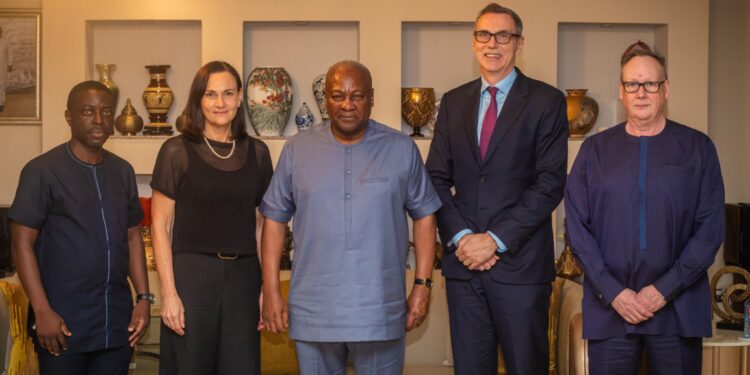
Newmont Corporation President and Chief Executive Officer, Natascha Viljoen, spearheaded a high-level executive delegation to Accra to reinforce the mining giant’s long-term investment strategy in Ghana during a consultative meeting with President, His Excellence John Dramani Mahama.
Accompanied by Chief Sustainability and Development Officer Peter Toth and Newmont’s Ghana regional leadership, the visit served as a critical platform to align the company’s Ahafo North expansion and existing operations with the government’s renewed focus on industrialization and local content.
The dialogue, which included U.S. Chargé d’Affaires Rolf Olson, centered on the collaborative necessity of a “stable and predictable regulatory environment” to ensure that the extractive sector remains a primary engine for Ghana’s macroeconomic stability and community development.
“We also highlighted the importance of a stable and predictable regulatory environment that enables continued investment and sustainable operations. We thank President Mahama and Chargé Olson for their time and constructive dialogue as we continue advancing safe, responsible mining in Ghana.”
Newmont Corporation

Building on more than two decades of successful operations within the West African nation, Viljoen and her team utilized the engagement to reaffirm Newmont’s role as a cornerstone of the Ghanaian economy.
The presence of Peter Toth underscored the company’s commitment to integrating ESG (Environmental, Social, and Governance) principles directly into the mining lifecycle, particularly as President Mahama pushes for a “technology-driven and locally owned sector” through his recently outlined six strategic pillars.
By engaging both the Presidency and the U.S. diplomatic mission, Newmont Corporation highlighted the importance of bilateral cooperation in securing sustainable operations.
The discussions aimed to bridge the gap between large-scale foreign direct investment and the President’s vision of moving Ghana “beyond exporting raw minerals” toward a future of value addition and enhanced local capacity.
“We reaffirmed the strength of our partnership and our shared commitment to a mining sector that drives economic growth, supports responsible development, and creates lasting value for communities,” Newmont declared.
Strengthening the Framework for Responsible Mining
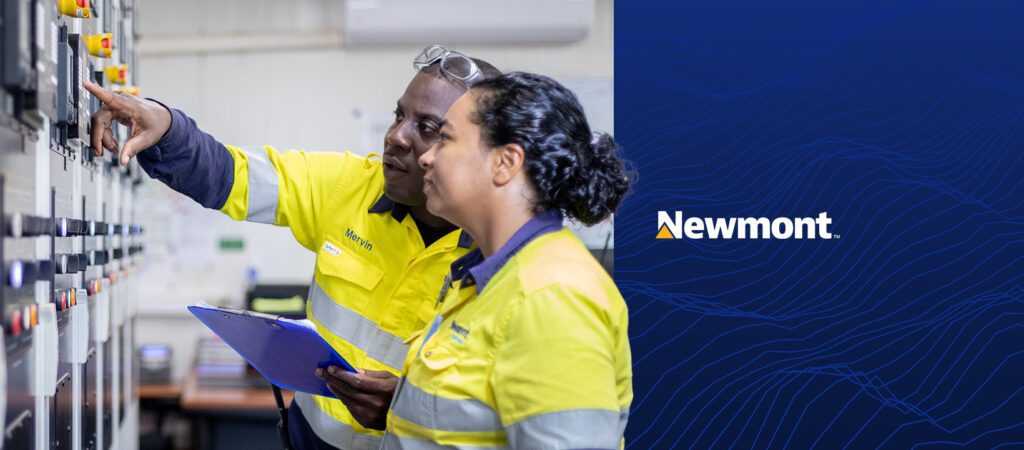
The engagement between Newmont’s leadership and the Ghanaian presidency is poised to significantly strengthen the domestic mining industry by synchronizing corporate strategy with national policy.
By advocating for a “stable and predictable regulatory environment,” Newmont is essentially seeking a “common ground” that allows for the massive capital injections required for projects like the Ahafo North expansion, which recently achieved commercial production.
Such stability is the bedrock of responsible mining, as it allows companies to commit to long-term social responsibility projects and environmental reclamation plans that shorter-term, volatile environments often discourage.
Furthermore, this high-level meeting acts as a catalyst for value creation beyond the pit.
When a global leader like Newmont aligns with a government’s local content agenda, it signals to the broader market that international standards and national aspirations are not mutually exclusive.
This synergy is expected to bolster the responsible development of the sector by ensuring that the transfer of technology and the empowerment of local enterprises become standard operating procedures rather than peripheral corporate initiatives.
Driving Economic Growth through Strategic Partnerships

Economic resilience in Ghana’s extractive sector depends heavily on the “continued investment” of tier-one operators.
The visit by Natascha Viljoen her first major regional engagement since becoming CEO sends a powerful message to investors regarding Newmont’s shared commitment to Ghana’s mineral wealth.
By maintaining an open line of communication with President Mahama, Newmont ensures that its operations, which contribute significantly to the country’s GDP and export earnings, remain insulated from the “arbitrary policy shifts” that can sometimes plague resource-rich nations.
The inclusion of the U.S. Chargé d’Affaires, Rolf Olson, further cements the “extractive partnership” as a matter of international importance.
This diplomatic layer provides an additional “safety net” for sustainable operations, encouraging a mining culture that prioritizes safety and transparency.
As Ghana strives to eliminate raw ore exports within the next decade, Newmont’s established infrastructure and “long-life assets” at Ahafo and Akyem provide the necessary scale to support the President’s vision of mineral-based industrial clusters and localized processing.
Creating Lasting Value for Host Communities
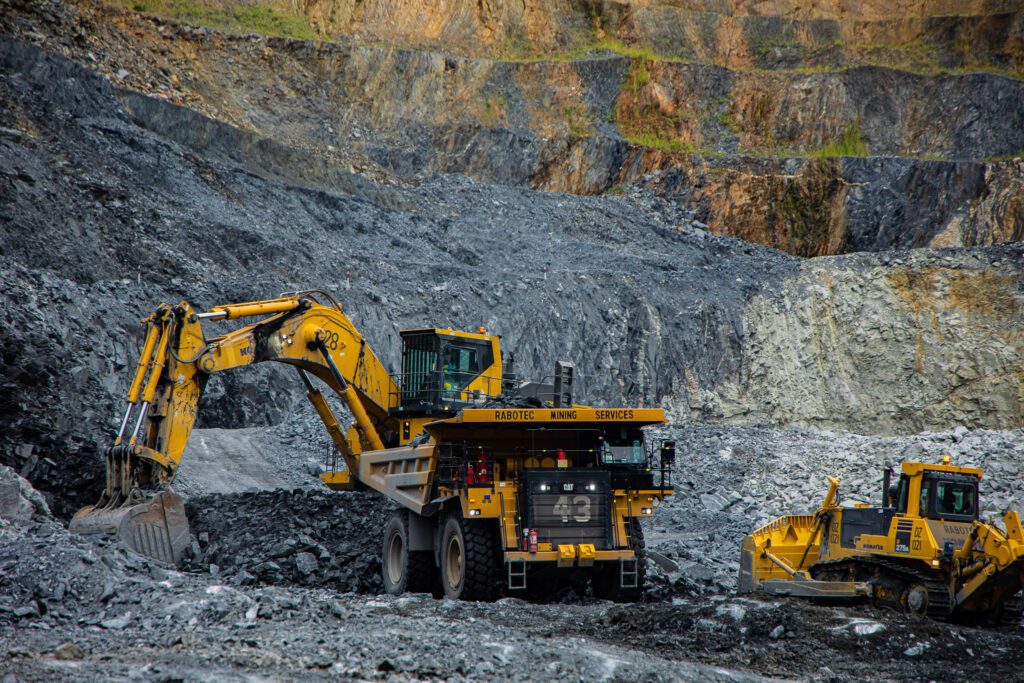
At the heart of the Accra deliberations was the creation of lasting value for the people living in the shadow of the mines.
Newmont’s leadership emphasized that for mining to be truly sustainable, it must leave a legacy that outlives the gold deposits.
This involves a shift from “transactional procurement” to “transformational partnerships,” where the mining company acts as a development partner rather than just a taxpayer.
This engagement reinforces a framework where “community engagement” is not just a regulatory hurdle but a core business strategy.
READ ALSO: MoGCSP Marks International Day For Street Children, Calls for Protection