
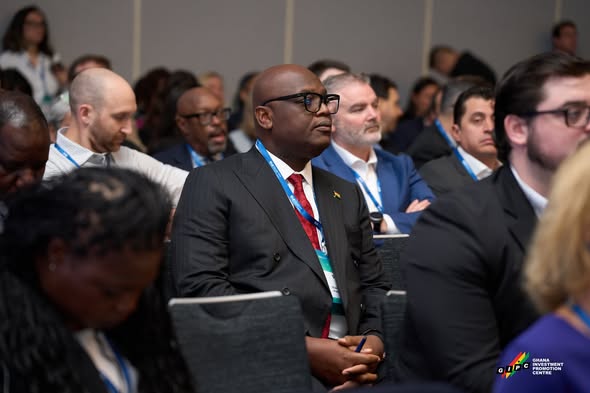
The global stage for commercial diplomacy has been set in Philadelphia, Pennsylvania, as the 56th World Trade Center Association (WTCA) Global Business Forum recently convened a powerhouse assembly of over 90 nations.
Within this high-stakes environment, the Chief Executive Officer of the Ghana Investment Promotion Centre (GIPC), Mr. Simon Madjie, delivered a masterclass in regional positioning, firmly establishing Ghana as the preeminent entry point for the broader African market.
According to the Ghana Investment Promotion Centre, Taking the podium as the only African nation to deliver a dedicated investment pitch, Mr. Madjie signaled not only Ghana’s competitive readiness but its intent to lead the continent’s industrial narrative in 2026.
“Speaking on a high-level panel on investment gateways, workforce development, and cross-border collaboration, Mr. Madjie outlined Ghana’s strong trade and investment frameworks, including AfCFTA, AGOA, ECOWAS, and the Ghana-EU and UK-Ghana Interim Trade Partnership Agreements, which collectively provide investors with expanded access to regional and international markets”
Ghana Investment Promotion Centre
The Philadelphia forum was a gathering of significant geopolitical and economic weight, featuring dignitaries such as the Chinese Ambassador to the United States, H.E. Xie Feng, and Philadelphia Mayor Cherelle Lesley Parker, alongside high-ranking officials from the US Department of State.
The Centre noted that Mr. Madjie’s presentation was anchored in the reality that in the modern global economy, a country’s value is increasingly measured by its connectivity. Ghana’s strategic advantage is no longer just its internal stability, but its role as a “super-connector” that bridges the gap between Western capital and the vast consumer markets of the African continent.
Central to this positioning is Ghana’s sophisticated trade architecture. Mr. Madjie meticulously outlined how the country leverages a suite of interlocking frameworks to offer investors unparalleled regional access, creating a low-friction ecosystem for international trade.
This framework ensures that an investment made in Accra is effectively an investment in a market of 1.3 billion people, protected by a network of international legal and commercial standards.
Fundamental Shifts
A defining moment of the forum was the announcement of the Ghana Investment Promotion Authority (GIPA) Bill, 2026 – a fundamental legislative leap that represents how the state manages foreign direct investment.
The GIPC CEO explained that by transitioning from a “Centre to an Authority,” the GIPA Bill introduces rigorous reforms aimed at institutionalizing investor confidence and drastically improving the ease of doing business. The new Authority is expected to wield greater regulatory autonomy, allowing it to streamline bureaucratic hurdles and provide a more robust shield for investor rights.
This move is a clear signal that Ghana is moving beyond traditional promotion toward a more authoritative and protective regulatory environment that meets the expectations of the most discerning global investors.
The industrial focus of the GIPC’s pitch was equally forward-looking, targeting sectors that are currently redefining the global supply chain. Mr. Madjie highlighted the emerging opportunities in pharmaceuticals, electric vehicles (EVs), and the digital economy.
As Ghana continues to build its capacity as a regional manufacturing hub, these sectors represent the highest growth potential for high-impact capital. The push for electric mobility, in particular, aligned with the global shift toward green technology, while the pharmaceutical drive addressed the urgent need for regional health sovereignty.
Through these alignments, the GIPC seeks to maintain Ghana’s relevance as a highly competitive destination for modern capital. This came on the heels of Ghana-US trade relations discussion, which was a recurrent theme throughout the forum.

Mr. Madjie noted that the bilateral relationship is moving beyond general trade into specific, high-value collaborations in the energy and agribusiness sectors. This is particularly significant given the forum’s location in Philadelphia, a historic center of American commerce.
The engagement served to reassure US investors that Ghana provides a stable, predictable, and highly rewarding environment for their capital, backed by a government that is actively legislating in favor of private sector growth.
The Future of African Trade
GIPC emphasized that the strategic brilliance of Ghana’s participation in Philadelphia lies in its exclusivity. As the only African country to deliver a dedicated investment pitch, Ghana effectively captured the undivided attention of the global business community in what was not merely a presentation, but a demonstration of leadership.
While many nations speak of potential, Ghana presented a concrete roadmap of legislative reforms, regional integration, and sectoral prioritization, with the message delivered by Mr. Madjie being that the country is not waiting for the future of African trade – it is actively building the infrastructure to host it.
As the forum concluded, the consensus among global policymakers and investors was clear: Ghana’s competitive edge is sharpened by its institutional maturity and its relentless focus on industrial value addition.
The GIPA Bill, 2026, will undoubtedly be viewed as a watershed moment in the nation’s economic history, providing the legal backbone for a new era of investment. With the GIPC at the helm, Ghana is successfully navigating the complexities of global trade, transforming itself from a promising market into an indispensable global partner.
Ultimately, the Philadelphia engagement reinforced the idea that Ghana is the gateway through which the world will engage with the African continent.

Through the strategic use of trade frameworks and a proactive legislative agenda, the GIPC ensured that the Ghanaian advantage was understood in the boardrooms of Philadelphia, Washington, and beyond.
READ ALSO: GoldBod Initiates Procurement of National Traceability System