

A new poll by Global InfoAnalytics has revealed a significant shift in the internal dynamics of the National Democratic Congress ahead of the 2028 elections, with Dr Cassiel Ato Forson emerging as a clear frontrunner in key swing regions.
The analysis, presented by Mussa Dankwah, highlights growing support for Ato Forson across Greater Accra, Central, and Western regions, traditionally considered decisive in national elections.
According to the data, Ato Forson commands 33 percent support in these regions, nearly double the 17 percent recorded by Johnson Asiedu Nketia. Other contenders trail behind, with Vice President Jane Naana Opoku-Agyemang securing 9 percent and Haruna Iddrisu polling 14 percent.
A notable 24 percent of respondents remain undecided, indicating that the race is still open despite Ato Forson’s early advantage. Mussa Dankwah noted that the findings reflect a growing consensus among voters on leadership direction within the NDC.
“For the first time, we are seeing convergence between NPP and NDC voters on who should lead the NDC,” he explained, pointing to a rare alignment across party lines.
Cross Party Appeal and Voter Alignment
The poll shows that Ato Forson’s appeal extends beyond the NDC base. Among New Patriotic Party voters, 16 percent expressed preference for him, compared to 12 percent for Asiedu Nketia.

Support for other candidates among NPP voters remained relatively low, with Jane Naana Opoku-Agyemang at 5 percent and Haruna Iddrisu at 8 percent. Within the NDC itself, Ato Forson leads with 41 percent, significantly ahead of Asiedu Nketia’s 22 percent.
Haruna Iddrisu follows with 18 percent, while Jane Naana Opoku-Agyemang records 12 percent. The data suggests that Ato Forson has consolidated a strong base within his party while also attracting interest from outside it.
Among floating voters, who often play a decisive role in elections, Ato Forson again leads with 29 percent, compared to 15 percent for Asiedu Nketia. His dominance is even more pronounced among respondents who declined to disclose their party affiliation, where he records 34 percent against Asiedu Nketia’s 9 percent.
Head to Head Contest Reveals Wider Gap
The poll also examined a direct contest between Ato Forson and Asiedu Nketia, a scenario widely seen as a defining battle for the party’s future. In this head to head matchup, Ato Forson’s lead expands significantly, with 45 percent support compared to 20 percent for Asiedu Nketia.
This represents a 25 point gap, underscoring what Dankwah described as a decisive shift in voter sentiment. Ato Forson’s support increases by 12 points from the broader race, while Asiedu Nketia gains only 3 points, suggesting limited room for growth.
The pattern is consistent across voter categories. Among NDC supporters, Ato Forson’s numbers rise from 41 percent to 56 percent, a 15 point increase, while Asiedu Nketia moves from 22 percent to 24 percent.
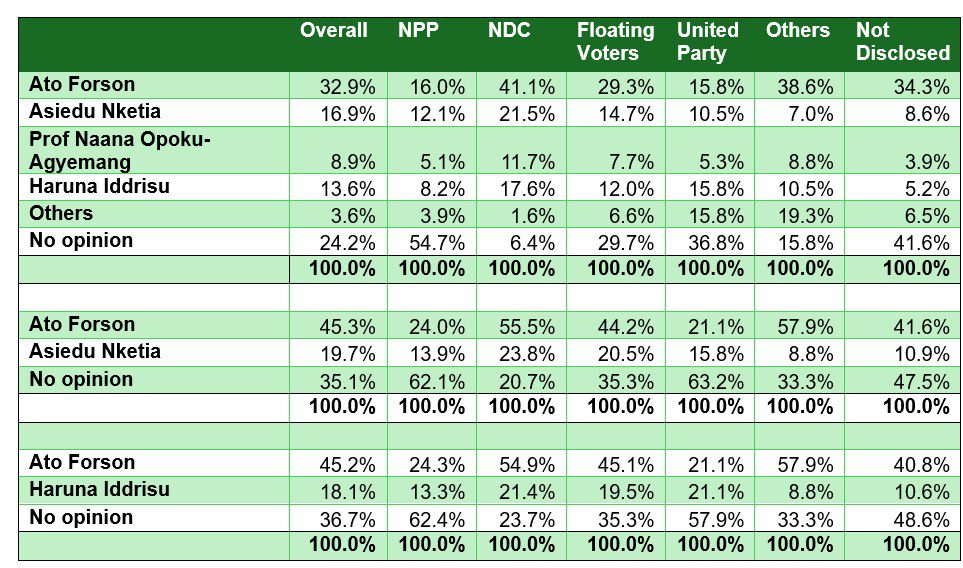
Among floating voters, Ato Forson climbs from 29 percent to 44 percent, again a 15-point jump, compared to a 6-point increase for Asiedu Nketia.
Dankwah indicated that these trends may point to a ceiling in Asiedu Nketia’s support base. The relatively small increase in his numbers, even in a direct contest, suggests that he may be nearing his maximum level of voter acceptance.
Implications for NDC Leadership Contest
The findings by the Global InfoAnalytics suggest that Ato Forson’s candidacy is gaining momentum across different segments of the electorate, positioning him as a leading contender for the NDC’s 2028 ticket.
His ability to attract support from undecided voters and those outside the party base could prove crucial in a competitive national election. At the same time, the data indicates challenges for Asiedu Nketia, whose support appears more limited in comparison.
The fact that many voters who initially preferred other candidates do not shift significantly toward him in a head to head scenario highlights potential vulnerabilities.
The presence of a large undecided group also means that the race remains fluid. With 24 percent of respondents yet to form a clear opinion, there is still room for shifts in voter preference as the contest evolves.
A Competitive Road Ahead
Mussa Dankwah described the emerging contest as one that will likely intensify over time. “The NDC race is looking very interesting from a polling perspective, and we are in for a long haul,” he said, suggesting that further developments could reshape the dynamics.

The data points to a potentially competitive and unpredictable internal contest, with multiple factors likely to influence the final outcome. Campaign strategies, party unity, and broader national issues may all play a role in determining who eventually leads the NDC into the 2028 election.
For now, however, the poll provides a snapshot of a race in which Ato Forson holds a clear advantage, particularly in critical swing regions. As the political landscape continues to evolve, the coming months are expected to bring further clarity to what is shaping up to be a closely watched leadership battle.
READ ALSO: US Likely To Resume Bombing Iran As Ceasefire Nears End