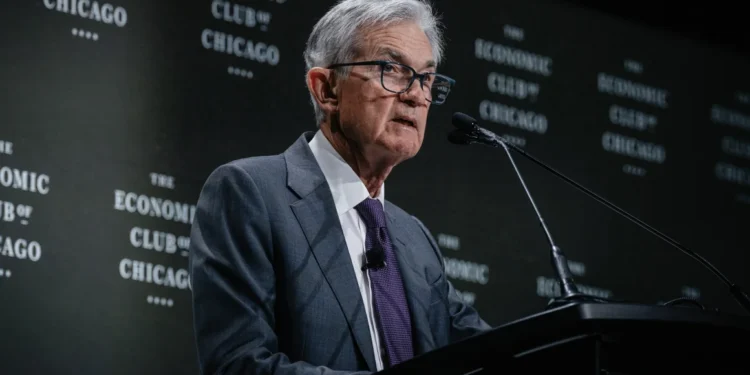
The Justice Department has ended its probe into Federal Reserve Chair Jerome Powell.
US Attorney for the District of Columbia Jeannine Pirro said on X that her office was ending its probe into the Fed’s extensive building renovations because the Fed’s Inspector General would scrutinize them instead.
In January, Powell disclosed that the Department of Justice has served the central bank with subpoenas and threatened it with a criminal indictment over his testimony this summer about the Fed’s building renovations. The move marked an unprecedented escalation in President Donald Trump’s battle with the Fed, an independent agency he has repeatedly attacked for not cutting its key interest rate as sharply as he prefers.

The subpoenas relate to Powell’s testimony before the Senate Banking Committee in June, the Fed Chair said, regarding the Fed’s $2.5 billion renovation of two office buildings, a project that Trump has criticized as excessive.
The day before, Powell cast off what had up to that point been a restrained approach to Trump’s criticisms and personal insults, which he has mostly ignored. Instead, Powell issued a video statement in which he bluntly characterized the threat of criminal charges as simple “pretexts” to undermine the Fed’s independence when it comes to setting interest rates.
“The threat of criminal charges is a consequence of the Federal Reserve setting interest rates based on our best assessment of what will serve the public, rather than following the preferences of the President.
“This is about whether the Fed will be able to continue to set interest rates based on evidence and economic conditions — or whether instead monetary policy will be directed by political pressure or intimidation.”
Jerome Powell
The investigation was among several undertaken by the Justice Department into Trump’s perceived adversaries. For months it had failed to gain traction as prosecutors struggled to articulate a basis to suspect criminal conduct.

A prosecutor handling the case conceded at a closed-door court hearing in March that the government hadn’t yet found any evidence of a crime, and a judge subsequently quashed subpoenas issued to the Federal Reserve. The judge, James Boasberg, said prosecutors had produced “essentially zero evidence” to suspect Powell of a crime. Boasberg branded prosecutors’ justification for the subpoenas as “thin and unsubstantiated.”
More recently, prosecutors made an unannounced visit to a construction site at the Fed’s headquarters but were turned away, drawing a rebuke from a defense attorney in the case who called the maneuver “not appropriate.”
The decision to abandon the investigation represents a rare pullback for a Justice Department that over the last year has moved aggressively, albeit unsuccessfully, to prosecute public figures the president does not like.
Justice Department Decision Clears Roadblock To Powell’s successor’s Confirmation
The decision also clears a major roadblock to the confirmation of Powell’s successor, Kevin Warsh.
The move could lead to a swift confirmation vote by the Senate for Warsh, a former top Fed official whom President Donald Trump, a Republican, nominated in January to replace Powell. Powell’s term as Chair ends May 15. Senator Thom Tillis, a North Carolina Republican, had said that he would oppose Warsh until the investigation was resolved, effectively blocking his confirmation.
With the investigation completed, the leadership transition at the world’s leading central bank may proceed quickly. Republicans praised Warsh during a Tuesday hearing even as Democrats questioned his independence from Trump, the lack of transparency around some of his financial holdings, and what they said was his flip-flopping on interest rates. Still, Trump’s previous appointment to the Fed’s Board of Governors, Stephen Miran, was approved by the full Senate just 13 days after his nomination.
Warsh said during the Senate hearing on Tuesday that he never promised the White House that he would cut interest rates, even as the President renewed his calls for the central bank to do so. “The President never once asked me to commit to any particular interest rate decision, period,” Kevin Warsh, a former top Fed official, said under questioning by the Senate Banking Committee. He added, “Nor would I ever agree to do so if he had. … I will be an independent actor if confirmed as Chair of the Federal Reserve.”