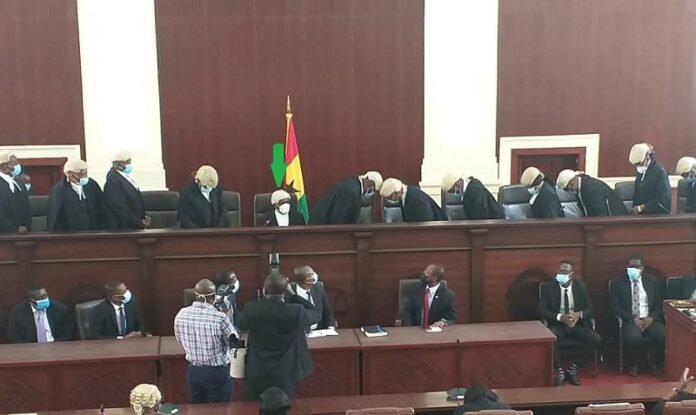
A seven-member panel of Ghana’s Supreme Court, chaired by Chief Justice Paul Baffoe-Bonnie, has granted an application by 14 civil society organisations seeking to join an ongoing constitutional case challenging the prosecutorial powers of the Office of the Special Prosecutor.
The case, filed by private citizen Noah Adamtey against the Attorney General, questions the constitutionality of aspects of the Office of the Special Prosecutor and its authority to prosecute corruption-related offences.
The decision by the apex court allows a coalition of governance and accountability focused organisations to formally participate in proceedings and present arguments that they believe are currently absent from the legal debate before the court.
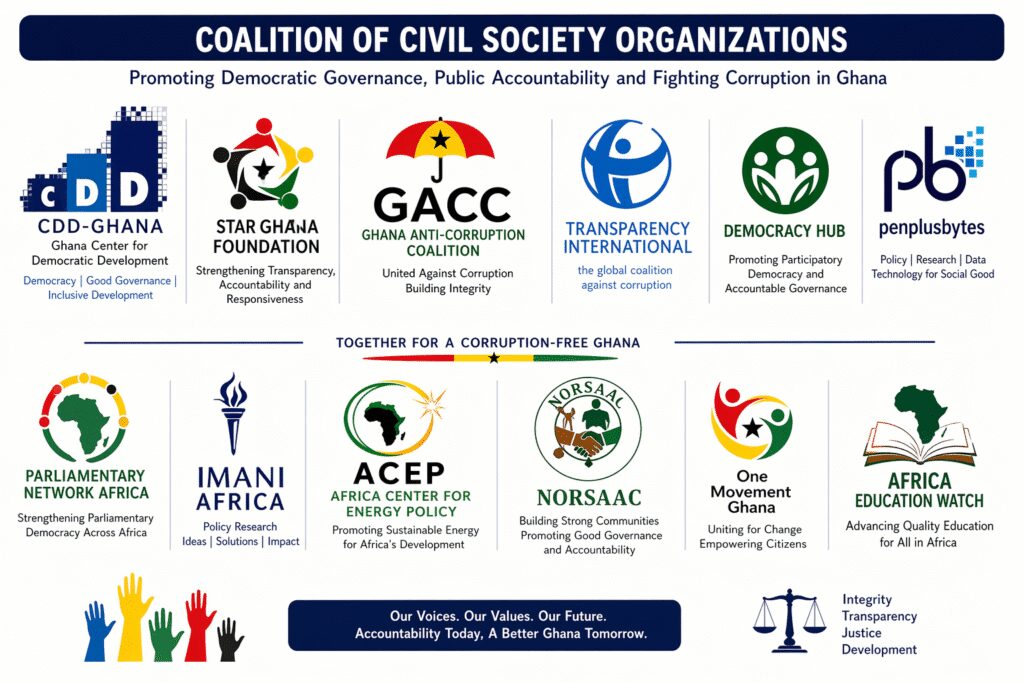
The coalition includes several prominent policy and governance institutions in Ghana, among them CDD-Ghana, Transparency International Ghana, Ghana Anti-Corruption Coalition, STAR-Ghana Foundation and Democracy Hub.
Other members of the coalition include NORSAAC, Penplusbytes, the Africa Center for Energy Policy, Odekro Parliamentary Monitoring Organization, A Rocha Ghana, Parliamentary Network Africa, IMANI Africa, the One Ghana Movement and Africa Education Watch.
Lawyers Explain Purpose of CSO Intervention
Following the court proceedings, private legal practitioner Samson Lardy Anyenini, who is part of the legal team representing the coalition, explained that the participating organisations believe the court would benefit from perspectives that have not yet been fully addressed in the ongoing arguments.
He stated that the intervention is intended to assist the court in reaching what the Chief Justice described as a lasting solution to the constitutional questions raised in the case.
“As you heard the lead counsel, Kizito Beyuo Esq, clearly put before the court, we believe that the court deserves a certain view that is currently missing in the argument.
“And thankfully, as you heard my Lords, they have read the brief, and they appreciate that it is important and it will help the court to come to, as his Lordship said, the Chief Justice said, a lasting solution”.
Samson Lardy Anyenini
Lawyer Samson Anyenini described the ruling admitting the CSOs into the case as positive news for the legal team and the organisations involved.

Coalition Seeks Historical and Interpretative Review
Another member of the coalition’s legal team, Clement Kojo Akapame, stated that the organisations are participating in the case as neutral actors rather than as parties pursuing political interests.
He explained that the coalition intends to assist the court by presenting historical context surrounding the establishment of the Office of the Special Prosecutor and by raising interpretative constitutional issues that may be relevant to the final determination.
“As you heard our lead counsel, senior Kizito Beyuo Esq, we are appearing before the court on behalf of these 14 NGOs as neutrals and as neutrals to bring a certain perspective to the case”.
Clement Kojo Akapame
Lawyer Akapame added that the legal team intends to present detailed arguments before the court in due course, but declined to disclose the substance of those arguments publicly ahead of the formal proceedings.
“So our main argument is for the court to look at the history on the establishment of this office. And we are calling the court’s attention to some interpretative matters that they will also need to look at”.
Clement Kojo Akapame
He further explained that the coalition did not want to litigate the matter in the media before filing its complete submissions before the Supreme Court.
Legal Team and Broader Significance
The coalition is being represented by a legal team that includes Kizito Beyuo, Oliver Barker Vormawor, Samson Lardy Anyenini and Clement Kojo Akapame.
The constitutional challenge is attracting national attention because of the significant role played by the Office of the Special Prosecutor in Ghana’s anti corruption framework.
Established to independently investigate and prosecute corruption related offences, the office has become one of the country’s key accountability institutions in recent years.
The case before the Supreme Court is expected to test important constitutional questions surrounding prosecutorial authority, institutional independence and the legal structure of anti corruption enforcement mechanisms.
The participation of multiple civil society organisations also highlights the broader public interest attached to the outcome of the proceedings, particularly among governance and transparency advocates.
Focus on Accountability and Constitutional Clarity
The intervention by the CSO coalition could widen the scope of legal arguments before the court by introducing policy, historical and governance perspectives beyond the immediate legal dispute between the parties.
The organisations involved have long been active in public accountability, democratic governance and anti corruption advocacy, making their participation significant within the broader national conversation on institutional reforms.
As the case progresses, attention is expected to remain focused on how the Supreme Court interprets the constitutional provisions governing the powers of the Office of the Special Prosecutor and the implications such a ruling may have for Ghana’s anti corruption architecture.
READ ALSO: Ghana Champions Regional Power Interconnection at 2026 Africa Energy Conference