
The Volta Regional Minister, Hon. James Gunu, has officially launched the Nkoko Nkitinkiti Programme in the Volta Region under the Government’s flagship Feed Ghana Programme, signaling a major policy shift toward community-based agricultural production and localized import substitution.
Speaking in the regional capital, the Minister detailed that the initiative serves as an operational instrument designed to revitalize the domestic poultry value chain while creating immediate employment opportunities for local families and young entrepreneurs.
In tandem with this agricultural rollout, Hon. Gunu completed a high-level working visit to Volo in the North Tongu District to inspect ongoing private-sector agro-industrial expansions, reinforcing the region’s position as a primary investment destination under the state’s ongoing industrialization framework.
“This initiative is more than a poultry project – it is a practical tool for reducing poverty, creating jobs, improving household incomes, and strengthening food security. With 180,000 day-old chicks allocated to the region, many families and young entrepreneurs will have the opportunity to build sustainable livelihoods through poultry farming”
Hon. James Gunu, Volta Regional Minister
According to Hon. Gunu, the distribution of the day-old chicks marks the localized implementation of a national movement aimed at curbing the substantial foreign exchange leak caused by poultry imports in the Volta Region.
Currently, domestic production satisfies only a minimal fraction of national meat demand, creating a structural reliance on imported frozen products that drains hundreds of millions of dollars from Ghana’s economy annually.
The Feed Ghana Programme intends to re-establish localized production centers. This approach builds a secure foundation for rural household incomes while ensuring consistent access to essential protein sources.

Culturally, the architecture of the Nkoko Nkitinkiti initiative draws directly upon historical socio-economic practices embedded within local communities. In many rural settlements across the Volta Region, small-scale animal husbandry has traditionally functioned as an informal insurance mechanism against sudden economic shocks or unexpected household expenditures.
Scaling this customary practice into a formalized, state-supported economic program, beneficiaries will receive specialized training in biosecurity protocols, vaccine administration, and feed management to ensure low mortality rates and maximize productivity at the landing points.
“The programme resonates with our traditional way of supporting families in times of need, where the sale of a few chickens could help address immediate household challenges. In many ways, Nkoko Nkitinkiti is a revival of that age-old poverty reduction strategy”
Hon. James Gunu, Volta Regional Minister
The decentralization of the bird allocation ensures that inputs are channeled directly through the region’s municipal and district assemblies, fostering a transparent distribution framework that prioritizes youth and women-led enterprises.
This structural arrangement allows localized agricultural extension officers to monitor the health and growth metrics of the poultry flocks in real time, establishing a continuous data pipeline back to the regional coordinating council to assess the program’s macroeconomic impact on rural poverty indices.
Agro-Industrial Interventions
Beyond micro-level household interventions, the regional administration is actively aligning public policy with large-scale private investments to build a comprehensive agro-industrial ecosystem.
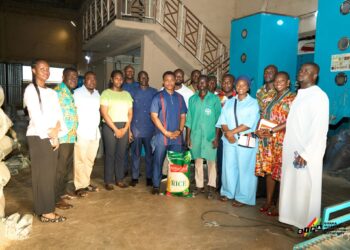
At Volo in the North Tongu District, Hon. James Gunu, accompanied by the District Chief Executive, Hon. Victoria Amefadzi Doe, and the Chief Director of the Volta Regional Co-ordinating Council (VRCC), Mohammed Avorna Akape, conducted an extensive assessment of Hari Agro Feed and Foods.

The high-level delegation, which included senior representatives from the 24-Hour Economy Secretariat and Fidelity Bank, evaluated the company’s current operational footprint and its long-term industrialization strategies.
“The Managing Director, Hari K. Vallurupalli, took us on a tour of the farms and shared the company’s vision of expanding agricultural production and establishing a sugar factory as part of a broader agro-industrial transformation agenda”
Hon. James Gunu, Volta Regional Minister
The assessment at the Volo facility focused primarily on the advantages of an integrated production model that completely eliminates waste across the processing cycle, as the agribusiness operates a closed-loop system where the byproducts of one processing phase serve as direct inputs for subsequent manufacturing lines, significantly reducing operating expenditures and optimizing raw material usage.
The proposed establishment of a modern sugar factory within the North Tongu basin is a major expansion of this model, promising to generate hundreds of direct factory jobs, integrate thousands of local outgrower farmers into a stable supply chain, and substitute imported sugar with premium domestic alternatives.
Through bringing banking executives and state policy coordinators directly onto the factory floor, the regional coordinating council is facilitating targeted commercial partnerships that de-risk agribusiness infrastructure investments.
This financial coordination is intended to allow local enterprises to expand their working shifts, maximize capacity utilization, and meet rising urban consumer demand under the 24-Hour Economy framework. For Hon. Gunu, these agricultural and industrial initiatives form the operational baseline for a broader spatial development strategy across the region.
“The Volta Region continues to position itself as Ghana’s preferred investment destination. Through the Volta Economic Corridor Project and the Government’s 24-Hour Economy agenda, we are unlocking opportunities in agriculture, agro-processing, aquaculture, tourism, and job creation”
Hon. James Gunu, Volta Regional Minister

As the distribution of the 180,000 day-old chicks commences across the respective district assemblies and the planning phases for the North Tongu sugar factory progress, the Volta Regional Co-ordinating Council expects a measurable shift in localized macroeconomic indices.
The integration of household poultry production with large-scale industrial manufacturing is expected to create a resilient dual-track economy that insulates rural populations from systemic shocks.
READ ALSO: Coordinated Evacuation Efforts Shielded Ghanaians From Frustration— Quashie