Africa’s quest for economic transformation may find its strongest catalyst in an industry that has long remained underutilized despite its immense potential.
The maritime sector, according to the Ghana Export-Import Bank (GEXIM), holds the key to unlocking industrial growth, export expansion, job creation and continental competitiveness.
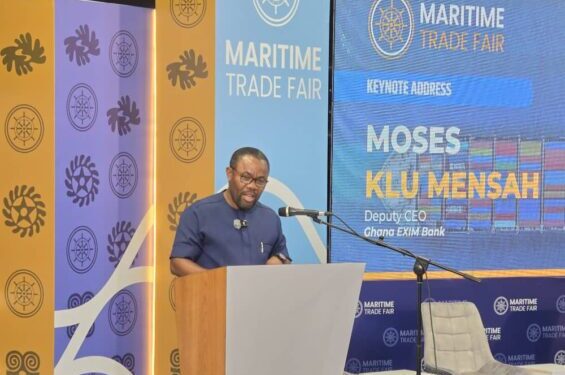
This bold vision was articulated by the Deputy Chief Executive Officer in charge of Banking at GEXIM, Moses Klu Mensah, during the opening of the Maritime Trade Fair in Accra. Speaking on behalf of GEXIM Chief Executive Officer Sylvester Adinam Mensah, he outlined what many industry observers are calling a practical blueprint for accelerating Africa’s economic future through strategic investments in maritime infrastructure, technology, logistics and finance.
Maritime Sector at the Center of Economic Growth
Addressing regulators, financiers, insurers, technology providers and logistics operators gathered at the event, Mr. Mensah emphasized that the maritime economy should no longer be viewed merely as a transport sector but rather as a strategic platform that drives industrialization and international trade.
He explained that maritime activities connect producers to markets, facilitate exports and imports, support manufacturing and influence the overall cost of doing business. As African countries seek to maximize opportunities under the African Continental Free Trade Area (AfCFTA), the efficiency of ports, shipping systems and logistics networks will increasingly determine their competitiveness.
According to him, countries that fail to strengthen their maritime ecosystems risk losing valuable trade and investment opportunities to more prepared economies.
Finance Remains the Missing Link
One of the most critical issues highlighted by GEXIM was access to finance.
Mr. Mensah noted that every participant in the maritime value chain, from exporters and freight forwarders to logistics firms, insurers, warehousing companies and technology providers, requires adequate capital to expand operations and improve efficiency.
He stressed that institutions such as GEXIM have an important responsibility beyond simply providing funding. They must also help businesses become export-ready, improve operational standards and position themselves to compete effectively in global markets.
The call comes at a time when many African businesses continue to face financing constraints that limit their ability to scale and take advantage of growing regional and international trade opportunities.
Technology Emerging as a Game Changer
Beyond infrastructure and financing, technology was identified as a powerful force capable of transforming Africa’s maritime landscape.
Mr. Mensah pointed out that digital solutions can significantly improve cargo tracking, customs processing, payment systems, insurance verification and access to trade information.
Such innovations can reduce delays, lower transaction costs and increase transparency across the supply chain. “The future of maritime trade will belong to countries that combine physical infrastructure with digital capability,” he stated.
His remarks reflect a growing global trend where digitalization is becoming essential for enhancing port efficiency and improving the movement of goods across borders.
Ghana Positioned to Lead
GEXIM believes Ghana is uniquely positioned to play a leading role in Africa’s maritime future.
The country’s strategic geographical location, political stability and ongoing investments in port infrastructure provide a strong foundation for growth. However, Mr. Mensah stressed that sustained investment in logistics, industrial value chains and maritime infrastructure will be necessary to fully capitalize on these advantages.
He also called for stronger alignment between regulation, infrastructure development and investment policies to eliminate bottlenecks and facilitate smoother trade flows throughout the region.
Such measures, he argued, would not only benefit Ghana but also contribute significantly to broader continental economic integration.
Maritime Industry Undergoing Rapid Transformation
Adding her voice to the discussion, Executive Director of Whitestone Shipbrokers, Gertrude Adwoa Ohene-Asienim, noted that the maritime industry is currently experiencing significant transformation driven by technological innovation, sustainability demands and evolving trade patterns.
She observed that digital platforms, fintech solutions, automation and smart logistics systems are rapidly reshaping the sector and creating new opportunities for African businesses.
According to her, the Maritime Trade Fair serves as a critical platform for fostering dialogue, innovation and collaboration among stakeholders while promoting practical solutions to industry challenges.
Investing in People for Long-Term Success
Mrs. Ohene-Asienim also emphasized that infrastructure and technology alone cannot secure Africa’s maritime future.
She highlighted the importance of capacity development and inclusion, particularly for women and young professionals entering the sector. She argued that sustainable growth will depend on developing a new generation of skilled leaders capable of driving innovation and managing the evolving demands of the maritime economy.
Her call for stronger partnerships among government institutions, academia, industry players and the private sector resonated strongly with participants seeking a more coordinated approach to sector development.
A Defining Moment for Africa
Africa’s economic transformation will require more than ambitious policies and trade agreements. It will demand strategic investments in maritime infrastructure, digital innovation, financing and human capital.
With trade becoming increasingly global and competitive, the maritime sector is emerging as one of the most powerful tools available to drive industrialization, create jobs and strengthen regional integration.
All in all, the future belongs to nations that recognize the maritime economy not as a supporting industry but as a cornerstone of economic prosperity and sustainable development.
READ ALSO: Ecobank Approves $40m Dividend After Three-Year Pause