
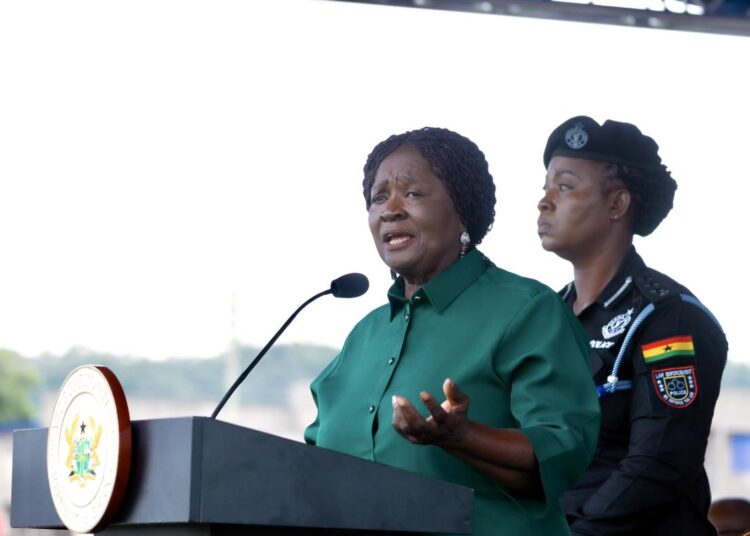
The Vice President Professor Jane Naana Opoku-Agyemang joined a broad gathering at Banda Ahenkro, a town in Ghana’s Bono Region, to mark the 47th anniversary of the June 4, 1979 uprising.
The event brought together government officials, leaders and members of the National Democratic Congress (NDC), representatives of the security services, religious leaders, and other citizens.
The commemoration formed part of national efforts to reflect on a defining moment in Ghana’s political history that continues to shape discussions on governance, accountability, and democratic development.
The June 4, 1979 uprising is historically linked to the actions led by June 4th Uprising, associated with Flight Lieutenant Jerry John Rawlings. The event led to the overthrow of the Supreme Military Council II government and ushered in a period of military-led transition that remains widely debated in Ghana’s political discourse.
Governance and Accountability Agenda
In her remarks at the event, the Vice President emphasized the importance of balancing historical reflection with national progress. She stated, “while history carries difficult lessons that we must not lose sight of, we must also highlight how far we have come so that we are encouraged to do even better.”

She explained that the current administration’s approach to governance is anchored in institutional efficiency and accountability. According to her, as part of efforts described as a reset agenda for Ghana, the Mahama Government has been structured to reduce administrative bloat while strengthening efficiency in public service delivery.
She further noted that this approach is designed to preserve the core pillars of democratic governance and accountability. The remarks reflected a broader policy direction aimed at reinforcing public trust in state institutions while ensuring that governance structures remain responsive to national needs.
The Vice President stressed that efficiency in government must go hand in hand with transparency and responsibility, particularly in a democratic setting where citizens expect accountability from their leaders.
Reflecting on the June 4 Legacy
The June 4 uprising remains a significant and complex moment in Ghana’s history. It followed a period of political instability marked by economic challenges, allegations of corruption, and dissatisfaction within sections of the military.
The events led to the formation of the Armed Forces Revolutionary Council, a military governing body that took control following the overthrow of the Supreme Military Council II led by General Fred Akuffo.

The aftermath of the uprising included a controversial period of what was described as a “house-cleaning” exercise, which saw the execution of senior military officials, including former heads of state Ignatius Kutu Acheampong and Fred Akuffo.
Despite its contentious nature, the period is also noted for its eventual commitment to transitioning power to civilian rule, culminating in the handover to President Hilla Limann following the 1979 elections.
While interpretations of the uprising vary, it remains a reference point in discussions about probity, accountability, and integrity in public life. Its legacy continues to influence political thought, particularly within movements and parties that trace aspects of their ideological foundations to the events of that period.
Call for Citizen Participation
The Vice President used the occasion to encourage active citizen engagement in national development. She noted that Ghana’s progress depends not only on government action but also on the participation of all citizens in shaping the country’s future.

She stated, “We still have far to go as a nation. We continue to encourage every citizen to play an active role in building the Ghana we all want.” Her remarks underscored the idea that national transformation requires shared responsibility between leadership and the public.
She emphasized that civic participation remains essential to sustaining democratic gains and ensuring that accountability is not limited to institutions alone but is also reinforced by citizen oversight and involvement.
The commemoration at Banda Ahenkro therefore served both as a moment of historical reflection and as a platform for reaffirming contemporary governance priorities centered on accountability, efficiency, and civic responsibility.
READ ALSO: Low Market Share in Hundred Billion Dollar Chocolate Sector Triggers Call for Change