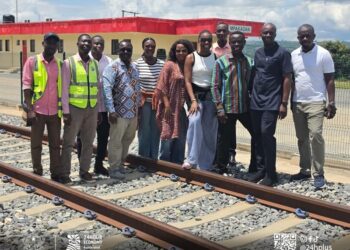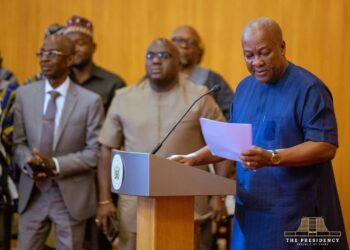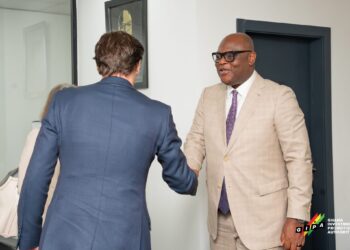

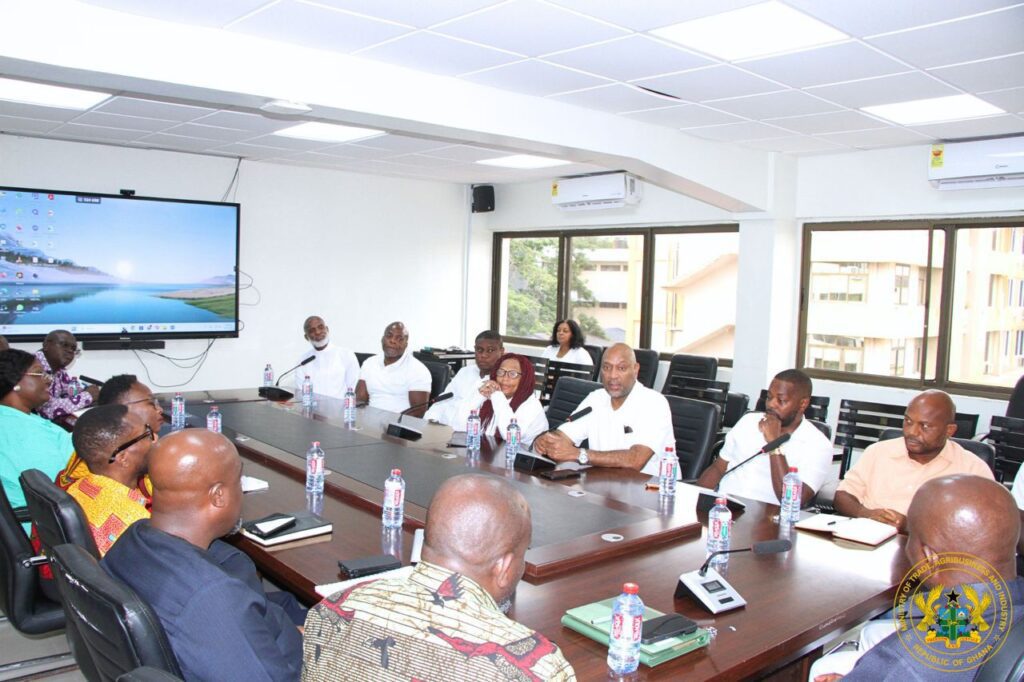
A high-level delegation of United States investors led by the Mayor of Newark, New Jersey, Ras J. Baraka, has met with Ghana’s Deputy Minister for Trade, Agribusiness and Industry, Hon. Sampson Ahi, to secure direct private capital partnerships across the West African sub-region.
According to the Ministry of Trade, Agribusiness and Industry (MoTAI), the executive briefing provided American asset managers with a firsthand understanding of Ghana’s macroeconomic operating environment while establishing formal, multi-sector trade links between the city of Newark and the Ghanaian state.
Welcoming the corporate delegation on behalf of the President of the Republic, John Dramani Mahama, and the substantive Minister for Trade, Agribusiness and Industry, Elizabeth Ofosu-Adjare, Hon. Ahi, emphasized Ghana’s institutional readiness to protect and support incoming foreign capital.
“Hon. Ahi highlighted Ghana’s stable democratic governance, peaceful business environment, and strong economic fundamentals, describing the country as an attractive destination for investors seeking opportunities in West Africa and the broader African continent”
Ministry of Trade, Agribusiness and Industry
The delegation traveled to Accra at the invitation of the Ga Mantse, with their itinerary strategically timed to coincide with the annual celebrations of the Ga State Festival. This highlights a growing trend within Ghana’s trade architecture, where cultural and historical diaspora connections are being systematically converted into hard commercial partnerships.

By embedding institutional investment exploration directly into the fabric of regional cultural events, trade planners are creating alternative, high-trust entry pathways for foreign direct investment (FDI).
The Ministry’s presentation focused heavily on Ghana’s long-standing reputation as a secure financial haven within the Economic Community of West African States (ECOWAS), leveraging its historical stability to attract risk-conscious institutional investors.
MoTAI’s primary pitch focused on the structural safety and long-term predictability of the domestic market.
For American fund managers looking to diversify their portfolios into emerging African economies, the risks associated with political volatility often act as a significant barrier. Hon. Ahi addressed these concerns directly by showcasing the country’s reliable legal frameworks and resilient underlying economic fundamentals.
Leveraging the AGOA Framework
A key component of the bilateral trade talks centered on the recent extension of the African Growth and Opportunity Act (AGOA). This federal legislative framework, by the United States government, grants eligible sub-Saharan African nations duty-free market access for thousands of qualifying products.
The Ghanaian government views the continuation of this agreement as a powerful incentive for American companies looking to set up manufacturing hubs within West Africa, establishing domestic processing plants and manufacturing bases inside Ghana’s specialized industrial zones.
Hon. Ahi noted that American investors can legally bypass restrictive tariff systems, allowing corporations to source raw agricultural and industrial inputs locally, add significant value through domestic manufacturing, and export finished consumer goods directly back into the United States retail markets with substantial tax advantages.
This approach directly supports the state’s current import-substitution policy, which aims to minimize the export of raw materials and build robust domestic manufacturing capabilities. The Ministry also steered the delegation’s attention toward three foundational pillars of the current national development agenda: agribusiness, energy, and infrastructure.
MoTAI highlighted the government’s active search for private capital to scale up mid-stream value addition in the agribusiness landscape, particularly in food processing, automated cold-chain logistics, and modern warehousing facilities designed to drastically cut post-harvest losses across rural farming communities.
In the energy and infrastructure sectors, the demand for sustained capital injection remains high. As industrial processing zones expand across the country, the need for stable, scalable power grids and modernized transport corridors becomes increasingly critical.
The Deputy Minister encouraged the American financial representatives to move past short-term commercial trading and instead focus on funding long-term, high-yield infrastructure projects that can support regional supply chains.
Responding on behalf of the visiting financial delegation, Mayor Ras J. Baraka expressed deep appreciation for the structured institutional reception provided by the ministry, reaffirming the American group’s commitment to building mutually profitable corporate partnerships that respect local economic goals while delivering consistent returns for investors.
The Mayor emphasized that Newark’s business community possesses significant capital reserves and technical expertise that can be successfully deployed to support Ghana’s industrialization agenda.

To maintain the momentum generated during this state visit, Mayor Baraka extended a formal invitation to the leadership of the Ministry of Trade, Agribusiness, and Industry to lead a Ghanaian trade delegation to an upcoming Festival and Business Summit.
Scheduled to take place in New York this coming October, the high-level summit will serve as the next major operational milestone for this commercial partnership, bringing together top-tier business executives, private equity investors, and international policymakers from both nations to sign definitive trade agreements and finalize capital allocations for the 2027 fiscal year.
READ ALSO: Ko-Jo Cue: Music as Lifelong Search for Purpose and Healing