Ghana’s economic recovery story has been one of resilience, discipline, and renewed optimism. Inflation has dropped sharply, foreign reserves have strengthened, and economic growth has regained momentum. Yet beneath these encouraging indicators lies a stubborn challenge that threatens to undermine the country’s long-term development agenda.
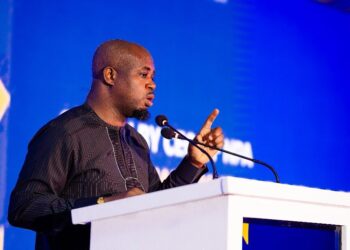
Deputy Managing Director for Operations and Support Functions at Fidelity Bank Ghana, Atta Yeboah Gyan, has raised concerns about what he describes as a significant disconnect between the sectors powering Ghana’s economy and the sectors receiving access to formal credit.
Speaking on the need for structural reforms within the financial system, Mr. Gyan argued that the gains made through macroeconomic stabilization will mean little if productive sectors continue to struggle for capital.
According to him, Ghana has successfully navigated one of the most difficult economic periods in its recent history. However, the next phase of development will depend on how effectively financial resources are directed toward businesses and industries that create jobs, generate exports, and drive inclusive growth.
Strong Economic Indicators Hide Structural Weaknesses
Mr. Gyan acknowledged the impressive progress made by the economy in recent months. Ghana recorded real GDP growth of 6 percent in the fourth quarter of 2025, while inflation fell dramatically from 23.8 percent in December 2024 to 5.4 percent by the end of 2025.
The country’s gross international reserves also climbed to US$13.9 billion as of April 2026, providing import cover of 5.5 months and strengthening confidence in the economy.
Despite these achievements, Mr. Gyan cautioned that major structural weaknesses remain unresolved.
One of the most striking examples is agriculture. The sector played a leading role in expanding Ghana’s trade surplus by 26 percent year-on-year to US$5.28 billion in April 2026. Yet it continues to face severe financing challenges.
The sector’s non-performing loan ratio stood at an alarming 54.7 percent as of February 2026, highlighting the difficulties banks face in extending credit while also exposing the risks confronting agricultural enterprises.
“There is a fundamental mismatch between where our export strength comes from and where our credit is going,” Mr. Gyan emphasized.
The Trust Deficit Holding Back Growth
At the center of the challenge, according to Mr. Gyan, is a trust deficit that exists on multiple levels.
The first dimension is structural. Traditional credit assessment models often fail to capture the realities of Ghana’s economy, particularly among smallholder farmers, informal businesses, and entrepreneurs who lack conventional financial records.
As a result, millions of economically active Ghanaians remain invisible to formal lending institutions despite operating viable businesses.
The second dimension is historical. Public confidence in financial institutions was significantly affected by the 2017 and 2018 banking sector cleanup as well as the Domestic Debt Exchange Programme. These events left lasting concerns among investors, businesses, and ordinary citizens.
“Building trust, in this environment, is a deliberate project. It requires showing up consistently. It requires making decisions that are good for the long term, even when they are harder in the short term.”
Atta Yeboah Gyan

Fidelity Bank Showcases Alternative Solutions
While acknowledging the scale of the challenge, Mr. Gyan pointed to several initiatives that demonstrate how targeted financing can unlock opportunities in underserved sectors.
Through the Mastercard Foundation’s BRIDGE-in-Agriculture programme, Fidelity Bank disbursed GH¢66.9 million last year. The funding supported 22,247 smallholder farmers, with women accounting for 62.4 percent of beneficiaries.
The programme also contributed to the creation of 12,912 new jobs while sustaining 11,566 existing jobs across agricultural value chains.
In the area of sustainability and climate innovation, the bank’s GreenTech Innovation Challenge awarded GH¢1.02 million in grants to 16 climate-smart enterprises in 2025.
Similarly, the Orange Corners Innovation Fund, supported by the Kingdom of the Netherlands, has disbursed GH¢9.83 million to more than 55 young entrepreneurs operating in agribusiness, technology, fashion, and creative industries. The initiative has generated over 1,000 jobs.
The Orange Inspire Creative Challenge has also provided GH¢550,000 in grants and concessionary loans to support Ghana’s growing creative economy.
“These are small numbers relative to the scale of the problem,” Mr. Gyan admitted. “But they represent a proof of concept that bankable models exist, and they need to be built and scaled.”
Three Bold Recommendations for the Future
To address Ghana’s financing challenges, Mr. Gyan proposed three key interventions.
First, he called for the creation of a co-designed risk-sharing framework involving government, commercial banks, and development finance institutions to support agricultural lending.
Second, he urged the financial sector to accelerate the adoption of alternative credit assessment tools that utilize mobile money records, supply chain information, and digital transaction histories.
Such innovations could unlock access to credit for thousands of entrepreneurs currently excluded from traditional lending systems.
Third, he advocated for greater use of patient capital, including grants, concessionary loans, and blended finance mechanisms. He stressed that such funding should be viewed as a strategic investment rather than charity.
A Defining Moment for Ghana
For Mr. Gyan, Ghana now stands at a critical crossroads.
The country has achieved a remarkable economic turnaround and restored stability after years of turbulence. However, the true measure of success will be determined by whether that stability translates into jobs, enterprise growth, and broad-based prosperity.
“Ghana has done something genuinely hard,” he said. “It came back from the edge. Now the question is what we build with the stability we have earned.”
All in all, economic stability alone is not enough. Unlocking capital for productive sectors could be the difference between a temporary recovery and a lasting transformation of Ghana’s economy.
READ ALSO: Health Minister Tasks Ghana Health Service to Lead Free Primary Healthcare Rollout