Bulgaria’s Defence Minister Dimitar Stoyanov has announced that the country will not send any more weapons to Ukraine.
Stoyanov told reporters in Sofia, “We have already made it clear that the war in Ukraine will not be resolved on the battlefield.”
“What we are witnessing is a war of attrition, and no matter how much weaponry is amassed, its only result is the loss of human lives. Ukraine needs more people, not more weapons. It has enough weapons, so we do not envisage providing more weapons to the Ukrainian army.”
Dimitar Stoyanov
The move cements the new Bulgarian government’s opposition to EU support for Ukraine after Prime Minister Rumen Radev won a parliamentary election in a landslide in April. Radev has, for years, been opposing arming Ukraine and calling instead for “diplomatic solutions.”
Bulgaria, which is member of NATO and the European Union, has been providing military aid Ukraine since Russia launched its full-scale invasion in 2022. The shipments of mostly Soviet-era weaponry played an important role at the early stages of the war.
Due to political controversies at home the shipments had been made mainly through third countries. Bulgaria has sent 13 aid packages to Kyiv since Russia’s 2022 full-scale invasion, but Radev has described the Ukrainian cause as “doomed.”
Radev, a former fighter pilot, has cited his military experience in support of his position that Ukraine should negotiate peace with Russia, and suggested in May that the EU should lead peace talks.
Stoyanov said that it was time to sit down at the negotiating table “to seek a just peace that is defined by both sides.”
He also cited the European Union’s role. “Of course, the role of the EU is extremely important,” he said, adding that “it would be difficult to assign this role to that of a mediator for the simple reason that the EU has also assisted Ukraine in its efforts in this war anyway.”
Additionally, Stoyanov announced that Bulgaria plans to increase defence spending to 5% of GDP by 2030. He explained that 3.5% of this amount consists of direct military expenditures, while 1.5% covers defence-related expenses such as infrastructure, cybersecurity, and other areas. “Last year, defence spending was 2.13% of GDP, this year, we hope it will be 2.15%,” Stoyanov said.
EU Announces New Russia Sanctions Package
Meanwhile, European Commission President Ursula von der Leyen unveiled the EU’s forthcoming 21st sanctions package against Russia at a press conference in Brussels.
The package comes amid rising global fossil fuel prices and will include a freeze on the current pricing mechanism for Russia energy imports until the end of 2026, meaning Moscow won’t be able to profit from rising prices resulting from the war on Iran. The measures also expand efforts to target third countries that help sustain Russia’s war machine.
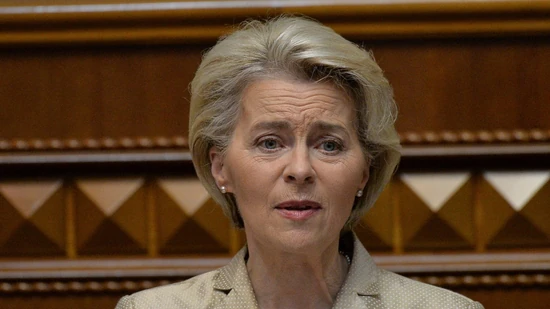
“The conflict in the Middle East and disruptions to global energy supply chains have eased some pressure on Russia. So the objective of our package couldn’t be clearer.”
Ursula von der Leyen
The EU’s top diplomat, Kaja Kallas, wrote on social media that the bloc’s diplomatic arm is “putting forward the largest set of listings in over two years, with over 170 proposals, notably on the financial sector, energy, and drones’ production.” Russian military personnel, both current and former, would also be denied entry to the EU if the proposal is approved by member states. “Europe’s door should not be open to Russia’s (ex-)combatants,” Kallas wrote.
The package also introduces new restrictions on crypto and financial services, including in third countries. For the first time, the EU is proposing a full ban on crypto-asset services linked to jurisdictions that facilitate sanctions evasion.
Von der Leyen said that this would serve as a deterrent for platforms enabling Russia to bypass restrictions. Even import restrictions and bans on Russian fish have been proposed for the first time. Those latter measures, like others, will also apply to Belarus, von der Leyen said, so as to prevent sanctions evasion via the Russia ally but otherwise landlocked nation.
On top of this, there will also be new sanctions against individuals, an additional 30 ships from the Russian shadow fleet that Moscow uses to bypass restrictions on energy exports, and new measures to punish vessels that offer ship-to-ship support to the shadow fleet.
Some sanctions are expected to be voted through formally at a meeting of EU Foreign Ministers in Luxembourg on June 15, while the rest could be formally adopted in July, if there is unanimity among EU countries.
READ ALSO: Disney Releases First Poster for Descendants: Wicked Wonderland Musical Sequel