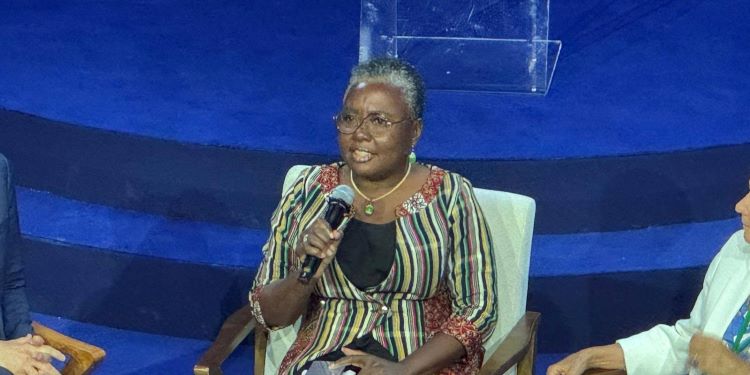
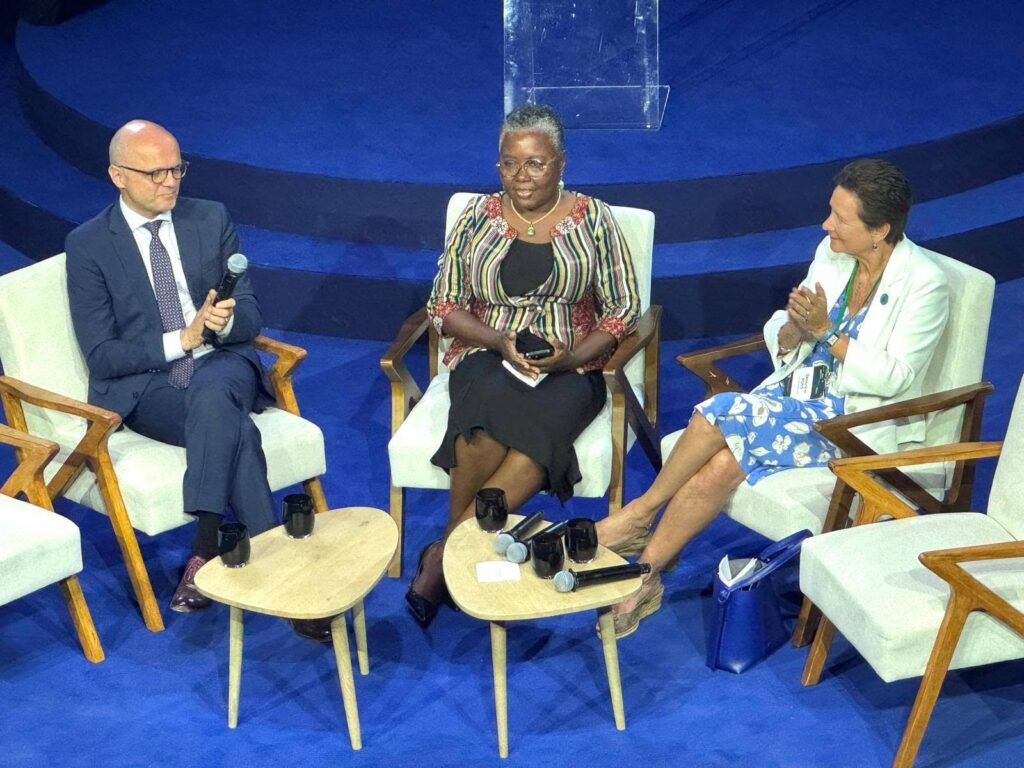
Ghana’s Minister for Fisheries and Aquaculture Development, Hon. Emelia Arthur, has delivered a definitive address directly challenging the foundational inequities of global marine management frameworks at the high-level Neptune Forum convened by Mission Neptune in Paris.
Confronting a global gallery of world leaders, marine scientists, international diplomats, and ocean advocates on World Oceans Day, Hon. Arthur introduced a rigorous West African perspective onto the forum’s core agenda, making it the epicenter of a profound diplomatic push for international maritime policy reform.
Speaking on the theme, “International Governance in a Fragmented World: Ocean Governance and Ghana’s Perspective,” the Minister clarified that the historical, extraction-heavy paradigms governing international waters have run their course, demanding an immediate transition toward an inclusive, science-driven, and legally equitable model of ocean sovereignty.
“She noted that while technological advancements have significantly improved humanity’s understanding of the ocean through real-time vessel monitoring, artificial intelligence, marine data collection, and seabed mapping, major challenges remain.
“These include declining fish stocks, threats to marine biodiversity, increasing vulnerability of coastal communities, and persistent maritime insecurity. The Minister emphasized that ocean governance must go beyond resource management and focus on equity, shared responsibility, and sustainable development”
Ministry of Fisheries and Aquaculture Development
For maritime nations like Ghana, ocean governance is not an abstract academic exercise or a secondary environmental concern, especially as the Atlantic coastline forms the foundational backbone of the state’s economic security, nutritional independence, historical legacy, and cultural identity.
As geopolitical fragmentation threatens to disrupt traditional multilateral systems, the domestic stability of developing coastal states hangs in the balance.

Hon. Arthur argued that global maritime policy must stop treating the ocean as a borderless commercial commons to be exploited by the highest bidder and start recognizing it as a shared ecological trust requiring mutual accountability.
Focusing on the technological disconnect currently defining international waters, and the accelerated deterioration of the of the marine biome, she noted that the advanced technological capabilities are completely insufficient if they exist within a broken regulatory vacuum.
Instead of using advanced data systems to equitably protect global resources, current frameworks allow advanced industrial economies to monopolize ocean data while doing little to halt the degradation affecting smallholder fishing communities.
Ghana’s position at the forum emphasized that real-time tracking and AI models must be coupled with strict legal enforcement and a commitment to shared global responsibility, transforming surveillance from a tool of passive observation into an active shield for vulnerable ecosystems.
Integrating the Blue Economy
To counter these transnational threats within its own economic zone, Hon. Arthur noted that Ghana is executing its comprehensive Blue Economy vision – an institutional rejection of uncoordinated, siloed approaches to marine preservation.
The framework seamlessly blends sustainable fisheries and modern aquaculture production with strict marine spatial planning, reinforced state enforcement mechanisms, and direct community stewardship, integrating local fishing cooperatives into the state’s regulatory enforcement architecture.
She explained that the Ministry for Fisheries and Aquaculture Development (MoFAD) is building a localized defense network to protect maritime resources from external predation.
This domestic framework is constantly challenged by the ongoing scourge of Illegal, Unreported, and Unregulated (IUU) fishing. In Paris, Minister Arthur elevated the fight against IUU fishing from a narrow environmental debate into an urgent matter of economic justice and national sovereignty.
“IUU fishing is not only an environmental concern but also a matter of economic justice, food security, and national sovereignty. Developing countries, particularly African coastal states, face disproportionate challenges in combating Illegal, Unreported and Unregulated fishing, requiring a fairer and more effective system of global ocean governance”
Hon. Emelia Arthur, Minister for Fisheries and Aquaculture Development
With foreign industrial fleets frequently exploiting local enforcement gaps across the Gulf of Guinea, depleting vital protein reserves, destroying the livelihoods of millions of artisanal fishers, and violating the territorial integrity of sovereign coastal states, the Minister insisted that global compliance mechanisms must be restructured to penalize these illicit industrial operations.
Framing ocean preservation as an inseparable component of global economic fairness, and providing a structured path forward for international maritime law, the Ghanaian delegation presented five core principles intended to form the baseline of future global ocean governance, pitching them as an interconnected philosophy of international cooperation.
The first principle, equity, demands that the financial profits generated by the global maritime economy are no longer extracted exclusively by wealthy nations, ensuring that coastal states receive fair compensation and protection.
This is tied directly to the second principle of stewardship, which replaces short-term exploitation models with a long-term commitment to ecological preservation. The third principle, scientific sovereignty, directly addresses the knowledge imbalance between the Global North and Global South.

Hon. Arthur argued that African states must stop acting as mere consumers of foreign oceanographic data and instead be supported with direct technology transfers and digital infrastructure investments to generate and apply their own marine insights.
The fourth and fifth principles focus on the human and security elements of ocean governance: the formal recognition of indigenous wisdom and the establishment of collective security, as indigenous coastal communities possess generations of sustainable conservation knowledge that must be integrated directly into high-tech modern policy design.
Anchoring its national agenda within this multi-layered framework, Ghana is redefining the expectations for international environmental diplomacy.
The Minister’s message at the Paris summit was clear: true ocean conservation cannot exist without institutional fairness, and multilateralism can only heal its current fractures when it respects the sovereignty and livelihoods of the people who live by the sea.
READ ALSO: Mahama Courts Belarusian Investment in Healthcare, AI and Infrastructure