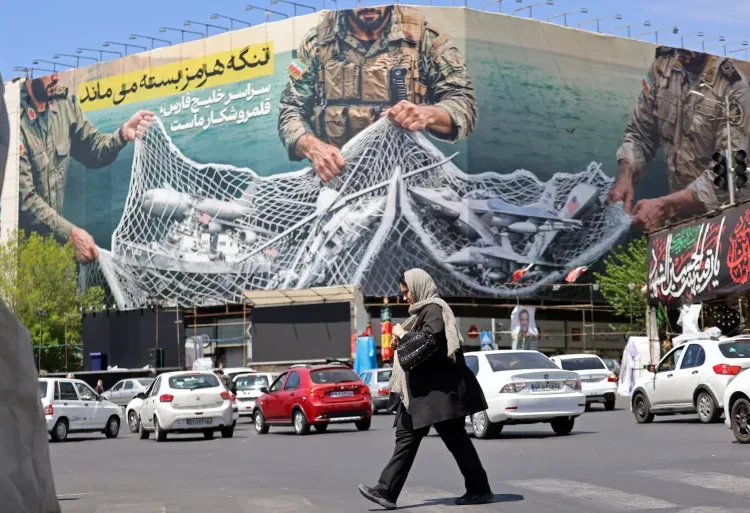
Iran has launched strikes on targets in Bahrain, Kuwait and Jordan, after the US struck Iranian sites near the Strait of Hormuz in what it said was retaliation for the downing of an Army Apache helicopter.
Iran’s Revolutionary Guards Corps (IRGC) said it launched missiles and drones on US targets early Wednesday morning. The IRGC said that it targeted a US military base in Jordan, the Ali Al Salem airbase in Kuwait, as well as the US Fifth Fleet in Bahrain. Sirens sounded in Kuwait, where authorities said they were intercepting “hostile aerial targets.”
It said it attacked 21 US targets and destroyed four of them, including an F-35 fighter jet hangar at the base in Jordan. It also claimed to have shot down a US MQ-9 drone in the skies over the Iranian city of Jam.
Jordan’s military said it intercepted five missiles from Iran, after Iran said it had targeted a US base in the Gulf nation. “We intercepted and downed five missiles launched from Iran toward Azraq,” said the General Command of the Jordanian Armed Forces in a statement, according to the state-run news agency.
The attack on Jordan appears to be the first time the Arab nation has been directly targeted since the ceasefire between the US and Iran came into effect in April. “The interception resulted in falling shrapnel, with no human injuries or material damage reported,” the statement said.
According to Iran’s state-affiliated news agency reports, Iran’s Revolutionary Guards said that they targeted a base at Al Azraq in northern Jordan with long-range solid-fuel missiles, saying they had destroyed hangars housing F-35 figher jet.
In February, the US deployed at least 18 US F-35 Lightning II stealth fighters to Muwaffaq Salti Air Base, near Al Azraq.
According to US Central Command (CENTCOM), the US military completed self-defense strikes against Iran in response to the downing of a US Apache helicopter. “CENTCOM forces struck Iranian air defense, ground control stations, and surveillance radar sites near the Strait of Hormuz with precision munitions from U.S. Air Force and Navy fighter jets,” CENTCOM said on X.

The US military said that the strikes mark a “proportional response” to recent attacks on US forces and international ships in regional waters.
After the US launched strikes, explosions were heard in Qeshm Island, Bandar Abbas, Sirik, Minab and Jask county; strategic locations around the Strait of Hormuz. Qeshm Island is considered part of Iran’s “arch defense” near the Strait of Hormuz. Bandar Abbas hosts a key Iranian naval and air base. Jask country also has a naval presence and is a home to a key shipping port.
The IRGC said that the US strikes allegedly damaged a communications tower in Sirik and destroyed two water reservoirs in the Bamani district.
Iran Calls U.S Strikes “Clear Violation” Of Sovereignty
Iran’s foreign ministry called the most recent US strikes on Iran a “clear violation” of the country’s national sovereignty and warned Middle Eastern countries hosting US troops that they might be targeted if Iran is attacked again.
The ministry statement said that Iran’s armed forces “inflicted heavy damage on US bases and assets in the region that served as the origin of these attacks,” adding that Iran “will not hesitate to target the source of attacks.”
The ministry said in a separate statement that Iran’s Foreign Minister, Abbas Araghchi held phone calls with his counterparts in Saudi Arabia and Turkey following the US attacks.

The Ministers, according to a report, reviewed the latest regional developments following the US attacks on areas in southern Iran. During these conversations, Araghchi condemned the US military aggression and the violation of Iran’s national sovereignty and territorial integrity.
He also emphasised the inherent right of Iran’s legitimate self-defence and the launch of retaliatory responses by Iran’s armed forces against aggressors.
Progress towards a peace deal remains slow, complicated further by Israel’s intensifying campaign in Lebanon against the Iranian-backed Hezbollah.
READ ALSO: Four National Development Plans Gather Dust as NDPC Pushes for Action