The Tree Crops Development Authority (TCDA) has aggressively scaled up its sub-national stakeholder mobilization efforts to diversify the country’s foreign exchange streams away from a historical over-reliance on cocoa, and transform the Ghana’s non-traditional agricultural export sector.
The Chief Executive Officer of the TCDA, Dr. Andy Osei Okrah, recently led a high-level institutional delegation to the Savannah Region, executing a critical working tour designed to align regional political leadership with grassroots agricultural production networks.
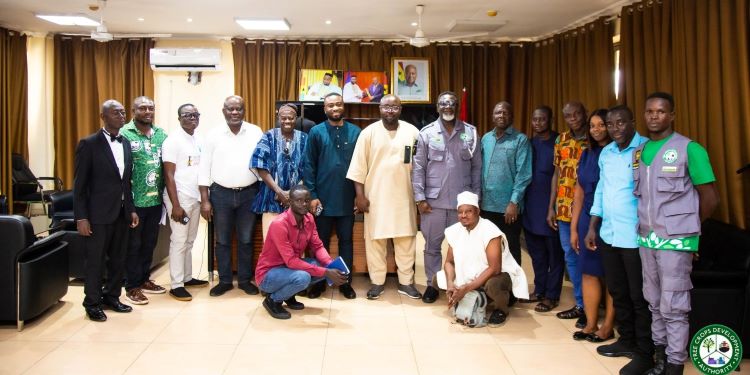
Centered in Damongo, the high-stakes tour included a formal courtesy call on the Savannah Regional Minister, Hon. Salisu Bi-Awuribe, followed by a town hall style engagement with local shea and cashew smallholders, signaling a new era of strict regulatory enforcement and state-backed supply chain optimization.
“The engagements formed part of the Authority’s commitment to strengthening partnerships and advancing the development of Ghana’s tree crops sector, particularly within the Savannah Region, which holds significant potential for the production of shea, cashew, and mango.
“During the meeting with the Regional Minister, discussions focused on strategic collaboration to expand tree crop production, attract investment, create employment opportunities, and improve livelihoods across the region”
Tree Crops Development Authority
The Savannah Region represents one of Ghana’s most vital ecological assets for non-cocoa agricultural industrialization. Its vast, arid arable land tracks possess optimal soil and climatic baselines for the cultivation of high-value tree crops, most notably cashew, shea, and mango.

Recognizing this latent economic power, the TCDA’s strategic mission aimed to build a unified framework linking state regulatory mechanisms directly with local government machinery and smallholder co-operatives.
This linkage is viewed by economic planners as an essential prerequisite for attracting commercial capital, de-risking the local agricultural supply chain, and establishing sustainable, poverty-reducing employment corridors throughout the northern vegetative belts.
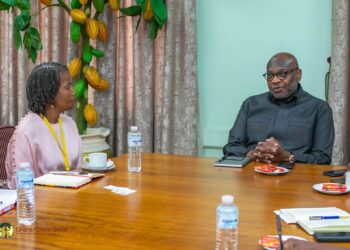
The primary political milestone of the working tour was reached during the bilateral consultation between Dr. Andy Osei Okrah and the Regional Minister, Hon. Salisu Bi-Awuribe. The dialogue focused heavily on removing the geographical and administrative bottlenecks that frequently isolate rural producers from centralized regulatory state organs.
To resolve this structural divide, the TCDA and the Regional Ministry agreed to collaborate on the immediate establishment of a dedicated TCDA Regional Office within the Savannah Region.
This infrastructure expansion will decentralize the authority’s operational footprint, bringing essential technical services, licensing protocols, and extension services directly to the doorsteps of local actors.
Embedding a permanent administrative apparatus in Damongo, the TCDA aims to accelerate localized service delivery and provide real-time data collection on crop yields, disease outbreaks, and market pricing anomalies.
Hon. Salisu Bi-Awuribe praised the authority’s decentralization strategy, noting that regional economic transformation requires direct institutional visibility. The regional government pledged to provide institutional support to ensure the new office has the political and logisitical backup necessary to execute its mandate without facing local bureaucratic delays.

Traceability and Compliance
During the high-level briefing with regional authorities, Dr. Okrah provided a clear overview of the TCDA’s statutory mandate, which covers the regulation, production, processing, and international trading of six highly profitable cash crops: cashew, coconut, oil palm, rubber, mango, and shea.
For Ghana to capture premium pricing structures within European and North American markets, the domestic industry must strictly adhere to international transparency and traceability standards.
To achieve this, the TCDA is implementing a comprehensive registration and licensing regime to map out every single actor along the value chain, from rural smallholders to urban aggregators and global exporters. This push for strict regulatory compliance was described as a critical defensive measure against market manipulation and product adulteration.
Dr. Okrah noted that enforcing uniform quality metrics and licensing buyers eliminates predatory middle-men who often exploit isolated farmers by underpaying for raw commodities.
Furthermore, robust traceability mechanisms ensure that Ghanaian tree crop exports can confidently clear international biosecurity and environmental regulations, safeguarding the country’s macro-export reputation.
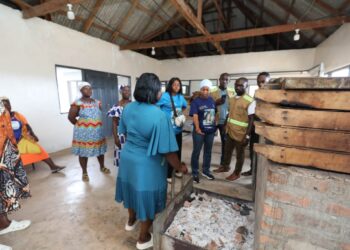
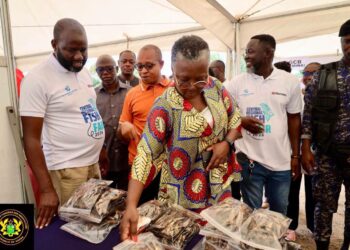
Moving from the regional administrative tables to direct grassroots dialogue, the TCDA Boss held an open forum with shea and cashew farmers in Damongo, where the rural producers strongly supported the Authority’s regulatory interventions, actively calling for even stricter enforcement of industry guidelines to protect their investments from illegal cross-border smuggling and localized market price fixing.
However, the farmers also highlighted major logistical and operational challenges that continue to limit their daily productivity, specifically pointing to an acute shortage of mechanized processing equipment and protective farming tools.

A major focus of the grassroots meeting centered on the specific economic needs of women workers, who form the backbone of the local shea nut collection and processing sector.
Traditionally, women collectors walk long distances in hazardous bush environments to gather wild shea nuts, processing them using labor-intensive, manual methods that limit output and lead to physical exhaustion. The local cooperatives made a strong appeal for targeted investments in mechanized processing units, specialized storage facilities, and protective gear.
Responding directly to these community concerns, Dr. Okrah gave a firm assurance that the TCDA is actively structuring targeted interventions to deliver modern agricultural tools and value-addition technology, ensuring that rural women retain a much larger share of the profits generated by the global shea cosmetics market.
The strategic tour concluded with a clear demonstration of institutional solidarity and public-private sector alignment. In recognition of his proactive leadership style and his clear commitment to structural agricultural reforms, Dr. Andy Osei Okrah was presented with a formal Citation of Honour.
The award was delivered on behalf of the national agricultural community by Hon. Iddrisu Sumani, the Founder and CEO of Bunyanso Farms Limited and current President of the West Gonja District Co-operative Farmers and Marketing Union Ltd.
READ ALSO: Government Unveils “No Life Jacket, No Journey” to Curb Boat Accidents