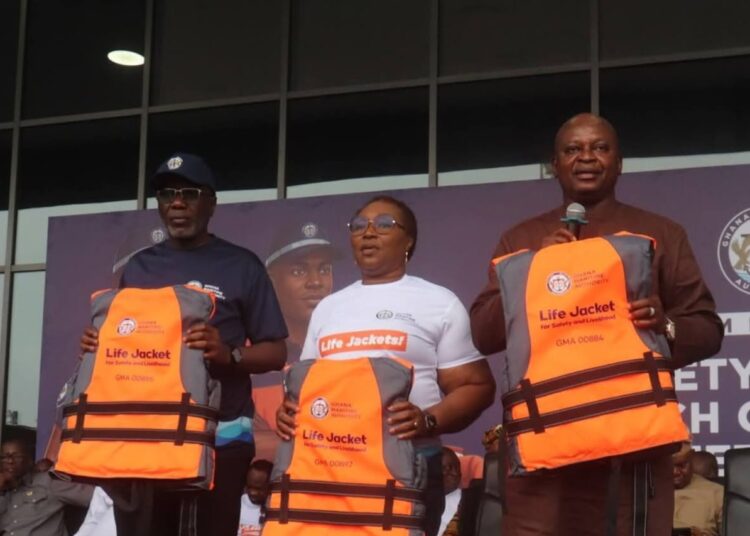
The Government of Ghana has launched a major intervention aimed at reducing fatalities on the country’s inland water bodies, with the commissioning of 200 Safety Guards and the rollout of a nationwide Life Jackets for Safety and Livelihoods Programme.
The initiative, spearheaded by the Ministry of Transport and implemented through the Ghana Maritime Authority, forms part of renewed efforts to strengthen safety compliance in communities that rely heavily on water transport for their daily livelihoods.
Announcing the initiative, the Minister for Transport, Hon. Joseph Bukari Nikpe, said the government was shifting from awareness campaigns to strict enforcement measures designed to save lives.
“…I officially commissioned the Safety Guards and launched the Life Jackets for Safety and Livelihoods Programme, a strategic intervention aimed at enhancing safety and saving lives across Ghana’s inland water communities,” the Minister stated.
Minister for Transport, Hon. Joseph Bukari Nikpe
The launch ceremony took place at the forecourt of the Ghana Maritime Authority, where government officials, maritime stakeholders, and representatives from inland water communities gathered to witness the commencement of the programme.

No Life Jacket, No Travelling
A central feature of the intervention is the introduction of a new policy that makes the wearing of life jackets mandatory for all passengers using inland water transport services.
According to Hon. Nikpe, the government has adopted a firm stance in response to the growing number of avoidable accidents recorded on the country’s lakes and rivers.
“Speaking at the forecourt of the Ghana Maritime Authority, I emphasized that the government has moved beyond awareness creation to decisive action with the introduction of the policy: ‘No Life Jacket, No Travelling.”
Minister for Transport, Hon. Joseph Bukari Nikpe
The Minister explained that the success of the initiative would depend largely on public cooperation and strict adherence to established safety protocols. He urged passengers, boat operators, and community leaders to embrace the policy as a necessary measure to protect lives rather than view it as an inconvenience.
Safety Guards Deployed Across Water Communities
To support implementation, the Ministry has commissioned 200 specially trained Safety Guards who will be stationed across inland water transport routes to monitor compliance and enforce regulations.

The guards have been tasked with ensuring that passengers wear life jackets before embarking on journeys and that operators comply with basic safety requirements.
Hon. Nikpe commended the newly commissioned officers for their commitment and encouraged them to execute their responsibilities with professionalism and diligence.
According to the Minister, the deployment represents a significant investment in preventive safety measures aimed at reducing accidents and improving confidence in inland water transportation.
“A total of 200 Safety Guards have been carefully selected and trained to ensure that all passengers wear life jackets before embarking on any journey across our water bodies”.
Minister for Transport, Hon. Joseph Bukari Nikpe
Expanding Access to Life Jackets
The government has also sought to address one of the long-standing challenges associated with inland water transport, namely the limited availability of life saving equipment.
As part of the programme, 20,000 life jackets have been supplied to communities nationwide for both sale and rental purposes. Officials believe the initiative will make safety equipment more accessible and affordable, thereby increasing usage rates among passengers.
The intervention forms part of wider efforts to close critical safety gaps that have persisted within Ghana’s inland transport sector for years.

Responding to a Growing Safety Crisis
The latest measures come against the backdrop of increasing concern over the frequency of fatal boat accidents across Ghana’s inland waterways. Recent years have witnessed several tragic incidents involving passenger vessels operating on the Volta Lake and other water bodies.
In April 2026, nine people reportedly lost their lives after a boat travelling from Yeji capsized during severe weather conditions. Investigations later revealed that none of the passengers had been wearing life jackets.
In October 2025, another accident near Kete Krachi claimed the lives of 15 people, including 11 children returning from a funeral. Authorities attributed the tragedy largely to overloading.
A separate incident on the Black Volta in May 2025 also resulted in multiple fatalities after an overloaded market boat collided with submerged tree stumps.
Maritime safety experts have consistently identified overloading, inadequate safety equipment, poor navigation practices, and the operation of vessels by untrained personnel as major contributors to these accidents.
The Auditor General has similarly highlighted regulatory shortcomings within the sector, prompting calls for stronger enforcement and institutional reforms.
Protecting Lives and Livelihoods
For many communities located along Ghana’s inland water systems, boats remain the primary means of transportation for accessing markets, healthcare services, schools, and other essential activities.
Government officials therefore maintain that improving safety standards is not only a public health imperative but also an economic necessity. Hon. Nikpe appealed to citizens to support the initiative by complying fully with the new regulations.

“I urge all citizens and commuters to cooperate fully with the Safety Guards and strictly adhere to all safety protocols while travelling on our water bodies. Together, we can prevent avoidable tragedies and protect lives”.
Minister for Transport, Hon. Joseph Bukari Nikpe
The launch of the Life Jackets for Safety and Livelihoods Programme by the Ministry of Transport and the Ghana Maritime Authority signals a more assertive approach to maritime safety enforcement.
Authorities hope the combined strategy of education, improved access to life jackets, and stricter oversight will significantly reduce accidents and help safeguard the thousands of Ghanaians who depend on inland water transport every day.
READ ALSO: Four National Development Plans Gather Dust as NDPC Pushes for Action