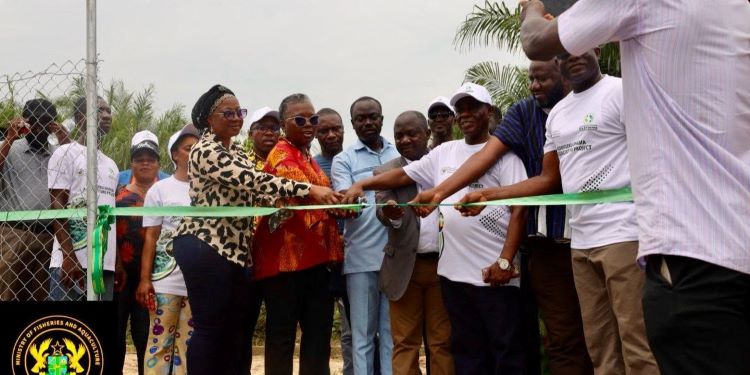
The Ministry of Fisheries and Aquaculture Development (MoFAD) has officially joined forces with private sector partner R&B Farms to launch the revolutionary Komfueku-Shama Aquaculture Project in the Western Region, marking a strong commitment to Ghana’s approach to environmental reclamation and domestic food security.
Designed to flip a long-standing environmental liability on its head, the initiative aims to repurpose heavily excavated land – scarred clay and quarry pits – across the Shama District into highly productive aquaculture assets that generate local employment and stabilize regional food systems.
“Leading the charge is Hon. Emelia Arthur, Member of Parliament for the Shama Constituency and Minister for Fisheries and Aquaculture Development. Delivering her keynote address, she described the project as a textbook example of modern resourcefulness.
“Minister Arthur emphasized that the project perfectly aligns with core national priorities, including job creation, the government’s 24-hour economy agenda, and Ghana’s broader Blue Economy drive”
Ministry of Fisheries and Aquaculture Development
According to MoFAD, underutilized and excavated extraction sites left behind by quarrying and clay mining operations have posed severe environmental, health, and physical safety hazards for rural communities across the Shama District, frequently accumulating stagnant water, degrading local soil systems, and restricting the economic viability of surrounding lands.
The Komfueku-Shama Aquaculture Project was born to change this narrative completely, piloting innovative and climate-resilient fish farming practices directly inside these deep, former extraction sites, to address three massive macro-policy goals simultaneously: boosting domestic food security, protecting natural marine ecosystems, and generating reliable, sustainable livelihoods.

Hon. Arthur explained that the transition from degraded industrial ruins to managed aquatic ecosystems offers a clear blueprint for circular economic development. Instead of utilizing heavy public capital to fill excavated pits with imported soil, MoFAD and R&B Farms are capitalizing on the pre-existing depth and water-retention capabilities of the quarry sites to establish stable aquaculture ponds.
This method not only bypasses the heavy capital requirements usually linked with constructing standard commercial ponds from scratch but also directly removes a local safety hazard.
The targeted demographic impact is equally significant, as the localized operations are intentionally structured to create reliable, long-term employment opportunities for local youth and women, who represent the most economically vulnerable segments of the coastal and rural workforce.
Delivering her keynote address at the official launch in Komfueku, Hon. Arthur highlighted the initiative as a classic manifestation of modern resourcefulness, emphasizing that sustainable economic transformation requires unconventional solutions to historical land challenges.
Support and Execution Models
The Minister further explained that beyond simply scaling up Ghana’s local Blue Economy drive to mitigate the national fish deficit, the continuous operational nature of commercial aquaculture aligns directly with the government’s 24-hour economy agenda.
Because intensive fish farming demands around-the-clock monitoring, automated feeding rotations, water quality tracking, and synchronized security networks, the project naturally establishes a continuous production cycle that maximizes labor efficiency and shifts the rural economy toward non-stop productivity.

The rollout has catalyzed strong regional and local institutional consensus across the Western Region’s administrative organs. Delivering a specialized policy statement on behalf of the Western Regional Minister, Hon. Joseph Nelson, regional authorities hailed the Komfueku initiative as a historic milestone for sustainable aquaculture and progressive environmental stewardship.
The regional administration expressed strong optimism that the project’s success will provide an explicit operational master blueprint, allowing other mining-impacted districts nationwide to reclaim heavily degraded lands for commercial food production. To ensure that the physical execution of the project faces minimal administrative or regulatory friction on the ground, the local government apparatus has committed its full support.
The District Chief Executive (DCE) for Shama, Hon. Otis Dentu, formally assured the public and the project partners that the local Assembly is fully mobilized to provide the necessary structural, logistical, and planning assistance required for a smooth, unhindered rollout.
This local governance backing ensures that zoning permits, access roads, and community security frameworks are tightly integrated into the project’s daily operations.
From the private sector perspective, the partnership models a new approach to rural industrialization. Mr. Benjamin Turkson, the Director of Operations at R&B Farms, reminded assembled stakeholders during the launch ceremony that the overarching corporate and public vision extends far beyond the basic mechanics of harvesting and distributing fish.
Focusing on full-chain value addition – including localized fish processing, cold storage, and feed distribution networks – the project aims to establish a self-sustaining agrarian ecosystem in Komfueku. As full-scale operations begin on-site, public and private stakeholders across Ghana’s agricultural sector are monitoring the development metrics with immense interest.
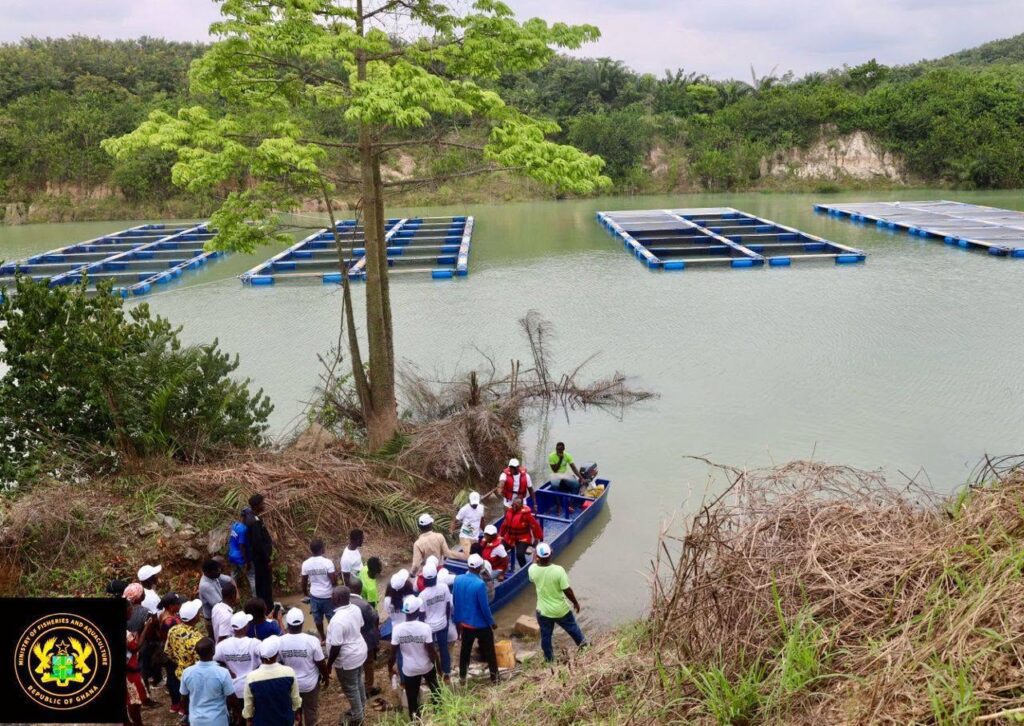
If the pilot fulfills its projections, these formerly hazardous, abandoned pits will not only feed the immediate populations of the Shama District but deliver a scalable, green, and sustainable model for rural economic transformation across the entire country.
READ ALSO: Insulation Failure Caused Akosombo Substation Fire – Committee Report