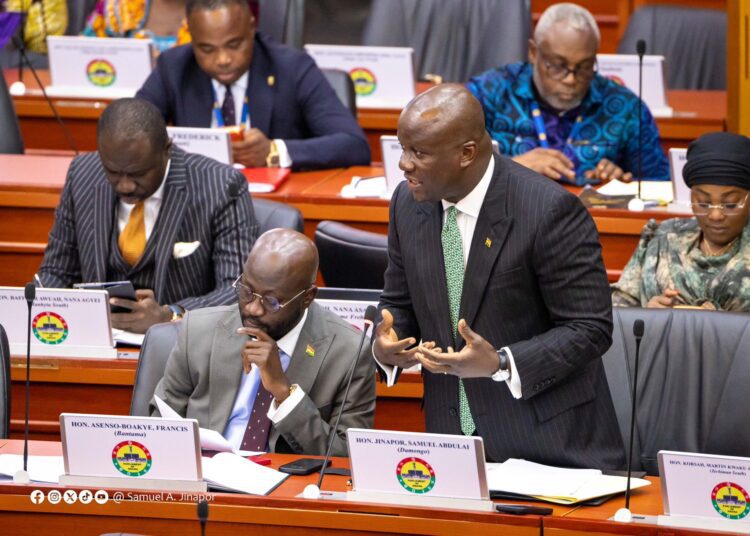
The Member of Parliament for Damongo and Ranking Member of the Foreign Affairs Committee, Honourable Samuel Abdulai Jinapor has argued that the national debate on the size of government requires a comprehensive examination of facts and constitutional provisions. Addressing the matter, Honourable Jinapor indicated that political arguments have often overshadowed objective assessments of government structures.
The Damongo MP stated that successive governments have adopted different administrative arrangements within the Office of the President. He cited the inclusion of National Security and the Free Senior High School programme under the Office of the President during the administration of former President Nana Addo Dankwa Akufo Addo.
Additionally, Honourable Jinapor noted that budgetary allocations linked to those arrangements generated public debate at the time. He added that questions surrounding expenditure at the Presidency have featured prominently in national political discussions over the years.
At the centre of his argument was the need for a dispassionate assessment of government operations. He remarked that constitutional provisions grant the President authority to appoint ministers and staff necessary for the effective running of the state.
Particular attention was given to Article 78(2) of the Constitution and provisions within the Presidential Office Act. The Damongo MP observed that the legal framework outlines the President’s powers regarding appointments and staffing structures.

Within this context, he welcomed the growing scrutiny of compensation and staffing levels within the Office of Government Machinery. He indicated that media organisations have contributed significantly to public understanding of the subject.
The emphasis, he said, should rest on facts and measurable outcomes. He argued that political point scoring has often diverted attention from substantive issues affecting public administration.
“We should interrogate the size of government dispassionately, objectively, and in a manner that serves the national interest. When you examine the facts, you cannot help but come to the conclusion that we do not really have a lean government and it is not less costly.”
Honourable Samuel Abdulai Jinapor
Furthermore, Honourable Jinapor contended that campaign pledges regarding a smaller and more efficient government should be assessed against actual governance outcomes. He explained that public debate gains credibility when supported by evidence and detailed analysis.
Consequently, the Ranking Member called for sustained examination of government expenditure and staffing arrangements. He stressed that transparent discussions on public administration remain essential to strengthening accountability and ensuring value for taxpayers.
Government Staffing Costs Under Spotlight Amid Spending Debate
The Damongo MP also turned attention to the financial implications of government appointments and compensation levels. He argued that expenditure associated with presidential staff and advisers deserves the same scrutiny often directed at ministers and deputy ministers.
Addressing budgetary allocations, Honourable Jinapor referred to explanations previously offered by Felix Kwakye Ofosu regarding the ranking of presidential appointees. He stated that several positions within the Presidency carry remuneration levels comparable to ministers and deputy ministers.
Central to this discussion was the argument that the cost of government extends beyond the number of ministers appointed. The Ranking Member explained that a government with fewer ministers could still generate substantial expenditure through appointments within the Presidency.
Moreover, he recalled raising similar observations during parliamentary discussions following President John Dramani Mahama’s State of the Nation Address in March 2025. He indicated that the distinction between ministerial numbers and overall administrative costs remains important in evaluating claims of a lean government.

Consideration was also given to budget figures covering the Office of Government Machinery. Honourable Jinapor stated that compensation allocations increased from approximately GH¢326 million in 2024 to projected levels of GH¢540 million in 2026.
Similarly, he drew attention to compensation figures for National Security. The Damongo MP indicated that allocations rose from about GH¢1.2 billion in 2024 to approximately GH¢2.4 billion in 2025.
“The government is lean when it comes to Ministers and Deputy Ministers. If you look at presidential staffers, presidential advisers and many appointees, the cost on the public purse becomes much higher.”
Honourable Samuel Abdulai Jinapor
Of significant importance, he said, is the relationship between staffing numbers and expenditure growth. He argued that increases in compensation budgets correspond with the expansion of presidential appointments across different offices.
Honourable Jinapor further referenced positions including advisers, envoys, coordinators and directors operating within the Presidency. He mentioned roles connected to agriculture, the 24 Hour Economy initiative, diaspora affairs, the Black Star Experience and relations with the Alliance of Sahel States.
Closely associated with this issue is the appointment of regional political coordinators across the country’s sixteen regions. The Ranking Member suggested that such appointments contribute to the overall cost of governance.
“You have to ask why these disparities exist. The answer is not far away because the numbers of political appointees have increased significantly.”
Honourable Samuel Abdulai Jinapor
The Damongo MP reiterated that discussions on government size should encompass both ministerial appointments and the wider network of presidential staff. He emphasised that taxpayers deserve a full picture of expenditure linked to public administration and governance structures.
READ ALSO: Presidency Staffing Salaries Not Increased Despite Budget Jumps — Presidential Spokesperson