The Democratic Republic of Congo’s Ebola outbreak has crossed a grim new threshold, with confirmed infections rising above 4,000 as health authorities confront a rapidly expanding epidemic fuelled by delayed detection, overwhelmed surveillance systems, conflict and the absence of a licensed vaccine or proven treatment for the strain driving the crisis.
Government data show that the number of confirmed infections has reached 4,053, including 1,850 deaths, making the current epidemic the second-largest Ebola outbreak ever recorded globally after the devastating 2014-2016 West Africa epidemic.
The figures underline the extraordinary speed at which the virus has moved through communities in eastern and northeastern Democratic Republic of Congo, where health workers have struggled to identify cases early enough to break chains of transmission.
The outbreak has been confirmed in five provinces: Ituri, North Kivu, South Kivu, Haut-Uele and Tshopo widening the geographical challenge facing authorities and international health organisations attempting to contain the disease.
According to the World Health Organization, the outbreak is caused by the Bundibugyo species of Ebola, for which there is presently no approved vaccine or targeted treatment. According to WHO, the disease is developing in a very challenging environment characterised by high levels of trade between impacted areas, population movement, insecurity, and humanitarian need.
Compared to the response environment around earlier severe Ebola outbreaks, this crisis marks a substantial shift. Responders have access to vaccinations and treatments designed particularly against the Zaire species of Ebola during the 2018–2020 outbreak in eastern Congo, which was once the largest in the nation.
That outbreak recorded 3,481 cases and 2,299 deaths over two years.
The current epidemic has already exceeded the previous national case record in a fraction of the time.
According to health professionals, the speed of transmission has been unprecedented at this stage of an Ebola outbreak, raising concerns that the official case count may not yet reflect the full scale of transmission occurring in communities.
Undetected Cases Complicate Efforts to Contain Ebola
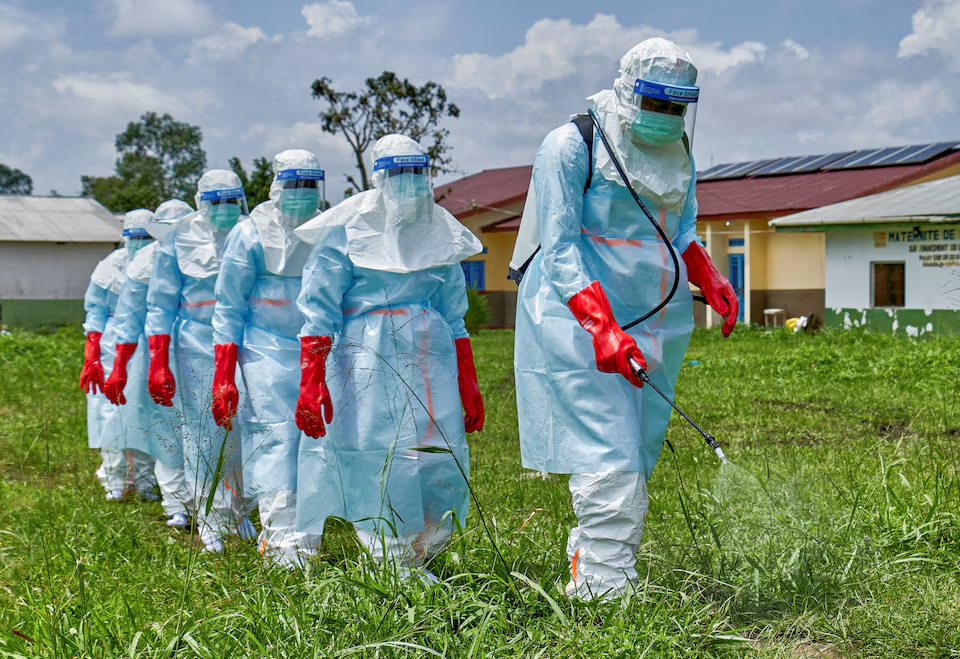
Evidence emerging from the outbreak suggests that the virus may have been spreading for months before authorities formally recognised the scale of the emergency.
The Bundibugyo strain was officially identified in May after health authorities investigated an unusual cluster of severe illnesses and deaths in Ituri Province.
WHO reported that the outbreak was officially declared on 15 May following laboratory confirmation of the virus in samples from Rwampara Health Zone. However, researchers have traced suspected infections much further back, suggesting that transmission may have begun as early as January around Mongbwalu, a mining community in Ituri.
The delay has resulted in significant consequences. Early cases were apparently ignored or diagnosed with unrelated ailments, and testing first concentrated on the incorrect Ebola species. Samples transported to Kinshasa were also allegedly mistreated, causing more delays in confirmation. By the time the correct virus was found, transmission had already begun within communities.
Traditional funeral traditions have added an extra layer of hardship. Ebola can spread thru touch with the bodies of those who have died from the disease, thus safe and culturally sensitive burial procedures are an important part of outbreak containment.
But the challenge extends beyond individual cases. Surveillance teams tasked with identifying people exposed to infected patients have been unable to keep pace with the growing number of infections. Health workers are expected to investigate alerts, identify contacts and monitor those potentially exposed, but limited resources and increasing caseloads have created a cycle that is increasingly difficult to break.
Every missed case creates the possibility of additional infections. Those additional infections generate more alerts and contacts for already stretched teams to investigate.
The result is an expanding workload at precisely the moment when faster surveillance is most urgently needed.
The crisis has also been worsened by reductions in international health assistance. Funding shortages have affected both surveillance systems that could have detected the outbreak earlier and the emergency response now attempting to contain it. Reports have pointed to staffing shortages, unpaid health workers and inadequate financing for critical response activities.
The consequences are particularly severe in communities where health systems were already struggling before Ebola emerged. Eastern Congo has endured years of armed conflict, displacement and humanitarian emergencies. Violence has restricted access to some communities, disrupted the movement of medical teams and supplies, and made it more difficult to establish reliable contact-tracing networks.
For health workers, reaching a village can itself become a security challenge.
READ ALSO: Nigerians Are Delighted With 2026 Commonwealth Games Performance, Adesina Ayooluwa Reveals