Women’s rights groups in Ghana have called for Parliament to keep its current 276 seats and have opposed a proposed increase to 300 in the ongoing constitutional review. They say the reform process must entrench the country’s existing gender equality gains.
The Affirmative Action Law Coalition and allied women’s rights organizations say the review must build on the Affirmative Action (Gender Equity) Act of 2024, which sets a 30 percent minimum for women in decision-making and public life, and must not leave those gains to chance.
In 2024, Ghana enacted the Affirmative Action (Gender Equity) Act, a significant national commitment to addressing the persistent underrepresentation of women in decision-making. The law requires a minimum of 30 percent representation of women in decision-making positions within its first two years.
Because the Act took effect in 2024, advocates say the 30 percent target should now have been reached across public institutions in 2026. They argue the constitutional review is therefore a decisive moment: it can consolidate that progress or undermine it.
Becky Enyonam Ahadzi, Coordinator of the Affirmative Action Law Coalition, said it would be contradictory for the state to legislate deliberate measures against inequality while amending the Constitution without the guarantees needed to sustain them.
“We cannot have a situation where, on the one hand, Ghana enacts legislation recognising the need for deliberate measures to address gender inequality, and on the other hand, constitutional reforms are adopted without embedding the guarantees necessary to sustain those goals.”
Becky Enyonam Ahadzi, Coordinator of the Affirmative Action Law Coalition

What the White Paper Proposes
The proposal to raise Parliament to 300 seats comes from the Government’s White Paper on the constitutional review. As described in the document, it would keep the 276 constituency MPs and add 24 seats allocated through proportional representation, specifically for women, youth and persons with disabilities.
The Ghana Federation of Disability Organisations has backed the plan and listed eight safeguards to prevent political hijack of the new seats, including entrenching the quota. The opposition New Patriotic Party (NPP) has rejected the expansion.
It argues that the current 276 MPs are already substantial for a population of about 32 million, and that there is no evidence more MPs would improve effectiveness.
Women’s groups say any enlargement of the House should not proceed unless firm, constitutionally backed protections for women’s participation come with it. In their view, expansion without such protections could dilute gains already made and leave future progress to political goodwill.
Civil society groups, including the Affirmative Action Law Coalition, have been preparing a position paper that supports proportional representation and constitutional gender quotas to increase participation by women, youth and persons with disabilities in governance.
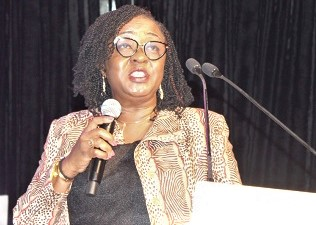
Ms. Ahadzi has also called for constitutional safeguards to boost women’s representation. She has noted that the first-past-the-post system limits women’s success.
Ghana’s Parliament has long fallen short of gender parity. Women have held only a small share of seats since the return to multiparty democracy in 1993, a gap campaigners say justified the 2024 law.
Targets Beyond 2026
The coalition stressed that the Act sets a phased trajectory, not a single milestone. Under the law, women’s representation in decision-making is expected to reach 35 percent by 2028 and 50 percent by 2034.
Advocates say these benchmarks give the country a clear, measurable roadmap, and that the constitutional review should treat them as a floor to be protected, not a ceiling to be bargained down.
“We have started this journey, and we cannot go back.”
Becky Enyonam Ahadzi
The organisations are urging the review committee, Parliament and the Executive to embed the principles and targets of the Affirmative Action (Gender Equity) Act in the Constitution. They insist that no amendment should weaken or contradict the 2024 law. They also want enforcement and accountability mechanisms so that the 30, 35 and 50 percent benchmarks are met on schedule.
Beyond Parliament, the groups say the guarantees should extend to appointive positions, public boards and other institutions of governance, in line with the scope of the Act.
A Test of Political Commitment
The intervention comes as Ghanaians continue to engage with a review that touches on the structure of government, electoral rules and the balance of powers. Women’s rights advocates say gender equity must be treated as a core governance issue, not a side concern.
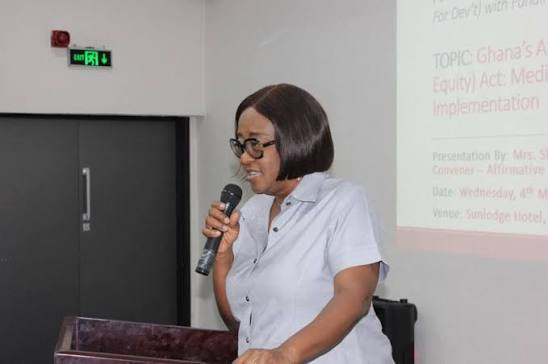
The groups have also appealed to civil society, traditional leaders, faith-based organisations and the media to join the push. They say they will continue engaging stakeholders and submit their position through the formal channels of the review.
As deliberations continue, the central question for lawmakers is whether the final amendments will lock in the gains of the 2024 Act or leave them dependent on ordinary legislation that can be amended or ignored.
READ MORE: Parliamentary Health Committee Calls on Government to Train Specialised Nurses