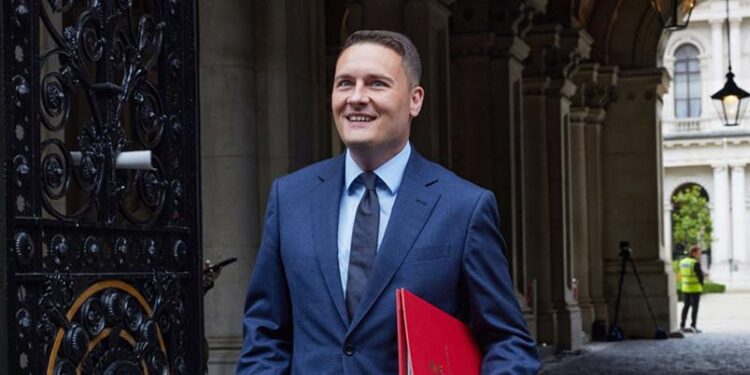
Political tensions within Britain’s governing Labour Party have intensified after senior Labour figure Wes Streeting signalled he was prepared to trigger a leadership contest, if Prime Minister Sir Keir Starmer refuses to outline a timetable for his departure following this week’s closely watched Makerfield by-election.
At a time when the Prime Minister is under increasing criticism for Labour’s election results, internal party unity, and overall political direction, the remarks represent one of the most direct challenges to Keir Starmer’s authority to date.
Wes Streeting, who previously served in the Cabinet and remains an influential voice within Labour, stated he believed a leadership change was necessary regardless of the outcome of the by-election. However, he suggested that a victory for Greater Manchester Mayor Andy Burnham in Makerfield could significantly accelerate pressure on the Prime Minister to reconsider his position.
Speaking in a series of media interviews, Streeting argued that Labour, “can’t carry on with this uncertainty and paralysis, and there will need to be a contest, and I’d be prepared to do that.”
“I would hope that after Thursday’s by-election, when the results are in, and I very much hope Andy Burnham wins I was there yesterday campaigning for him again when the results are in, I hope the Prime Minister will at that stage reflect on his own position and set out a timetable.”
Wes Streeting
He added, “I think that would be a better way forward for everyone, and would enable that better culture that we aspire to.”
Streeting further claimed that he already commands the support of around 80 Members of Parliament, enough to secure a place in a leadership contest should one be triggered. While no formal challenge has yet been launched, the assertion underscores the extent of dissatisfaction among some sections of Labour’s parliamentary ranks.
His criticism extended beyond questions of leadership style and touched on broader concerns about government policy and decision-making.
Streeting accused the Prime Minister of failing to listen to colleagues, military advisers and voters who delivered what he described as a clear warning during local elections earlier this year.
“In terms of the Labour Party, I don’t think he’s listening to his Cabinet, I don’t think he’s listening to the parliamentary party and I don’t think he’s listening to voters, who only in May sent the Labour Party that extremely humbling message at the ballot box.”
Wes Streeting
He also argued that Labour’s current difficulties stem from deeper structural problems involving leadership, policy direction and internal culture.
Despite the growing criticism, Streeting noted “there is a huge amount of talent on the front bench and the back bench of the parliamentary Labour Party,” adding, “it isn’t used nearly well enough, and the divides between Labour’s different tribes are often overstated.”
“I think we all have a shared sense of what’s wrong. I think we have different views about how to put it right, but at the end of it, we need to come together.”
Wes Streeting
Starmer Defiant as Burnham’s Rising Profile Fuels Succession Debate

While Streeting’s comments have fuelled speculation about a potential leadership contest, Sir Keir Starmer has shown no indication that he intends to step aside.
Speaking to journalists while attending the G7 summit in France, the Prime Minister rejected suggestions stating that, “so very many times on my political journey, people have said to me it’s not possible. They said it’s not possible to turn the Labour Party around. It’s not possible to win an election.”
“It’s not possible if you do win election, to invest in your public services and stabilise the economy wrong every time, and that’s why I intend not to walk away from this, but to carry on with what I was elected to do, which is to serve this country, bring back the change that people desperately need in their lives.”
keir Starmer
Despite growing criticism from some members of his own party, the Prime Minister’s uncompromising posture shows a will to weather the political storm..
However, attention is increasingly turning toward Andy Burnham, whose campaign in Makerfield has generated considerable interest among Labour supporters and political observers alike.
The Greater Manchester Mayor is widely viewed as one of the party’s most popular and experienced figures, and his potential return to Parliament has reignited discussion about Labour’s future leadership.
Former Deputy Prime Minister Angela Rayner added to the speculation by praising Burnham’s campaign and suggesting he was connecting with voters through a “new type of politics.”
The by-election itself is attracting national attention because of its potential implications for both Labour and the wider political landscape. Burnham’s nearest challenger is Reform UK’s Robert Kenyon, although concerns have emerged within Reform that some supporters could defect to Restore Britain, a party campaigning on a more hardline position regarding immigration and border controls.
But for Labour, the race is now about more than just a parliamentary seat. It has developed into an informal assessment of the party’s leadership and future course.
In the event that Burnham wins, pressure on Starmer may increase significantly as demands mount for Labour to reconsider its approach in light of upcoming elections. The Prime Minister may soon have to deal with a more serious internal conflict over the party’s identity, goals, and leadership if he is adamant about holding onto his position.
READ ALSO: Kasapreko’s Debut Surge Adds GHS1.2bn Value to GSE