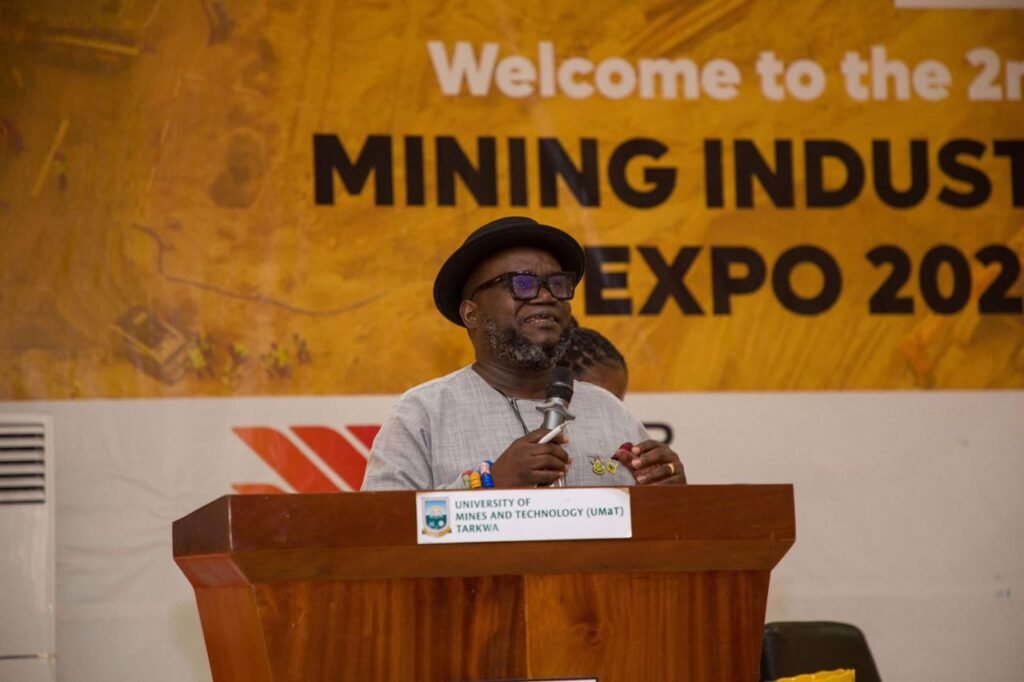
Sam Pobee, the Managing Director of AngloGold Ashanti Obuasi Mine, has asserted that a country’s baseline mineral wealth is fundamentally insufficient on its own to secure sustained foreign direct investments within the global extractive ecosystem.
Writing in a recent thought piece published by the Ghana Chamber of Mines, the industry leader explained that while rich underground deposits serve as an initial geographic attraction, the international pool of mining capital is exceptionally liquid, highly competitive, and inherently drawn toward administrative jurisdictions that demonstrate robust corporate security.
Consequently, the trajectory of large-scale mining operations depends heavily on the systemic environments that host them, proving that physical endowment is merely a preliminary baseline rather than a permanent guarantee of economic success.
“Beyond geology, investors are increasingly focused on the consistency of policies, reliability of agreements, and long-term investment security. Given the long lifecycle of mining projects, sustained confidence in regulatory and fiscal frameworks is essential to attracting and retaining investment.”
Ghana Chamber of Mine
Pobee highlighted that resource-rich nations frequently misinterpret geology as an absolute economic advantage, overlooking the fluid mobility of modern exploration budgets.
Because major financial institutions and investment committees evaluate multi-decade risks before deploying billions of dollars, they prioritize the administrative health, legislative predictability, and operational safety of a sovereign territory far above its subterranean ore grades.
In a highly contested global marketplace, the fiscal and regulatory mechanisms established by state authorities act as the ultimate differentiator, dictating whether resource capital deepens its regional footprints or migrates to more secure international alternatives.
The Dynamics of Global Capital Mobility
The modern extractive industry operates on an infrastructure where financial resources are entirely unbound by geography, moving effortlessly toward regulatory frameworks that reduce operational volatility.
Sovereign jurisdictions worldwide are constantly competing for an identical, finite pool of institutional development funding, meaning that any domestic instability rapidly triggers capital flight.

When corporate entities evaluate long-term ventures, they actively look beyond natural geological formations to assess whether a host nation can safeguard their assets from unpredictable regulatory shifts or arbitrary legislative overhauls.
Furthermore, because modern asset managers can seamlessly reallocate their portfolios across diverse mineral frontiers ranging from Australia and Canada to emerging jurisdictions in the Americas local statutory reliability becomes a critical competitive benchmark.
A nation’s capacity to establish an inviting, transparent commercial landscape is what transforms raw material potential into actual, operational infrastructure.
When policy frameworks become volatile or unpredictable, global financiers quickly mitigate their risk profiles by curtailing their local exploration exposure and redirecting heavy machinery budgets to alternative sovereign markets.
Policy Consistency and Institutional Credibility
Achieving enduring stability within the mining sector requires an unwavering commitment to policy consistency, ensuring that long-term project agreements remain wholly insulated from shifting political cycles.
Because the lifecycle of an industrial mine spanning from initial exploration and environmental permitting to active production and final reclamation frequently covers several decades, investors demand contractual agreements that remain reliable over time.
Institutional credibility cannot be manufactured overnight; rather, it is systematically forged through consecutive years of transparent governance, objective legal structures, and explicit fiscal terms.
Host governments must realize that maintaining predictable regulatory parameters is not an act of favoring multinational corporations, but a strategic necessity to remain economically competitive on the global stage.
When national institutions honor their bilateral agreements and maintain clear, unchanging tax obligations, they foster an atmosphere of trust that encourages operators to make generational capital commitments.
Conversely, sudden escalations in local levies or structural delays in state ratifications introduce institutional friction, dampening investor confidence and signaling to international markets that a jurisdiction may no longer be a dependable destination for long-term project financing.
Sustained Frameworks for Multi-Decade Investments
The immense temporal scale of major extractive projects requires fiscal and regulatory frameworks that offer absolute long-term investment security to justify high upfront exploration expenses.
Industrial mining ventures demand hundreds of millions of dollars in fixed infrastructure long before the first ounce of ore is commercially extracted, making these investments uniquely vulnerable to post-investment policy changes.

To mitigate these inherent structural risks, sovereign host nations must cultivate a cooperative, predictable ecosystem that guarantees legislative durability and protects ongoing corporate developments from abrupt regulatory intervention.
Ultimately, the long-term viability of an extractive economy rests heavily on the realization that institutional strength is a much more powerful economic driver than unmined wealth.
While underground geology determines a nation’s initial eligibility on the global index, it is the unwavering credibility of its state institutions that seals final investment selections.
By anchoring their resource strategies in regulatory transparency and policy consistency, sovereign nations build the enduring confidence required to attract, maximize, and retain productive global capital for decades to come.
READ ALSO: Trump Delays Clayton’s Nomination For Director Of National Intelligence