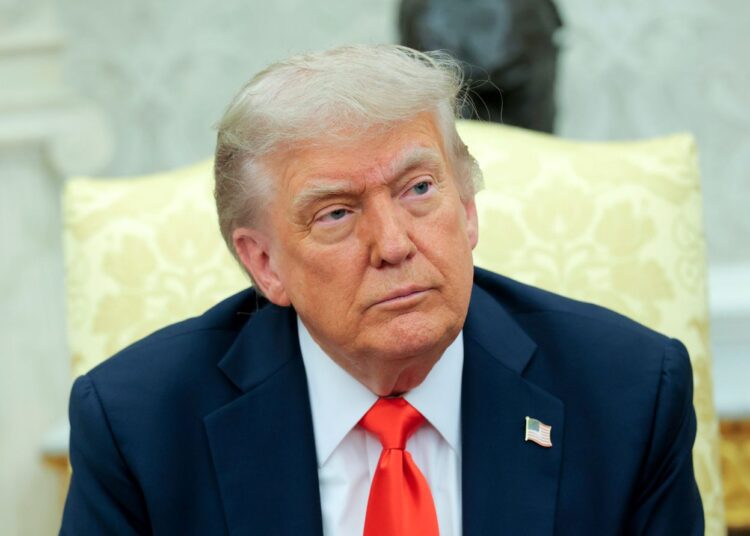
The Presidents of the US and Iran have signed the Memorandum of Understanding (MoU), an initial peace deal aiming to end the war, allowing it to immediately take effect.
Trump signed a hard copy of the initial deal during a state dinner hosted by French President Emmanuel Macron at the Palace of Versailles. Tehran confirmed that Iranian President Masoud Pezeshkian also signed the document.
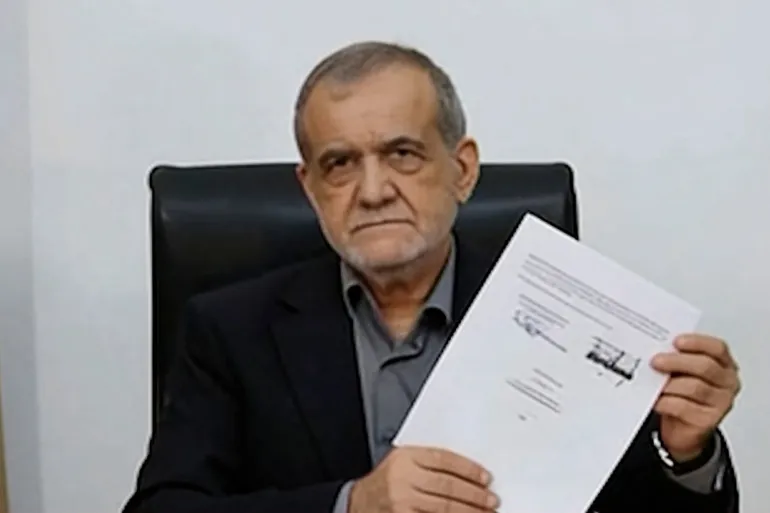
The agreement includes reopening the Strait of Hormuz, a $300bn (£224bn) plan for Iran’s “reconstruction”, and the US terminating “all types of sanctions” on Iran. However, the issue of Iran’s nuclear programme, the main reason stated by the US for the conflict, is still to be negotiated over an extendable 60-day period.
The text says the US and Iran will “commit to negotiating and achieving the final deal in maximum 60 days, extendable with mutual consent.” The agreement says “Iran reaffirms that it shall not procure or develop nuclear weapons”, which was Trump’s number one condition since the start of the war. The memo also says that Iran’s enriched uranium will be “down-blended,” meaning diluted, on site, under the auspices of the IAEA, the UN’s nuclear watchdog.
The first point of the agreement declares the “immediate and permanent termination of military operations on all fronts, including in Lebanon.” However, Israel has said that it had no plans to withdraw its troops from Lebanon, and it launched attacks on Hezbollah on Wednesday.
Trump has been growing concerned that Israeli military operations against Hezbollah could upend a deal with Iran. He admonished Israeli Prime Minister Benjamin Netanyahu at the G7 on Wednesday.
As for the Strait of Hormuz, the agreement says there will be no charges for ships going through the critical waterway for 60 days but it leaves open the possibility of future charges. There were none before the conflict.
The deal has been shrouded in secrecy and confusion for days. U.S. officials did not disclose the terms even after saying Trump and Vice President JD Vance digitally signed it over the weekend. Trump signed a physical copy while dining with French President Emmanuel Macron at Versailles, the palace where many historic agreements have been signed over the centuries, ending wars or territorial disputes.

Earlier on Wednesday, US officials held a media briefing, where they read out the text verbatim from the memo and denied the US was required to pay “a cent of money” to Iran under the $300bn fund. At the G7 summit, Trump said that reports that the US would give Iran money under the fund were a “fake story.”
The White House had planned a signing ceremony on Friday in Switzerland, but its fate is now uncertain, with conflicting information from the U.S., Iran and Pakistan. Iran’s Ministry of Foreign Affairs spokesperson, Esmaeil Baghaei noted, given that both sides signed the agreement electronically, Baghaei noted that there would not be a signing ceremony on Friday in Geneva, Switzerland, as had previously been expected. Negotiating teams, however, still plan to be in the Swiss city. A decision on a possible in-person meeting between them is expected in the coming hours, though for now such plans are paused, according to Baghaei.
Baghaei addressed Iranian media following the signing, stating that Iran will monitor the US’s compliance “without any leniency” and will not “fulfil” its commitments if Washington “evades its obligations.” He also said that Iran’s nuclear programme and the lifting of US sanctions will be discussed during the 60-day period, but Tehran’s missile programme is off the table.
Baghaei additionally said Iran would not ship its stockpile of highly enriched uranium abroad and that dilution of the material was “introduced as an option to close the door on other possibilities.” Regarding Israel’s war on Lebanon, Baghaei said that Iran has shown it “does not abandon its friends” and that it was the US’s responsibility to compel Israel to respect commitments to Iran. On the Strait of Hormuz, Baghaei said Iran will finalise a new regime to manage the waterway along with Oman and will “charge fees for services” there.
Republican Louisiana Senator Bill Cassidy, who recently lost his re-election bid to a Trump-backed challenger, said: “This is the worst foreign policy blunder in decades.”
Republican Texas Senator Ted Cruz, an Iran hawk in Congress, questioned the $300bn fund for Iran.
“Giving billions of dollars to theocratic lunatics who want to murder us is not a good idea,” Cruz told reporters. “I think the president, unfortunately, is receiving bad advice.
New Hampshire Senator Jeanne Shaheen told the BBC that it was “a very bad deal” and did not address issues such as Iran’s support for regional proxies, like the militant group Hezbollah, or its missile programme.”It’s not accomplished any of the aims that President Trump laid out at the start of the war,” she said.
Iran has touted the agreement as a victory. On Wednesday, chief negotiator Mohammad Bagher Ghalibaf told Fars, an Iranian state news agency, that the US had failed to achieve its goals with Iran and pointed to the memo as proof.“The agreement is a record of US failure,” Ghalibaf said. “People will see it and judge.”
READ ALSO: Tyla Drops Teaser for New Single Ahead of Major Album