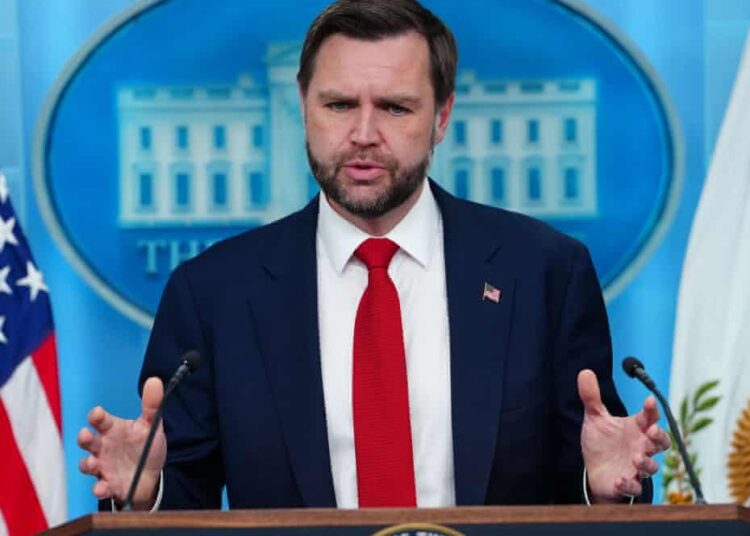
US Vice President, JD Vance has announced that the 60-day window laid out in the memorandum of understanding to reach a final agreement with Iran begins today.
That sets a deadline for the final deal between Iran and the United States as August 17, 2026.
“I would say the 60-day period officially started today. It was signed late, and it may have even been signed technically, you know, because of the time shift, I think it’s signed technically today, Iran time.”
JD Vance
Addressing the media, he clarified Donald Trump’s remarks about a shift in the US President’s stance regarding Iran’s ballistic missile arsenal. Trump stated on 28 February that destroying Iran’s missiles and missile industry was a key objective of the war. Yesterday, however, he told reporters in Paris that it would be “unfair” for Iran to not have “some” ballistic missiles, because other countries have them.

“Countries don’t give up the right of self-defence. Israel doesn’t give up the right of self-defence if Hezbollah fires rockets or drones at Israel. The Iranians don’t give up the right of self-defence in their country. But we do expect that, as part of the final deal, they are not going to be able to build the kind of missiles that can broadly threaten the entire world.”
JD Vance
Also, Vance stated that Congress should have received the formal signed copy of the memorandum of understanding today and the White House is planning to brief lawmakers soon. He added that the administration is “quite confident” that it can lift sanctions on Iranian oil without congressional approval.
He insisted that the waiving of sanctions on Iranian oil is not a “new benefit” given that Iran was already selling oil before the war and insisted that this will benefit the US because “we can see where the money moves now.” However, before the war, under the weight heavy sanctions, Iran had to sell its oil at a steep discount. It can now sell its oil freely, to more countries, and charge more for it.
Additionally, the US Vice President said that he plans to go to Switzerland for talks with Iran this weekend, but that the plan could change.
“We think these technical negotiations are going to start sometime this weekend. That’s still the plan, but that could change. I suspect this weekend but I’m not sure.”
JD Vance
Vance said that he is planning to lead the US negotiating team as they try to reach the final agreement with Iran. Asked if he’s still going to Switzerland tomorrow for the formal signing ceremony, Vance remarked, “I may, it just depends exactly on when the Iranians can get there.”
US Expects Israel Not To Go “Wild” In Lebanon
Vance said that the deal is about wider peace in the region, and that while the US expects Hezbollah to not attack Israel, it also expects “that the Israelis are not going to be going wild in Lebanon.”
Commenting on Trump’s recent criticisms of Israeli Prime Minister Benjamin Netanyahu and Israel’s attacks on Lebanon, Vance stated that while Israel has the right to defend itself, “the Israelis, just like everybody else, have to respect this peace process.”
“The President has grown frustrated sometimes that we seem to be right on the cusp of a major breakthrough in the agreement, and then all of a sudden, there’s a major explosion that goes off in a civilian population center in Beirut, and a lot of people who have nothing to do with Hezbollah lose their lives. That’s not acceptable.”
JD Vance
Moreover, Vance issued an extraordinary rebuke to Israeli critics, particularly members of Netanyahu’s cabinet who have lambasted the peace deal and Trump, saying that Trump is the “only Head of state in the entire world who is sympathetic to the nation of Israel at this moment in time.”
“If I was in the Israeli cabinet, I might not be attacking the only powerful ally that I have anywhere left in the entire world…
“The problem for Israel is not Donald J Trump and anybody in Israel who thinks their biggest problem is the President of the United States needs to wake up and smell the reality of the situation that country is in.”
JD Vance
He added that over the last three months of war, two-thirds of the weapons used to defend Israel were produced in the US.
READ ALSO: Inadequate Electricity Supply Directly Restraints Long Term Economic Growth – ASEC