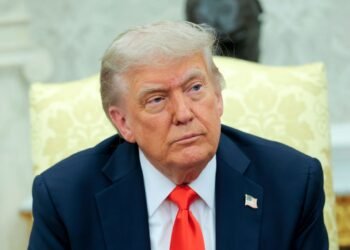
United States President Donald Trump has pushed back at critics of the Memorandum of Understanding (MoU) signed by Washington and Tehran to end the US-Israeli war with Iran.
In a series of posts on Truth Social, Trump maintained that he had strengthened Washington’s hand in the region, rejecting criticism from Democrats and a handful of Republicans that the MoU only addresses issues that the conflict itself created.
The agreement included reopening the Strait of Hormuz, ending the US naval blockade on Iran’s ports, and halting fighting on all fronts, including, ostensibly, Lebanon.
Pointing to US attacks that have degraded Iran’s navy, air force and traditional military capabilities, Trump said, “The War has diminished Iran!” He stated that Democrats, however, are saying “Iran is better off now than it was four months ago.” He added, “Can you imagine getting away with that??? How stupid can some people be???”
In a second post, Trump declared that Iran, not the US, entered negotiations out of “desperation” adding, “They are FINISHED!”
He said, “We’ll play out the 60 days,” in an apparent reference to the MOU’s negotiation period, during which time Iran’s nuclear programme, the future administration of the Strait of Hormuz, the releasing of Iran’s frozen assets, the lifting of all sanctions on Iran, and the creation of a $300bn reconstruction plan for Iran were set to be discussed.
Trump had also sat down for an on-camera interview with a news yesterday, in which he suggested that Iran’s signing of the MoU “probably is unconditional surrender.”
He added that he learned from the war, which remained unrestrained by the US Congress, that there “are no limits” to his power. He also took aim at a handful of Republican Iran hawks who have criticised the MoU.
That has included Senator Tom Cotton, the Chairman of the Senate Intelligence Committee, who has criticised the agreement’s immediate lifting of US sanctions on Iran’s fossil fuel industry, calling it a “step in the wrong direction.”
Senator Roger Wicker, meanwhile, criticised both the planned $300bn reconstruction fund for Iran, which Trump has maintained will not be funded by US taxpayer dollars, and the pledge to halt fighting in Lebanon.
Trump’s Statement Follow US-Iran Talks Postponement
The US President’s series of posts, a continuation of his defence of the deal to end the war launched by the US and Israel on February 28, follow after US Vice President JD Vance’s trip to Switzerland to begin negotiations on a host of entrenched issues as outlined in the MOU was called off.
The delay has thrown into question the longevity of the deal, only a day after both sides signed on, with Israel’s ongoing fighting in Lebanon threatening to derail the diplomatic breakthrough.
Hours before postponing his trip, Vance gave some indication of the state of flux when he told reporters at a White House briefing that he was uncertain if the talks were going to happen this weekend.
“Our plan is to go to Switzerland, I don’t know exactly when. We think these technical negotiations start sometime this weekend. That’s still the plan. But that could change.”
JD Vance
Vance also lodged a rare public rebuke of Israel amid its ongoing military campaign, warning Israeli officials against attacking “the only powerful ally that [they] have anywhere left in the entire world.”
Meanwhile, Iranian Foreign Ministry Spokesman Esmaeil Baghaei again said that Tehran holds the US responsible for attacks in Lebanon, as Israel said it hit more than 150 targets since midnight.
Iran’s Foreign Minister, Abbas Araghchi said that the US has the “commitment and responsibility towards ending the war on all fronts, including Lebanon.” In a call with his Pakistani counterpart, Mohammad Ishaq Dar, the Iranian foreign ministry said that Araghchi emphasised that any violations of the MoU would be directed at the US, and “warned of the consequences and repercussions of such an action.”
Moreover, Iran’s Foreign Ministry Spokesperson Esmaeil Baghaei denied reports that Tehran has invited the International Atomic Energy Agency to inspect its nuclear facilities. He noted that, as pointed out in the MoU with the US, Iran will maintain the current status quo of its nuclear programme pending a final deal.
He stated that inspections of facilities that have been carried out until now, such as at Bushehr, will continue. He added that inspections of other facilities, for which the IAEA’s access was suspended due to the war, will depend on the process and outcome of the negotiations.