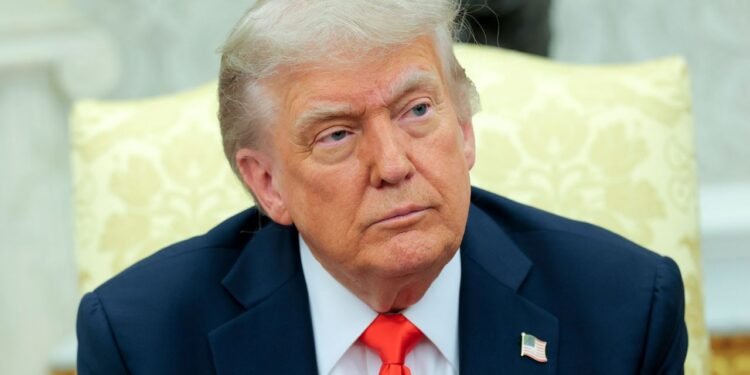
US President Donald Trump has blamed Iran for carrying out a drone strike on a cargo ship in the Strait of Hormuz, calling it a “foolish violation” of the ceasefire agreement with the United States.
Trump said that one drone damaged the upper deck of the ship, but the vessel was able to proceed, adding that the US shot down three other drones aimed at the ship.
Trump’s post on social media did not identify the ship or the time of the strike, but yesterday, the British military said a vessel was hit by a projectile off the coast of Oman.
Following reports of the attack, Iran’s Persian Gulf Strait Authority, a new government agency established to control shipping in the strait, wrote on X that transit outside its own designated routes “will not be covered by the guarantee of safe passage.” The United Kingdom Maritime Trade Operations center said that the vessel sustained damage, but it reported no injuries or environmental effects from the attack off the coast of Oman.
The development came during a fragile time for the US and Iran as they work to negotiate a permanent end to the war. Iran has increasingly challenged the region and the US over its control of the Strait of Hormuz, even with the current interim deal it reached with the US last week.
The attack on the cargo ship happened while a United Nations maritime agency was beginning an operation to move stranded ships out of the strait this week, using an alternative route, hugging the shores of Oman rather than sailing through the central part of the strait.
The route was laid out by Oman and the International Maritime Organization. North of the route is a corridor in the center of the strait where ships moved freely before the war, transporting about a fifth of all the world’s oil and natural gas.
The opening of the alternative passage through the strait was expected to relieve pressure on the world economy and remove Iran’s main source of leverage in ongoing peace talks with the U.S.
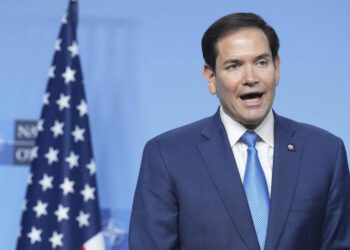
U.S. Secretary of State Marco Rubio, on a visit to the Gulf to reassure American allies, said that Washington was committed to the new route and ensuring that ships are able to transit the strait. “If that stops, then we’re going to have a problem,” Rubio said Thursday before the report of the strike on the ship.
Traffic through the strait increased in recent days but was still well below prewar levels. Yesterday, oil briefly dipped below its last prewar price of just under $73 per barrel, a sign that the market believes the situation is improving.
The U.S. and Iran are still negotiating terms of the peace deal, including issues such as getting ships through the key strait and addressing the future of Iran’s stockpile of highly enriched uranium. Under the interim deal, the two sides have 60 days to work out the details.
Evacuations Halted Until Security Guarantees Given
The International Maritime Organization halted the evacuations after the attack and said on Friday that they won’t resume until there are guarantees that the other ships won’t be attacked.
Arsenio Dominguez, the agency’s Secretary-General said that about 115 ships were able to move out of the strait in recent days, leaving about 500 still in the area.
Shipping analysts said that the drone strike cast a shadow over what had been a growing stream of trapped vessels finally leaving the Gulf and an increasing flow of tankers carrying crude oil. “A week of widening commercial confidence in the Strait of Hormuz has hit its first significant test,” marine data company Windward said on X.
It said that while the strait remains operationally open with 43 transits recorded after the incident, “the pace of normalization has slowed.” On Wednesday before yesterday’s drone strike, 78 vessels transited the strait, the highest since the war began, although below the prewar averages of 130 or more per day.
According to marine data and analytic firm Lloyd’s List Intelligence, at least two tankers reversed course while attempting to transit the strait on the UN-backed route near Oman after Iran insisted vessels use only the Teheran-approved routes.
Meanwhile, a flare-up of fighting in Lebanon between Israel and Iranian-backed Hezbollah militants threatened the wider truce. Iran says that the tentative deal to end the war would require Israel to withdraw from Lebanon — a condition Israel has rejected.
READ ALSO: IAEA Chief Calls For Full Access To Monitor Iran’s Nuclear Programme