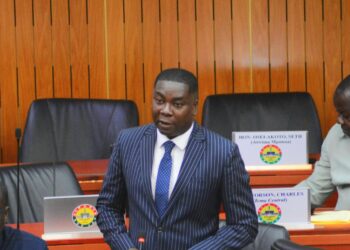
Bright Simons, Policy Analyst and Vice President of IMANI Africa, has asserted that the integrity of Ghana’s investment climate hinges entirely on an unwavering commitment to the rule of law, warning that the unresolved legal impasse surrounding the Black Volta gold project signals a dangerous breakdown in institutional accountability.
Commenting on the protracted dispute between the Ghanaian firm Engineers & Planners (E&P) and international investors, namely Ibaera Capital, over the asset ownership of Azumah Resources’ multi-million-dollar gold concessions, Bright Simons highlighted that ignoring judicial rulings severely tarnishes the nation’s democratic credentials.
His critique underscores a vital truth for the extractives sector: when powerful, politically connected entities are permitted to bypass established legal frameworks, it erodes investor confidence, distorts the market, and compromises national progress.
“What is the public’s interest in all this? Pretty simple: a) the rule of law should work & be seen to work regardless who is involved; and b)when the rule of law breaks down, the cost of doing business goes up for EVERYONE. If you want an example, just look at the mess in the lands sector.”
Bright Simons, Policy Analyst and Vice President of IMANI Africa
The policy analyst detailed how a chain of institutional breakdowns has left the strategic mining asset completely deadlocked in both local and international legal arenas.

Despite early assurances from the sector minister responsible for mining to broker an amicable settlement between E&P and the foreign investors, state-led mediation collapsed entirely, forcing the multi-million-dollar dispute into strict international arbitration.
The arbitral tribunal subsequently ordered E&P to reverse its controversial ownership transfer of the Black Volta asset which the foreign investors flatly decry as a fraudulent maneuver masked by aggressive media spectacles yet the local firm has steadfastly refused to comply.
Even after the High Court in London formally affirmed the tribunal’s binding decision, the directives remain flagrantly ignored, creating a troubling precedent of corporate non-compliance that directly undermines the authority of cross-border contract enforcement.
The Anatomy of a Flouted Judicial Resolution
The escalating friction over the Wa-Lawra gold belt project illustrates the severe limitations of state-backed compromises when corporate actors reject binding legal decisions.
When the Ministry of Lands and Natural Resources failed to secure a negotiated settlement, the battle shifted directly to international legal chambers.
The arbitral tribunal’s mandate was unambiguous: return the ownership structures of the mining concession to their pre-dispute status.
Instead of aligning with international standards, the local counterparty chose defiance, a stance that persisted even after the United Kingdom’s judicial system validated the initial tribunal ruling.

This multi-tiered non-compliance highlights a deeper, more malicious corporate strategy. By leveraging public relations campaigns and media spectacles to “whitewash” what investors maintain is a fraudulent transfer of shares, the ongoing narrative attempts to replace legal realities with curated public sympathy.
For energy and mining analysts, this strategy exposes a glaring vulnerability in the West African mining landscape, where contractual obligations can be subverted by domestic influence, effectively locking up valuable gold reserves that could otherwise generate massive state revenue.
Regulatory Deafness and Institutional Paralysis
Beyond the immediate corporate tug-of-war lies a more concerning layer of state institutional inertia that threatens the core of Ghana’s governance.
Key regulatory bodies, including the Minerals Commission, the Ministry of Mines, and the Attorney General’s department, have chosen an alarming path of passive neutrality. Simons metaphorically observes that these critical offices “have all developed glaucoma. And auditory loss. And aphasia.”
This collective silence from state monitors creates a protective vacuum for non-compliant actors, signaling to the global market that local regulatory frameworks lack the teeth or the political will to enforce valid international court decrees.

Compounding this regulatory breakdown is an unfolding financial controversy involving the ECOWAS Bank for Investment and Development (EBID). The regional financier claims it stepped in to fund a major buyout of the Black Volta asset from the international investors on behalf of E&P.
This development introduces a volatile dynamic to the dispute, as the foreign private equity backers explicitly deny authorizing or receiving compensation for any such transaction.
As this “developing story” unfolds, it raises uncomfortable questions regarding due diligence processes within regional development banks and how public funds can become entangled in contested corporate takeovers.
Reputational Damage and the Rising Cost of Business
The broader fallout of this legal deadlock extends far beyond the borders of the Upper West Region, directly striking at Ghana’s reputation as a secure haven for foreign direct investment.
For decades, the nation positioned itself as Africa’s premier gold producer by guaranteeing strict adherence to international arbitration and property rights.
However, the open defiance of an English High Court ruling by a well-connected local firm, coupled with state indifference, risks shifting global perceptions toward resource nationalism and high-risk legal environments.
Independent economic data suggests that freezing development on the Black Volta project has already cost the country hundreds of millions of dollars in deferred royalties, local employment, and corporate taxes.

When institutional frameworks crumble, the economic consequences are distributed across the entire private sector. A domestic environment where court orders can be ignored with impunity forces international financiers to demand higher risk premiums, driving up capital costs for all Ghanaian enterprises.
Bright Simons draws a direct parallel to the pervasive chaos inside the capital’s real estate market, advising skeptics to “try buying land in Accra and you will understand” how systemic lawlessness paralyzes economic growth.
Ultimately, if regional institutions and state regulators refuse to restore structural sanity to the extractive industry, the entire country will bear the heavy financial burden of a degraded investment reputation.
READ ALSO: Highlife Legend Revives Classic with Star-Studded Ghanaian Remix