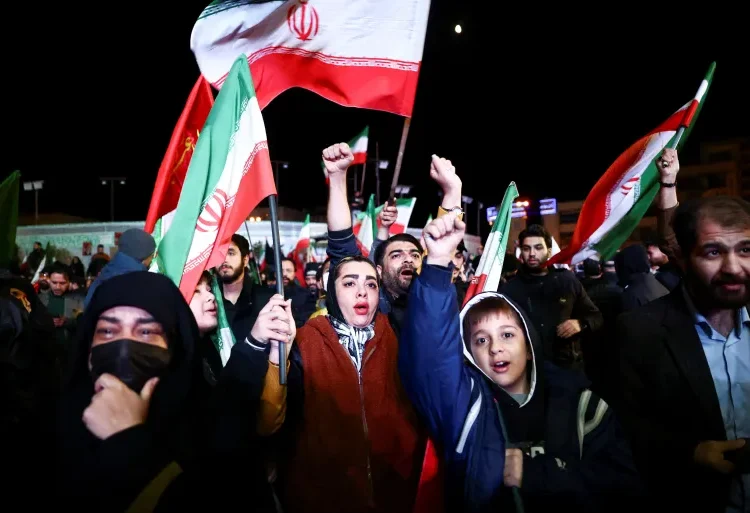
Iran’s military has carried out drone strikes targeting US bases in the Gulf after the US bombed Iranian cities for a second consecutive night.
The strikes targeted a Patriot missile system in Kuwait, an early warning satellite antenna site in Qatar, and fuel tanks belonging to the US military in Bahrain.The Iranian military said it used “a large number of various types of drones” in the attacks.
It said that Iran’s Armed Forces “will not allow the goals and aspirations of the foolish President of the United States to be realised under any circumstances and will defend the lofty ideals of the Islamic Revolution until final victory.”
This came as the United States military conducted another wave of strikes on Iran, a day after it launched a round of attacks, threatening a return to full-fledged war. Explosions were reported in Iranian cities along the Strait of Hormuz, including Bushehr, Chabahar, Bandar Abbas, Sirik, Jask, and Abu Musa Island. At least one person was killed in Iranshahr.
The escalation, which is the most severe since both sides signed a memorandum of understanding in mid-June that ended the fighting, saw the US launch attacks on the eastern Iranian cities as well as Aq Qala in northeastern Iran.
The US military’s Central Command (CENTCOM) said early today that it had completed “an additional round of strikes against Iran … to further degrade Iran’s ability to attack commercial shipping and innocent civilian mariners in the Strait of Hormuz.”
CENTCOM said that 90 Iranian military targets had been hit including air defense systems, coastal surveillance assets, missile and drone storage sites, naval capabilities, and military logistics infrastructure along Iran’s coastline.
Iran’s Ministry of Health said that US forces have attacked five provinces in the country over the past two days, killing 14 people and wounding 78 others.
Ebrahim Rezaei, Spokesman for the Iranian Parliament’s National Security Committee, had warned of a response after Wednesday’s US attacks. “Wait for the hard slap by Iranians,” he wrote on X.
Following Wednesday’s strikes, Mohammad Bagher Ghalibaf, Iran’s parliament speaker, said the Strait of Hormuz “will only open with ‘Iranian arrangements’, not American threats”.
“America still hasn’t learned that bullying and breaking promises are no longer cost-free. Let me put it plainly: if you strike, you’ll get hit.”
Mohammad Bagher Ghalibaf
Both the US and Iran have accused the other of violating the MoU, which ended the war, lifted the US naval blockade on Iran, and opened the Strait of Hormuz. But it left more intractable issues, like the future of Iran’s nuclear programme and the administration of the Strait of Hormuz, to be determined over a 60-day negotiating period.
The key point of contention appears to be over the fifth clause of the MoU, which says that Iran “will make arrangements using its best efforts for the safe passage of commercial vessels, with no charge for 60 days only, from the Persian Gulf to the Sea of Oman, and vice versa.”
Iran has interpreted the provision to mean it had sole “responsibility in determining arrangements for the safe passage of ships through the Strait of Hormuz”, Foreign Ministry spokesman Esmaeil Baghaei said Wednesday. That position has been used to justify attacks on unapproved vessels transiting the strait.
Return To Full-scale War Looms Amid Uncertainty
Speaking to reporters on board Air Force One, Trump did not rule out a return to full-scale war. “We just hit them very hard, and I say we hit them 20 to 1,” he said, adding that every time “they hit us, we’re going to hit them 20.”
However, at a news conference earlier on Wednesday, he had said that he did not think the war would restart. “Anything that happens is going to be over very quickly,” he said.
Trump had said earlier that the exchange of attacks meant the ceasefire was “over”. Still, he said he did not want a return to full-fledged war and suggested that negotiations could still continue. Speaking from a NATO summit in Ankara, Trump also lodged a laundry list of threats against Iran.
Beyond another round of strikes, Trump said the US could reinstate its naval blockade and target Iran’s electricity and water plants, attacks that international law experts say constitute war crimes. He also said that US forces “may take over” Iran’s Kharg Island, a prospect that would all but assuredly require boots on the ground.
The latest strikes have drawn condemnation from Trump’s political opponents, including progressive US Senator Bernie Sanders, who said that a return to war would “cost more lives and waste more taxpayer dollars.”
READ ALSO: Debate Emerges Over Ownership of Ghana Gas Expansion as ASEC Urges State Control