The Presidency has dismissed the Minority’s demand for the removal of Attorney General and Minister for Justice Dr Dominic Ayine over the disbursement of GH¢350 million for flood relief, describing the call as baseless and lacking any factual or legal foundation.
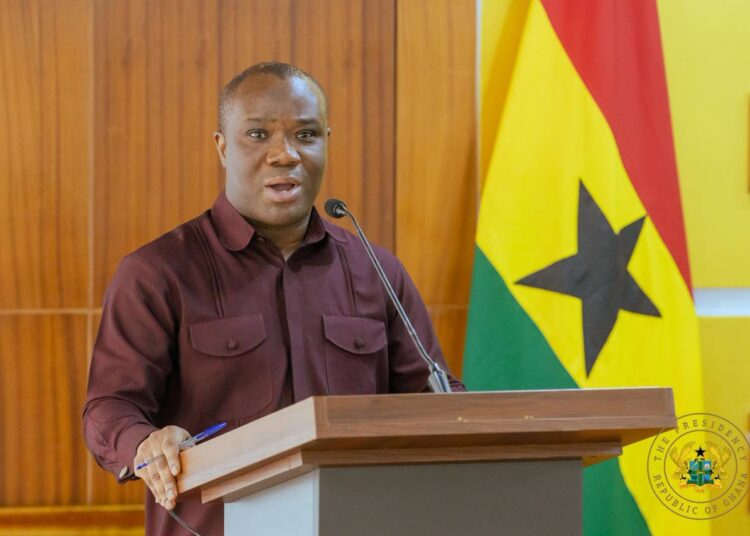
Presidential Spokesperson and Minister of State in charge of Government Communications, Felix Kwakye Ofosu, said the Minority’s accusations ignore the legal processes followed by government and wrongly seek to implicate the Attorney General for performing his constitutional responsibilities.
“I’m surprised that the Minority finds it necessary to use precious time to make calls that are completely misplaced, baseless, and totally unwarranted,” Kwakye Ofosu said, opening his rebuttal with a direct challenge to the caucus’s motives.
The Minority’s Case Against the Attorney General
The Minority has argued that the GH¢350 million approved for flood relief may have been released in breach of a court order, since the Contingency Fund was reportedly under attachment at the time of disbursement.
The caucus further contends that if the money did not come from the Contingency Fund, government may instead have accessed another public account without parliamentary approval, a possibility they say raises serious questions about the legality of the entire transaction.
However, Minister of State in charge of Government Communications, Kwakye Ofosu, rejected both claims outright, offering a step-by-step account of how the funds were actually sourced and disbursed.
He explained that after Parliament’s Finance Committee approved the proposed withdrawal from the Contingency Fund, the Bank of Ghana informed the Finance Minister that it could not release the money because the account was subject to an injunction.
According to Kwakye Ofosu, the government respected the court’s decision rather than attempting to circumvent it, and instead sought an alternative funding source already approved under the 2026 Budget.
This alternative source, he said, was the Contingency Vote, which forms part of the Appropriations Act and therefore required no additional parliamentary approval beyond what Parliament had already granted.
He noted that Parliament had appropriated GH¢3.6 billion under the Contingency Vote, giving the Finance Minister clear authority to access the GH¢350 million needed for flood relief without seeking fresh legislative clearance.
Defending the Attorney General’s Involvement
Central to the Minority’s grievance is Dr Ayine’s role in the matter, which Kwakye Ofosu addressed directly. He said the Attorney General merely provided a legal opinion after the injunction became known, a routine and constitutionally sanctioned function rather than any form of misconduct.

Kwakye Ofosu argued that offering legal advice constitutes a standard part of the Attorney General’s constitutional responsibilities and cannot reasonably justify demands for his dismissal.
He framed the Minority’s attempt to tie Ayine’s advisory role to allegations of wrongdoing as a misunderstanding, whether genuine or deliberate, of how the Attorney General’s office is meant to function within government.
Taken together, Kwakye Ofosu maintained that government neither violated the court order nor breached any public finance laws throughout the process.
“There is really no issue. No law has been breached. There has been nothing done that is illegal,” he stated, repeating the core message he has delivered consistently across his response to the controversy.
Addressing Questions on Committee Attendance
When asked whether Minority members were present during the Finance Committee’s deliberations on the withdrawal request, Kwakye Ofosu said the issue was irrelevant because the committee had a quorum and lawfully approved the request regardless of which specific members attended.
He added that Parliament’s records confirm the committee completed its work and submitted its report before the Finance Minister proceeded with the disbursement, leaving no procedural gap for the Minority’s objections to exploit.

Kwakye Ofosu closed his response by insisting that the Minority’s demand for the Attorney General’s dismissal remains unsupported by the facts as government understands them.
He urged critics to distinguish between political arguments and the legal framework governing emergency public spending, suggesting that the controversy has drifted from questions of legality into territory better described as political positioning.
With the Presidency firmly rejecting the calls for Ayine’s removal and laying out what it describes as a fully lawful funding pathway through the Contingency Vote, the dispute now rests on whether the Minority accepts this explanation or continues pressing the matter.
The underlying land related injunction affecting the Contingency Fund remains unresolved before the courts, meaning the same legal workaround Kwakye Ofosu described could resurface in future emergency funding decisions until that litigation concludes.
READ ALSO: Gulf States Caught in US-Iran Escalation