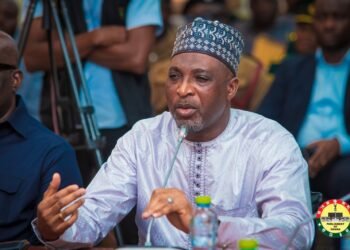

Speaker of Ghana’s Parliament, Rt. Hon. Alban Sumana Kingsford Bagbin, has issued a stark warning that democracy across Africa is backsliding, arguing that money has come to define political success in ways that threaten the very foundation of public trust.
Speaker Bagbin made the remarks at the High-Level Regional Convening on the Financialisation of Politics in Africa, held at the Kempinski Hotel in Accra.
Addressing a gathering of parliamentarians and stakeholders, the Speaker declared that when money becomes the primary measure of political success, public office ceases to function as a public trust and instead becomes, as he described it, an investment to be recovered.
Speaker Bagbin painted a troubling picture of the state of democratic governance across Africa, pointing to opaque campaign financing, vote buying, and state capture as forces eroding public confidence and pushing citizens away from political participation altogether.
He characterised the situation not merely as a passing challenge but as a crisis of democratic integrity, one that demands urgent and practical solutions rather than continued diagnosis of the problem.
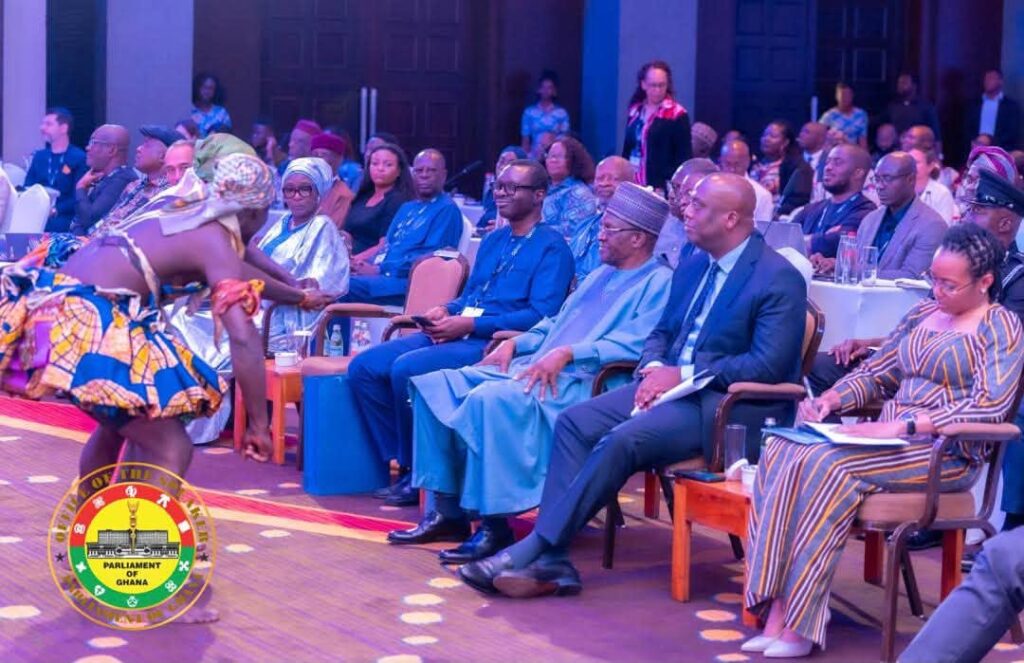
His remarks reflected growing concern among regional leaders that the financial dimensions of politics have begun to overshadow the democratic principles the continent has worked to build since the wave of political liberalisation decades ago.
Ghana’s Role in Securing UN Resolution 11/7
Despite the grim assessment, Speaker Bagbin used the platform to highlight a significant diplomatic achievement he credited to Ghana’s leadership on the international stage. He proudly recounted Ghana’s pivotal role in securing the adoption of UN Resolution 11/7 at the Conference of State Parties in Doha in December 2025.
The resolution, co-sponsored by Ghana alongside Norway and Mongolia, demands greater transparency in the funding of political parties, candidates, and election campaigns.
Speaker Bagbin singled out Ambassador Matilda Osei-Agyeman for particular praise, crediting her diplomatic leadership for helping secure what he described as a historic milestone in the global fight against corruption.
However, the Speaker was careful to temper celebration with realism, stressing that the resolution’s adoption represents only the beginning of a much longer process. He insisted that the real work now lies in translating this international commitment into enforceable national laws and functioning oversight mechanisms capable of holding political actors accountable.
Measuring Success Beyond Adoption
Expanding on this point, Speaker Bagbin told participants that the true measure of success would not be the resolution’s adoption but its effective implementation by state parties across the continent.
“Distinguished participants, the role of Parliament in advancing reform in this direction cannot be overemphasized. A true measure of success, however, will not be the adoption of the resolution itself, but its effective implementation by state parties”.
Rt. Hon. Alban Sumana Kingsford Bagbin, Speaker of Ghana’s Parliament
He described the convening as an opportunity for African countries to translate international commitments into practical reforms at both national and regional levels, with Parliament positioned as a central actor in ensuring that resolutions do not remain symbolic gestures but evolve into laws, budgets, and measurable improvements in political integrity.

Institutional Reforms Under Speaker Bagbin’s Leadership
Beyond his remarks on the international resolution, Speaker Bagbin announced a series of institutional reforms he has championed within Ghana’s Parliament. These include the creation of a Legal and Governance Services Division, which will house dedicated departments focused on Anti-Corruption, Investigations, and Human Rights.
He also announced the establishment of a new Ethics and Standards Committee, which will be supported by an independent Commissioner tasked with overseeing matters of parliamentary conduct and accountability.
These reforms, according to Speaker Bagbin, form part of a broader effort to strengthen Ghana’s governance architecture from within, rather than relying solely on external or international mechanisms to drive change.
Parliament’s Central Role in Safeguarding Accountability
Drawing on his dual roles as President of the African Parliamentarians Network Against Corruption and Vice President of the Global Organisation of Parliamentarians Against Corruption, Speaker Bagbin challenged fellow lawmakers across the continent to take up the responsibility of leading reform efforts within their own legislatures.
He outlined the specific functions Parliament is uniquely positioned to perform in this regard, noting that Parliaments establish the legal frameworks governing political parties, elections, and campaign financing, while also scrutinising public expenditure and overseeing anti-corruption agencies and other accountability institutions.
He added that Parliament also serves as the primary platform through which citizens’ concerns can be articulated and addressed within the formal structures of governance.

Standing Up to the Bank of Ghana
To illustrate Parliament’s oversight authority in practice, Speaker Bagbin recounted a pointed exchange involving the Bank of Ghana, which he said had once claimed independence from parliamentary scrutiny. He rejected that position outright, insisting that no institution funded by public resources can operate beyond the oversight reach of the legislature.
“I’m sure my colleagues in Ghana will understand why I insisted when even the Bank of Ghana claimed that they were independent and could not answer to the call of the Parliament. That I raised the question, independent from whom or of whom? That is our bank. We put our money there”.
Rt. Hon. Alban Sumana Kingsford Bagbin, Speaker of Ghana’s Parliament
He explained that Parliament’s authority stems directly from its role in generating public revenue through taxation, a responsibility that carries with it an obligation to ensure those funds are properly accounted for.
“The members of parliament have been given the power to ensure that the laws that we pass, calling on the people to pay taxes, and the people obey and pay the taxes. We generate the revenue and we put them in that bank. The people expect us to hold that bank with whoever has access to the money to account to them,” he said, adding that the Bank of Ghana ultimately appeared before Parliament following his insistence.
A Call for Collaboration Across Africa
Speaker Bagbin closed his address with a broader appeal for regional cooperation, urging African nations to engage in peer learning as they confront the shared challenge of financialised politics.

He acknowledged that no single country holds all the answers, but expressed confidence that collective effort could help safeguard democratic institutions across the continent. “Strengthening integrity in political finance is not just an anti-corruption objective, it is a democratic imperative,” he said.
His remarks are expected to resonate strongly among parliamentarians and civil society actors gathered at the convening, many of whom continue to grapple with similar challenges of money’s growing influence over political processes in their own countries.
READ ALSO: Ato Forson to Reveal Ghana’s Next Fiscal Strategy in Crucial July 23 Mid-Year Budget